
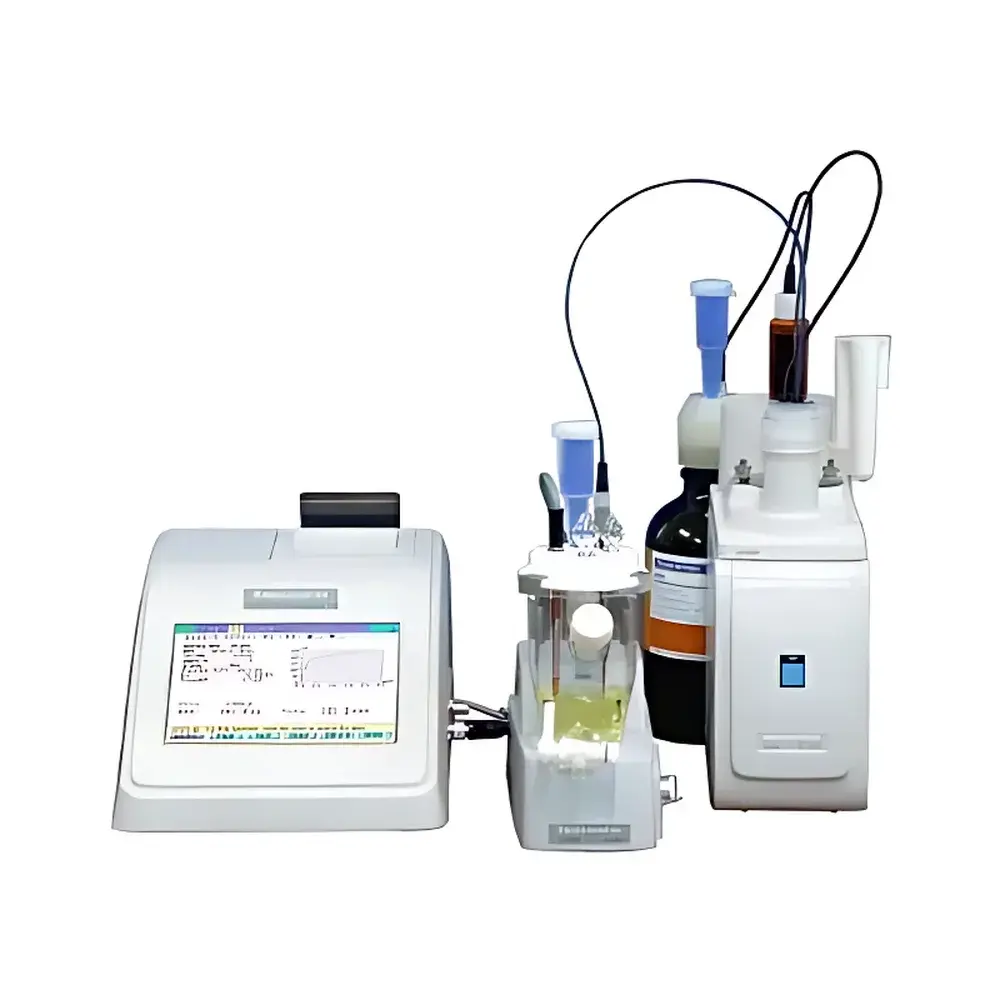
AQV-2200 Karl Fischer Moisture Analyzer
| Origin | Shanghai, China |
|---|---|
| Manufacturer Type | Authorized Distributor |
| Origin Category | Domestic (China) |
| Model | AQV-2200 |
| Pricing | Upon Request |
Overview
The AQV-2200 Karl Fischer Moisture Analyzer is a dual-channel, microprocessor-controlled coulometric and volumetric titration system engineered for high-precision water content determination across diverse industrial and regulatory laboratory environments. Based on the electrochemical principle of Karl Fischer (KF) titration—where iodine generated *in situ* via controlled electrolysis (coulometric mode) or delivered from a standardized reagent solution (volumetric mode) reacts stoichiometrically with water—the AQV-2200 delivers trace-level quantification down to 0.1 mg H₂O (equivalent to ~10 ppm in typical solid/liquid matrices). Its dual-cell architecture enables simultaneous independent analysis using either coulometric–coulometric, coulometric–volumetric, or volumetric–volumetric configurations—eliminating sequential measurement bottlenecks and enhancing throughput without compromising reproducibility. Designed for compliance-critical workflows, the instrument supports GLP/GMP-aligned data integrity protocols and integrates seamlessly with external sample introduction systems—including solid/liquid evaporators and automated sample changers—to extend applicability to thermally labile, viscous, or non-homogeneous samples.
Key Features
- Dual independent KF titration channels: Configurable for concurrent coulometric–coulometric, coulometric–volumetric, or volumetric–volumetric operation with full parameter isolation per channel.
- Modular cell design: Supports three interchangeable titration cells—standard (150 mL), reduced-volume (75 mL), and ultra-low-volume (20 mL)—optimized for reagent economy, reduced waste generation, and improved sensitivity for trace moisture analysis.
- Advanced endpoint detection: Dual-mode AC polarization current and AC polarization potential difference sensing ensures robust, drift-resistant endpoint recognition under variable matrix conditions.
- 7.5-inch full-color capacitive touchscreen interface: Intuitive graphical navigation with real-time titration curve visualization, method editing, and on-device data review—no external PC required for basic operation.
- Integrated background correction: Automatic baseline drift compensation (user-selectable ON/OFF) minimizes systematic error from ambient moisture ingress or reagent decomposition.
- Flexible reagent handling: Optional auxiliary burette or fixed-tip titration head enables rapid reagent exchange or back-titration without cell disassembly.
Sample Compatibility & Compliance
The AQV-2200 accommodates a broad spectrum of sample types—including hygroscopic solids (e.g., pharmaceutical powders, polymers), viscous liquids (e.g., transformer oil, cosmetic emulsions), and volatile organics—when coupled with optional evaporation units (solid heater, oil heater) that thermally liberate bound water prior to KF detection. All hardware interfaces (RS-232, USB, LAN, analog I/O) support bidirectional communication with analytical balances, autosamplers, and LIMS platforms. The system implements core GLP functionality: electrode maintenance logging, volumetric accuracy verification (burette calibration traceability), and precision testing routines. Data storage adheres to ALCOA+ principles—each result includes timestamp, operator ID, method version, cell status, and raw titration curve metadata—enabling audit-ready documentation compliant with FDA 21 CFR Part 11 (when paired with validated third-party software) and ISO/IEC 17025 requirements.
Software & Data Management
Data are stored locally (100 results in internal memory) and externally via USB flash drive (≥256 MB; capacity for ~9,900 records). Method files (50), sample templates (99), and evaporator protocols (50) are managed directly on-device. Raw titration curves and numerical outputs (mg H₂O, % w/w, ppm, mL reagent) export in CSV format without proprietary software dependency. The built-in thermal printer (58 mm paper width) produces permanent hardcopy reports with full metadata. For enterprise integration, USB and LAN ports enable direct data streaming to laboratory information management systems (LIMS) or electronic lab notebooks (ELN), supporting automated report generation and centralized audit trails.
Applications
- Pharmaceuticals: Quantification of residual moisture in APIs, excipients, and lyophilized products per USP <921>, EP 2.5.12, and JP 2.05, supporting stability studies and release testing.
- Food & Beverage: Water activity assessment in oils (e.g., olive, coconut), dairy powders, confectionery syrups, and tobacco—critical for shelf-life prediction and microbial safety compliance.
- Polymers & Plastics: Monitoring moisture content in PET, PA6, PEEK, and epoxy resins prior to extrusion or molding to prevent hydrolytic degradation.
- Petrochemicals: Trace water analysis in hydrocarbon streams, lubricants, and catalysts per ASTM D6304 and IP 386, ensuring corrosion mitigation and process reliability.
- Cosmetics & Personal Care: Batch release testing of emulsions, gels, and anhydrous formulations where water content affects viscosity, preservative efficacy, and phase stability.
FAQ
What KF titration methods does the AQV-2200 support?
It supports both volumetric and coulometric Karl Fischer titration, with dual-channel capability enabling simultaneous execution of either method combination.
Can the AQV-2200 be used for solid samples with low water content?
Yes—when connected to an optional solid-sample evaporator unit, it reliably quantifies water in hygroscopic or thermally stable solids at levels as low as 10 ppm.
Is the instrument compatible with regulatory data integrity requirements?
It provides GLP-compliant features including audit-trail-capable method storage, electrode calibration logs, and full result metadata; full 21 CFR Part 11 compliance requires validated third-party software integration.
How is reagent consumption minimized during routine operation?
The 20 mL ultra-low-volume cell option reduces KF reagent usage by >80% compared to standard cells while maintaining measurement accuracy and dynamic range.
Does the system require proprietary software for data export?
No—CSV-formatted results and titration curves export directly via USB without additional software installation.






