
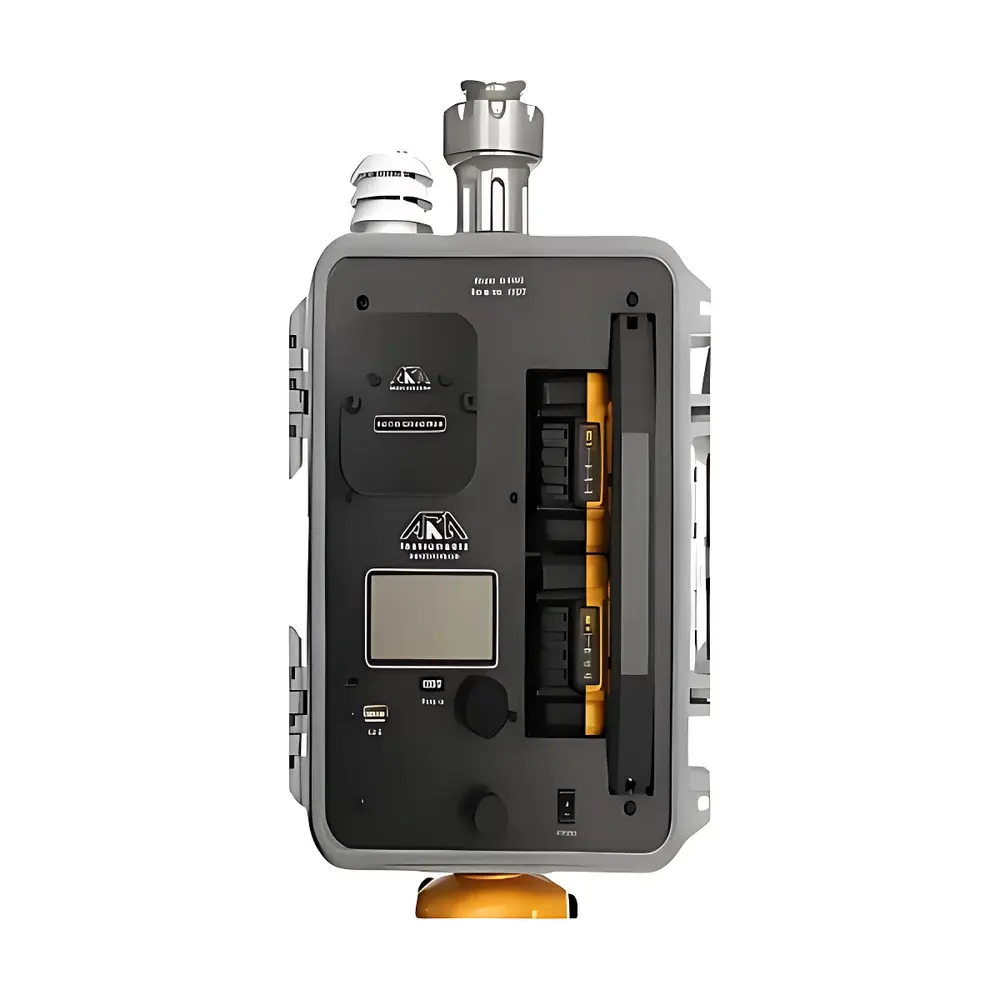
ARA N-FRM Intelligent Air Sampler
| Brand | ARA |
|---|---|
| Origin | USA |
| Model | N-FRM |
| Flow Rate | 10–20 LPM (nominal 16.7 LPM) |
| Flow Accuracy | ±2% (±1% with calibration) |
| Operating Time | >30 hours on rechargeable 18 V lithium battery |
| Charging Time | 1 hour |
| Data Output | USB flash drive |
| Dimensions | 25.4 × 30.48 × 17.78 cm |
| Sampling Weight | 15 lbs |
| Shipping Weight | 25 lbs |
| Filter Holder | Standard FRM-compliant 47 mm cassette mount |
| Particle Separation | Low-maintenance, oil-free cyclonic inlet for PM₂.₅ and PM₁₀ |
Overview
The ARA N-FRM Intelligent Air Sampler is a U.S.-engineered, portable ambient air monitoring system designed to meet U.S. Environmental Protection Agency (EPA) Federal Reference Method (FRM) performance criteria for total suspended particulates (TSP), PM₁₀, and PM₂.₅. It operates on the principle of isokinetic gravimetric sampling—drawing ambient air through a standardized 47 mm filter cassette at a precisely controlled volumetric flow rate of 16.7 LPM, as mandated by 40 CFR Part 53 for FRM compliance. Unlike conventional fixed-station samplers, the N-FRM integrates real-time environmental sensing and programmable data logging into a single compact, field-deployable architecture. Its battery-powered operation eliminates dependency on grid power or generators, enabling reliable deployment in remote locations, mobile monitoring campaigns, and short-term emergency response scenarios—without compromising metrological traceability or regulatory defensibility.
Key Features
- FRM-certified flow control: Maintains stable 16.7 LPM ±2% across variable ambient conditions, validated per EPA Protocol 2 and ISO 9001-aligned calibration procedures.
- Integrated environmental sensor suite: Measures and logs barometric pressure, temperature, relative humidity, and optional wind speed (via external probe) synchronously with particulate mass collection.
- Modular particle detection capability: Optional real-time optical particle counter (OPC) enables concurrent measurement of size-resolved particle number concentration (e.g., 0.3–10 µm), supporting time-series correlation between gravimetric mass and dynamic aerosol behavior.
- Intuitive human-machine interface: Touch-enabled LCD display with menu-driven programming for start/stop scheduling, flow setpoint adjustment, and alarm thresholds—accessible onsite or via infrared remote control.
- Maintenance-optimized design: Oil-free, low-pressure-drop cyclonic inlet separator minimizes clogging and eliminates routine lubrication requirements; service intervals exceed 1,000 operating hours.
- Ruggedized field portability: Aluminum alloy chassis, IP54-rated enclosure, and integrated carrying handle support transport and setup on tripods, vehicle mounts, or rooftop platforms.
- Regulatory-ready data management: All sampled parameters—including timestamped flow, pressure, temperature, and battery voltage—are stored internally and exportable via standard USB flash drive in CSV format for audit trail reconstruction.
Sample Compatibility & Compliance
The N-FRM is compatible with all EPA-approved 47 mm quartz fiber, Teflon®, and cellulose ester filter media used in FRM-compliant gravimetric analysis. Its inlet geometry and flow profile comply with EPA guidance for PM₂.₅ and PM₁₀ fractionation (40 CFR Part 53, Appendices L and O). The system supports dual-stage sequential sampling configurations when paired with optional impactor modules. Data integrity meets GLP and GMP documentation standards, with timestamped metadata suitable for submission to state air agencies and inclusion in SIP (State Implementation Plan) reporting. While not itself an EPA-certified FRM device (as certification applies to complete systems including lab analysis protocols), the N-FRM satisfies all physical and operational performance specifications required for FRM-equivalent field collection under EPA’s Ambient Air Monitoring Guidance (EPA-454/R-19-002).
Software & Data Management
No proprietary software installation is required. Raw measurement logs are written directly to FAT32-formatted USB drives in plain-text CSV files, ensuring long-term readability and compatibility with common analytical tools (e.g., Excel, R, Python pandas). Each record includes UTC timestamp (NTP-synchronized if GPS module added), instantaneous flow (LPM), differential pressure (kPa), ambient temperature (°C), relative humidity (%RH), battery voltage (V), and—when enabled—particle count per size bin. Audit trails include firmware version, operator ID (user-configurable), and configuration change history. For laboratories operating under FDA 21 CFR Part 11 or ISO/IEC 17025, optional digital signature modules and encrypted log archiving can be implemented via third-party middleware compliant with electronic record retention policies.
Applications
- Urban and regional air quality monitoring networks requiring FRM-grade primary data collection.
- Roadside and near-source monitoring for traffic-related PM exposure assessment.
- Industrial fence-line and perimeter monitoring for fugitive dust compliance (e.g., OSHA PELs, local nuisance ordinances).
- Short-term epidemiological studies and source apportionment field campaigns.
- Emergency response during wildfire smoke events, chemical spills, or industrial accidents.
- Occupational hygiene assessments where personal or area sampling must align with NIOSH/ACGIH methodologies.
- Academic and governmental research on aerosol dynamics, deposition modeling, and climate-relevant particulate characterization.
FAQ
Does the N-FRM require annual calibration to maintain FRM equivalence?
Yes—users must perform flow calibration at least once per year using an NIST-traceable primary standard (e.g., bubble meter or critical orifice calibrator), documented per EPA Protocol 2. Calibration certificates and raw data must be retained for audit purposes.
Can the N-FRM operate unattended for more than 24 hours?
Yes—on a full charge, it delivers >30 hours of continuous operation at nominal flow. For extended deployments, optional solar charging kits (model SOLAR-12V) provide supplemental power without grid dependency.
Is the real-time particle sensor certified for regulatory reporting?
No—the OPC module provides supplementary trend data only. Regulatory mass concentrations must be derived from gravimetric analysis of collected filters in an accredited laboratory per EPA Method IO-3.2 or ISO 12103-1.
What filter types are validated for use with the N-FRM?
Quartz fiber (Pallflex® EFA-0600), Teflon® membrane (Gelman Supor®), and mixed cellulose ester (MCE) filters meeting ASTM D1357 and EPA Method 201A specifications have been verified for compatibility and minimal blank contribution.
How is meteorological data synchronized with particulate sampling?
All sensors share a common internal clock and sampling interval (default 1-minute resolution); environmental readings are time-stamped within ±100 ms of each flow measurement, enabling precise co-location analysis in post-processing.
Related Products







