
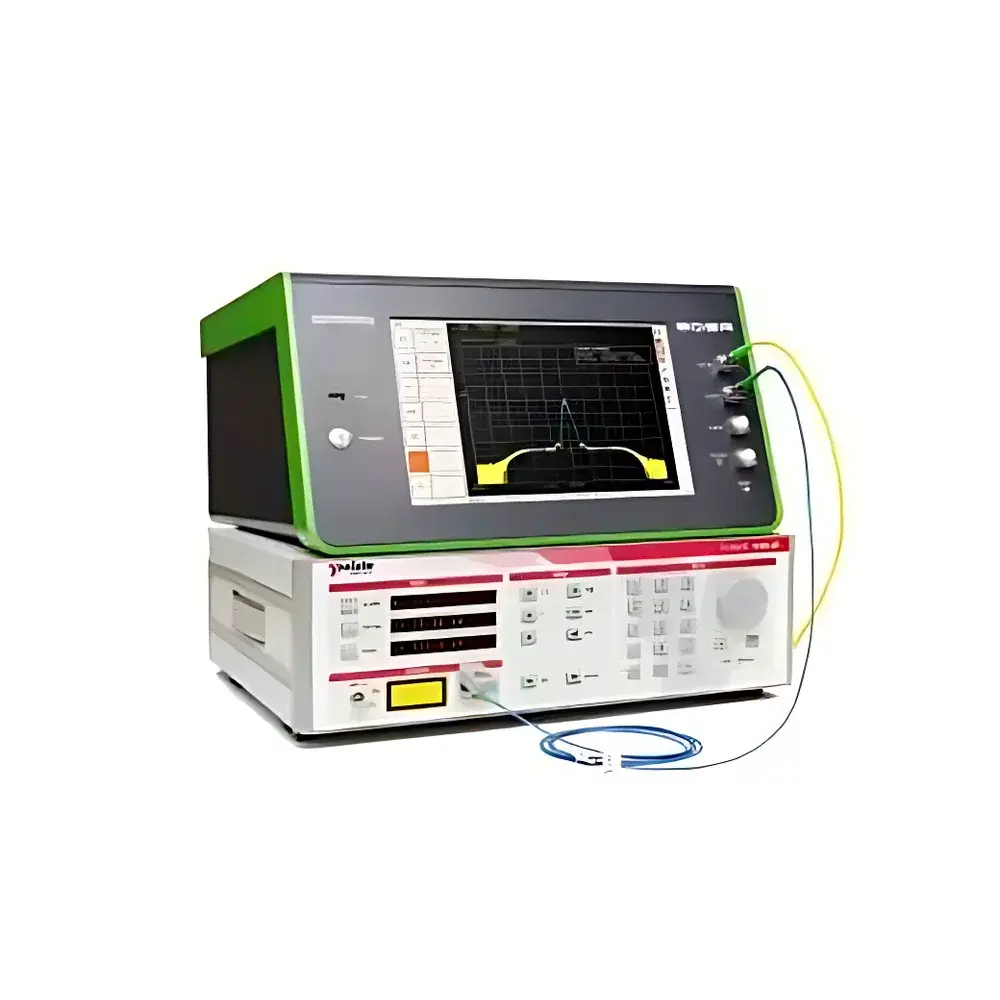
Aragon Photonics BOSA Series High-Resolution Optical Spectrum Analyzer
| Origin | USA |
|---|---|
| Manufacturer Type | Authorized Distributor |
| Origin Category | Imported |
| Model | BOSA |
| Price Range | USD 42,000 – 70,000 |
| Core Component | Gas Laser-Based System |
Overview
The Aragon Photonics BOSA Series High-Resolution Optical Spectrum Analyzer is an advanced, all-optical instrument engineered for ultra-precise spectral characterization in modern photonic research and high-speed optical communications. Unlike conventional diffraction-grating or interferometric optical spectrum analyzers (OSAs), the BOSA leverages stimulated Brillouin scattering (SBS) — a coherent nonlinear optical process — to achieve intrinsically narrowband, tunable optical filtering. In this architecture, an external-cavity tunable laser source (TLS) pumps a highly nonlinear optical fiber, generating a dynamic, frequency-selective SBS gain peak with sub-10 MHz linewidth. As the TLS sweeps across the target wavelength range, the SBS filter co-scans, enabling direct, heterodyne-free spectral acquisition with exceptional fidelity. This physics-based approach eliminates local oscillator (LO) sideband artifacts, phase noise coupling, and residual interference fringes common in Fourier-transform or scanning Fabry–Pérot OSAs — resulting in true artifact-free spectral traces with >80 dB spurious-free dynamic range.
Key Features
- True all-optical detection architecture based on stimulated Brillouin scattering (SBS), eliminating electronic mixing and LO-related distortions
- Resolution down to 10 MHz (0.08 pm at 1550 nm), with selectable resolution modes (10 MHz / 20 MHz) across models
- High absolute wavelength accuracy of ±0.5 pm (typ.), traceable to NIST-calibrated TLS reference
- Scanning speed up to 20 nm/s (BOSA 400), optimized for rapid device characterization and production test throughput
- Integrated polarization-resolved spectral analysis: simultaneous measurement of orthogonal polarization states (X/Y or SOP evolution)
- Optical phase spectrum capability: enables chirp profiling, eye diagram reconstruction, and constellation mapping for advanced modulation formats
- Fully SCPI-compliant remote control via Ethernet (TCP/IP) or GPIB interface, supporting integration into automated test systems and manufacturing execution systems (MES)
Sample Compatibility & Compliance
The BOSA series is compatible with standard single-mode fiber (SMF-28) inputs and supports both continuous-wave (CW) and modulated optical signals from lasers, transceivers, and optical frequency combs. It meets core requirements for optical component validation under ITU-T G.694.1 (DWDM grid), IEEE 802.3bs (400G ZR), and IEC 61280-2-9 (OSNR measurement). Its deterministic, non-averaged spectral acquisition methodology aligns with GLP-compliant lab practices, and audit-ready data logging (including timestamped metadata, instrument configuration, and calibration history) satisfies FDA 21 CFR Part 11 readiness when deployed in regulated photonics R&D environments.
Software & Data Management
The BOSA Control Suite provides a native Windows application with intuitive GUI and comprehensive scripting support. Key software capabilities include: automatic OSNR calculation with user-defined signal/noise bandwidths and guard-band spacing; real-time trace locking for stable averaging over variable acquisition windows; ASCII export of full spectral datasets (wavelength, power, polarization state, phase) with one-second frequency comb resolution; variable resolution mode emulation for cross-platform comparison with legacy OSA instruments; and integrated power integration over arbitrary spectral windows. All measurement sessions generate immutable .bosa binary files containing raw photodetector waveforms, TLS tuning logs, and environmental sensor readings (temperature, humidity), ensuring full traceability and reproducibility.
Applications
- Characterization of 100G/400G/800G coherent transceivers (DP-QPSK, 16-QAM, OFDM, Nyquist-WDM)
- Laser linewidth, frequency noise, and coherence length analysis for narrow-linewidth sources
- DWDM channel spacing verification and FlexGrid network commissioning
- Nonlinear dynamics studies in fiber lasers and microresonators
- Optical frequency comb line identification, stability monitoring, and tooth-to-tooth phase correlation
- Polarization-mode dispersion (PMD) and polarization-dependent loss (PDL) spectral mapping
- Chirp and group delay ripple analysis in semiconductor optical amplifiers (SOAs) and tunable filters
FAQ
What distinguishes BOSA’s SBS-based detection from traditional OSA technologies?
BOSA avoids heterodyne mixing and mechanical scanning elements. Its SBS filter is generated optically within fiber, delivering intrinsic narrow linewidth, no LO sidebands, and immunity to thermal drift-induced calibration drift.
Can BOSA measure optical phase directly?
Yes — through interferometric reconstruction using dual-polarization sampling and TLS phase modulation, enabling time-domain waveform retrieval (e.g., eye diagrams) and instantaneous frequency (chirp) mapping.
Is the BOSA compliant with industry-standard calibration protocols?
All BOSA models ship with factory calibration certificates traceable to NIST standards. Optional annual recalibration services include ISO/IEC 17025-accredited reporting.
How does BOSA handle polarization-multiplexed signals?
It performs simultaneous, synchronous spectral acquisition on two orthogonal polarization axes, enabling real-time Stokes parameter evolution tracking and SOP trajectory visualization.
Can BOSA be integrated into automated test benches?
Yes — full SCPI command set, TCP/IP socket interface, and LabVIEW/Python API support enable seamless integration with NI TestStand, Keysight PathWave, or custom CI/CD test frameworks.





