
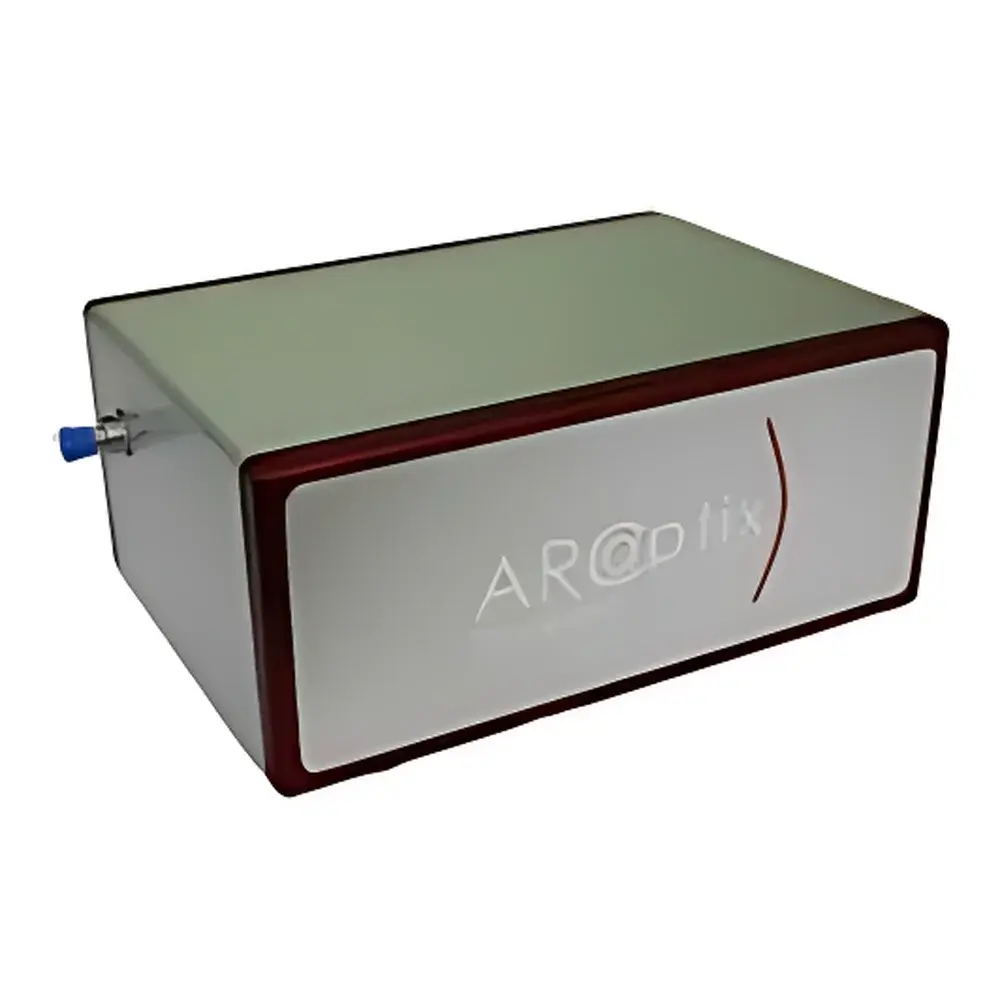
ARC FT-NIR Rocket Fourier Transform Near-Infrared Spectrometer
| Brand | ARC |
|---|---|
| Origin | Switzerland |
| Model | FT-NIR Rocket |
| Instrument Type | Portable |
| Spectral Range | 900–2600 nm (11000–3800 cm⁻¹) |
| Resolution | 4 cm⁻¹ (≤0.8 nm @ 1100 nm, ≤2 nm @ 1700 nm, ≤5 nm @ 2600 nm) |
| Wavenumber Accuracy | <1 cm⁻¹ @ 4000 cm⁻¹ (25±5°C) |
| Signal-to-Noise Ratio | >10,000:1 (RMS, full spectrum, single scan) |
| Dynamic Range | >3000:1 |
| Scan Speed | 1 spectrum/sec (averaging mode) |
| A/D Conversion | 24-bit |
| Detector | InGaAs photodiode array |
| Reference Laser | Integrated solid-state 850 nm laser |
| Optical Interface | SMA905, fiber input ≥1 mm core, NA = 0.2 |
| Power Supply | 5 V DC via USB 2.0 |
| Operating Temperature | 10–30 °C |
| Dimensions | 180 × 160 × 80 mm |
| Weight | 850 g |
| Compliance | CE, RoHS, USB-IF certified |
Overview
The ARC FT-NIR Rocket is a portable, fiber-coupled Fourier Transform Near-Infrared (FT-NIR) spectrometer engineered for high-fidelity spectral acquisition in demanding field and laboratory environments. Unlike dispersive NIR systems, the FT-NIR Rocket employs a self-compensating Michelson interferometer architecture—enhanced by an integrated solid-state reference laser at 850 nm—to ensure intrinsic wavelength stability, minimal thermal drift, and exceptional reproducibility across repeated measurements. Its optical design maximizes throughput while maintaining rigorous adherence to Fourier transform principles: each interferogram is digitized at Nyquist-sampled points, enabling robust phase correction and precise wavenumber calibration traceable to the internal laser reference. With a spectral coverage spanning 900–2600 nm (11000–3800 cm⁻¹), the instrument supports both transmission and reflectance modalities without hardware reconfiguration, making it suitable for rapid qualitative screening and quantitative chemometric modeling in regulated and non-regulated settings.
Key Features
- World’s most compact FT-NIR platform (180 × 160 × 80 mm, 850 g), optimized for benchtop, mobile lab, and process line integration
- Self-compensating interferometer with monolithic beam splitter and active path-length stabilization via embedded 850 nm reference laser
- High optical throughput enabled by large-core fiber coupling (≥1 mm, NA = 0.2) and low-loss ZnSe optics
- True 24-bit analog-to-digital conversion with >3000:1 dynamic range, minimizing saturation risk during high-intensity source exposure
- USB 2.0 plug-and-play interface with deterministic latency; no external power supply required—operates entirely from 5 V DC bus power
- Thermally stabilized optical bench (10–30 °C operational range); wavenumber accuracy maintained within ±1 cm⁻¹ at 4000 cm⁻¹ under ambient fluctuations
Sample Compatibility & Compliance
The FT-NIR Rocket accommodates diverse sample forms—including powders, granules, liquids, films, and opaque solids—via standard fiber-optic probes (transmission, diffuse reflectance, or contact probe configurations). It complies with ISO/IEC 17025 requirements for spectral instrument validation and supports IQ/OQ documentation protocols. While not pre-certified for GMP environments, its deterministic USB communication stack, repeatable spectral acquisition, and built-in laser-referenced calibration enable straightforward alignment with FDA 21 CFR Part 11 data integrity expectations when deployed with compliant third-party software. The system meets CE marking directives (2014/30/EU EMC, 2011/65/EU RoHS) and USB-IF interoperability standards.
Software & Data Management
The spectrometer ships with ARC SpectraView™—a Windows-compatible application (XP through Windows 11) supporting real-time interferogram visualization, apodization selection (Happ-Genzel, Blackman-Harris), zero-filling, phase correction, and Fourier transformation. Export formats include CSV, JCAMP-DX, and HDF5, ensuring compatibility with chemometric platforms such as Unscrambler®, MATLAB®, and Python-based scikit-learn workflows. Audit-trail functionality logs user actions, acquisition parameters, and calibration timestamps. Raw interferograms are retained alongside processed spectra, facilitating retrospective reprocessing and method transfer validation per ICH Q2(R2) guidelines.
Applications
- Raw material identification and blend uniformity assessment in pharmaceutical manufacturing (ASTM E1655-22 compliant)
- Moisture, protein, and fat quantification in agricultural commodities using PLS regression models
- In-line monitoring of polymer curing kinetics and additive dispersion homogeneity
- Laser diode characterization—center wavelength, spectral width, and side-mode suppression ratio (SMSR) analysis
- Forensic fiber and plastic fragment differentiation via spectral library matching (e.g., ASTM E2926-21)
- Quality control of edible oils, dairy products, and botanical extracts under AOAC Official Methods
FAQ
Is the FT-NIR Rocket compatible with third-party chemometric software?
Yes—CSV and JCAMP-DX exports support seamless integration with Unscrambler, SIMCA, MATLAB, R, and Python-based modeling tools.
Does the instrument require routine wavelength calibration using external standards?
No—its integrated 850 nm solid-state reference laser provides continuous internal calibration, eliminating the need for NIST-traceable polystyrene or rare-earth oxide standards for daily operation.
Can the FT-NIR Rocket operate in humid or dusty industrial environments?
It is rated for IP20 indoor use only; for harsh environments, enclosure integration or fiber-probe remote sampling is recommended.
What is the minimum integration time per spectrum?
One full-resolution spectrum (4 cm⁻¹, 11000–3800 cm⁻¹) is acquired in ≤1 second in averaging mode; faster frame rates are achievable at reduced resolution or truncated spectral windows.
Is firmware upgrade capability supported over USB?
Yes—ARC provides signed firmware updates via SpectraView™; all upgrades preserve calibration coefficients and maintain traceability records.





