
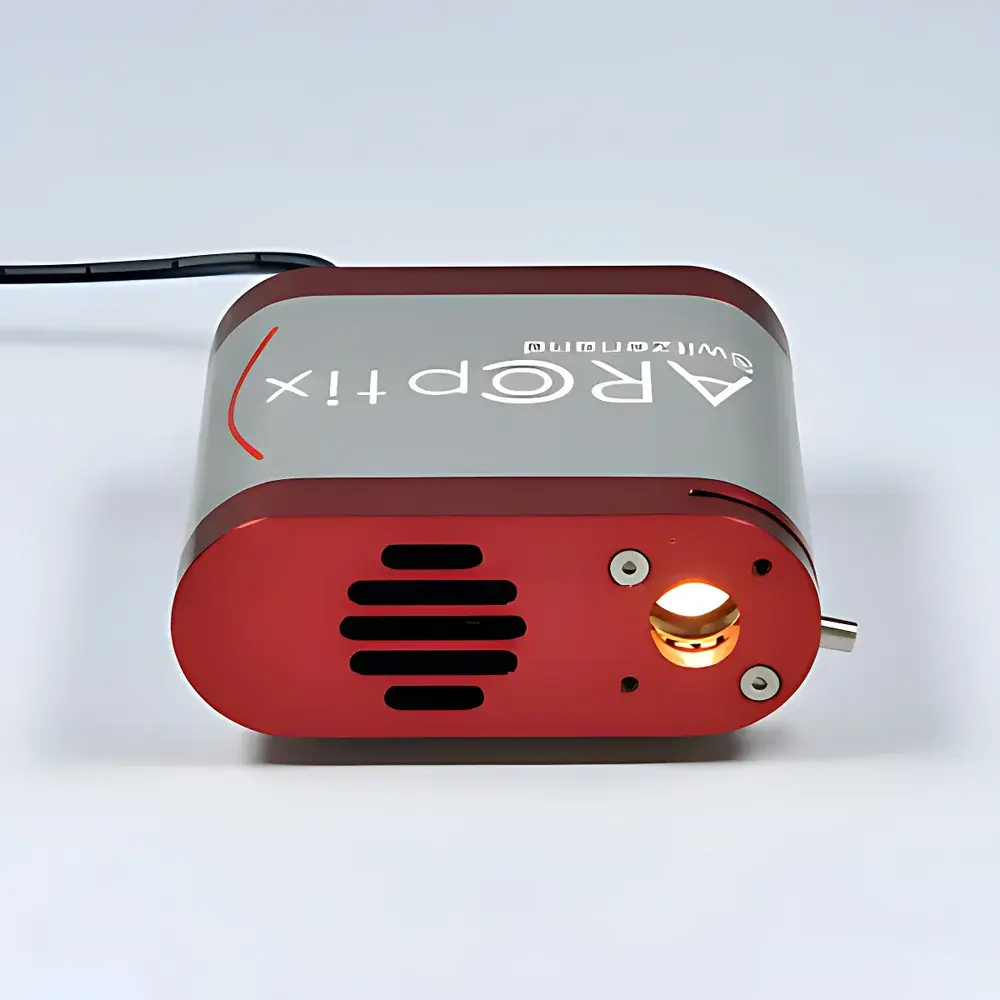
Arcoptix ArcLight NIR & IR Broadband Infrared Source
| Brand | Arcoptix |
|---|---|
| Origin | Switzerland |
| Model | ARClight NIR, ARClight IR |
| Spectral Range (NIR) | 400–4,000 nm |
| Spectral Range (IR) | 1–25 µm |
| Wavenumber Range (NIR) | 25,000–2,500 cm⁻¹ |
| Wavenumber Range (IR) | 10,000–400 cm⁻¹ |
| Filament Temperature (NIR) | ~2,850 K |
| Filament Temperature (IR) | ~1,400 K |
| Rated Lifetime (NIR) | 4,000 h |
| Rated Lifetime (IR) | 10,000 h |
| Lamp Power Options (NIR) | 5 W or 20 W |
| Lamp Power (IR) | 20 W |
| Lamp Type (NIR) | Quartz Tungsten Halogen (QTH) |
| Lamp Type (IR) | Silicon Carbide (SiC) Globar |
| Fiber Coupling Options | SMA-905 (NA = 0.25, BK7 lens) / SMA-905 (NA = 0.3, Off-axis parabolic mirror) |
| Collimated Beam Diameter | 12.7 mm |
| Operating Temperature | 5–40 °C |
| Attenuation | Manual iris diaphragm |
| Cooling | Integrated air fan |
| Input Power | 100–240 V AC to 12 V DC (included converter) |
| Dimensions (NIR, w/o coupler) | 92 × 92 × 43 mm |
| Dimensions (IR, w/ coupler) | 140 × 92 × 43 mm |
| Weight | 390 g |
Overview
The Arcoptix ArcLight NIR & IR broadband source is a precision-engineered thermal emitter designed for demanding spectroscopic applications across the visible, near-infrared (VIS-NIR), and mid-infrared (MIR) spectral domains. Based on fundamental blackbody radiation principles, the ArcLight leverages two distinct emitter technologies—quartz tungsten halogen (QTH) for high-color-temperature VIS-NIR output (400–4,000 nm) and silicon carbide (SiC) globar for stable, low-noise MIR emission (1–25 µm). Each variant is optimized for radiometric stability, spatial uniformity, and long-term repeatability under laboratory and industrial QC conditions. The source operates with minimal spectral ripple and exhibits excellent temporal stability (<0.5% RMS intensity drift over 1 hour), making it suitable for quantitative reflectance, transmittance, and absorption measurements where signal-to-noise ratio and baseline fidelity are critical.
Key Features
- Two dedicated configurations: ArcLight NIR (QTH-based, 400–4,000 nm, ~2,850 K) and ArcLight IR (SiC globar-based, 1–25 µm, ~1,400 K)
- High radiance output with calibrated spectral continuity—no gaps or discontinuities across specified ranges
- Integrated, temperature-stabilized DC power supply ensures consistent filament heating and minimizes thermal drift
- Manually adjustable iris attenuator enables precise optical density control without altering spectral shape
- Modular fiber coupling interface (SMA-905) with interchangeable optics: BK7 collimating lens (NA = 0.25) for NIR or off-axis parabolic mirror (NA = 0.3) for IR—both field-replaceable without tools
- Free-space output mode available by removing the coupler, delivering a collimated 12.7 mm beam ideal for FTIR, monochromator illumination, or custom optical benches
- Active air cooling system maintains thermal equilibrium during extended operation; fan noise <35 dB(A) at 1 m
- Compact, benchtop form factor (max. 140 × 92 × 43 mm) with EMI-shielded enclosure compliant with IEC 61326-1 for electromagnetic compatibility in shared lab environments
Sample Compatibility & Compliance
The ArcLight series supports a broad range of sample geometries and measurement modalities—including transmission through thin films, diffuse reflectance from powders or coatings, and specular reflection from polished surfaces. Its stable spectral output meets requirements for ASTM E1421 (standard practice for calibration of near-infrared spectrophotometers) and ISO 17025-accredited laboratories performing method validation. When used with NIST-traceable reference standards (e.g., SRM 2036, 2068), the source enables reproducible instrument performance qualification per USP <857> and Ph. Eur. 2.2.24. The device’s electrical safety conforms to IEC 61010-1 (measurement/control lab equipment), and its RoHS-compliant construction satisfies EU Directive 2011/65/EU. No laser classification applies, as all variants operate as incoherent thermal emitters.
Software & Data Management
While the ArcLight is a standalone hardware source with no embedded microcontroller or USB interface, its analog behavior ensures full compatibility with third-party data acquisition systems (e.g., National Instruments DAQ, Thorlabs PM100D, Ocean Insight spectrometers). Intensity stability profiles and spectral irradiance data (provided in CSV and .spc formats via Arcoptix’s calibration certificate) can be imported into MATLAB, Python (using NumPy/SciPy), or LabVIEW for automated baseline correction, dark current subtraction, and spectral ratioing workflows. For GLP/GMP-regulated environments, users may integrate the ArcLight into validated instrument platforms that enforce 21 CFR Part 11 audit trails—e.g., when paired with spectrometers featuring electronic logbooks, user access controls, and immutable data export.
Applications
- FTIR spectroscopy requiring stable, high-brightness MIR illumination for polymer identification and pharmaceutical API quantification
- NIR reflectance mapping of agricultural samples (grains, leaves) and food quality assessment (moisture, protein, fat content)
- Calibration of hyperspectral imaging systems operating in SWIR (1,000–2,500 nm) and LWIR (8–14 µm) bands
- Testing optical filters, dichroics, and anti-reflection coatings across multi-octave spectral spans
- In-line process monitoring in semiconductor wafer inspection and thin-film thickness metrology
- Research-grade photothermal spectroscopy and photoacoustic cell excitation where broadband thermal modulation is required
FAQ
Can the ArcLight NIR and IR models be operated simultaneously in a single setup?
No—each unit is a physically separate emitter with distinct thermal management, power delivery, and optical alignment requirements. Co-locating both sources introduces thermal cross-talk and stray light interference; dual-range experiments require sequential measurement or beam-combining optics with appropriate dichroic separation.
Is the spectral irradiance data NIST-traceable?
Yes—each unit ships with a factory calibration certificate referencing NIST SRM 2036 (for NIR) and SRM 2068 (for IR), including absolute spectral irradiance values (W·sr⁻¹·m⁻²·nm⁻¹) measured at the output plane under defined geometry and integration time.
What is the recommended warm-up time before radiometric stability is achieved?
For ArcLight NIR: ≤15 minutes to reach thermal equilibrium and <0.3% intensity drift over subsequent 60 minutes. For ArcLight IR: ≤30 minutes due to higher thermal mass of SiC element; stabilization confirmed via real-time photodiode monitoring (optional accessory).
Can the manual iris attenuator be motorized or remotely controlled?
Not natively—but the mechanical iris design allows third-party integration with stepper-motor actuators (e.g., Thorlabs K10CR1) using custom mounting brackets. Arcoptix does not supply or validate such modifications.
Are replacement lamps and couplers available as spare parts?
Yes—QTH lamps (5 W and 20 W variants), SiC globars, SMA-905 couplers with BK7 lens or off-axis parabolic mirror, and replacement fans are stocked and shipped globally with documented lot traceability and shelf-life labeling.






