
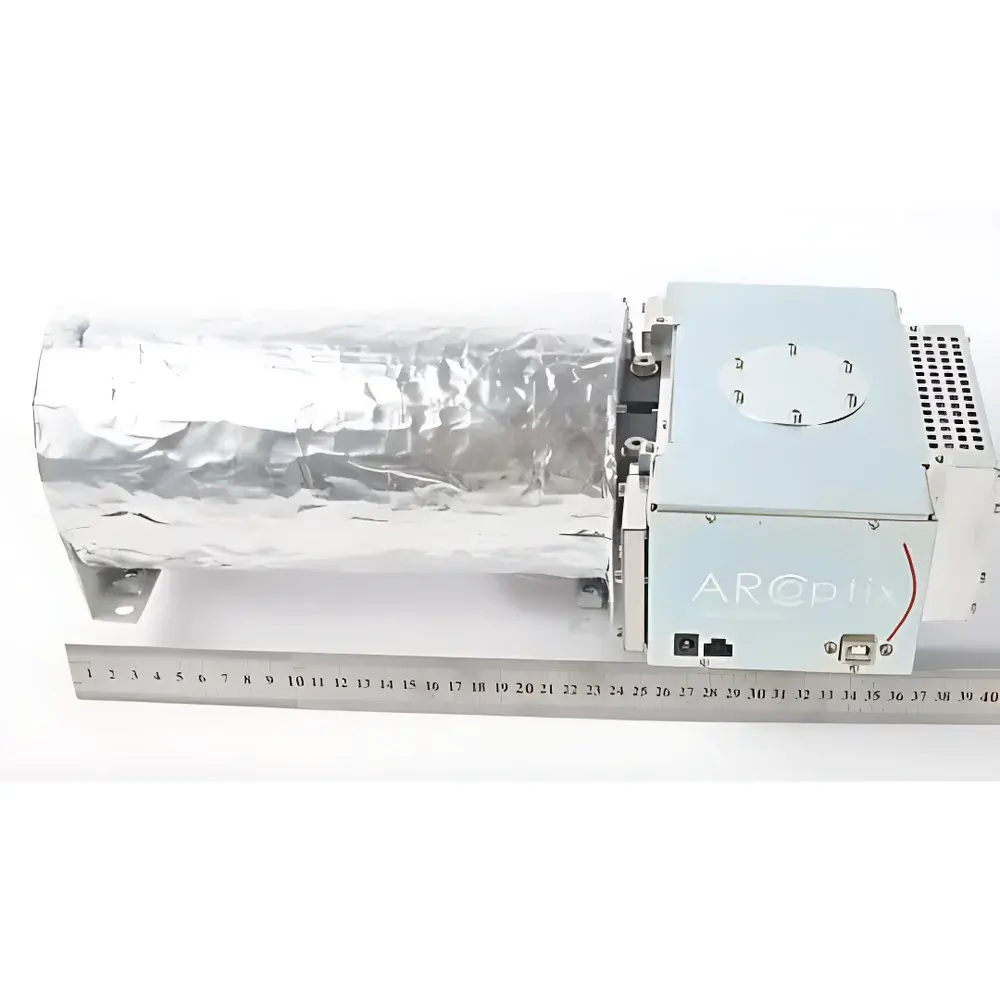
Arcoptix FT-IR Rocket Miniature Fourier Transform Infrared Spectrometer
| Brand | Arcoptix |
|---|---|
| Origin | Switzerland |
| Model | FT-IR Rocket |
| Detector | Thermoelectrically Cooled HgCdTe (MCT) |
| Interferometer Type | Permanently Aligned Dual Corner-Cube Design |
| Reference Laser | Solid-State Stabilized Laser (PPM-level wavelength stability) |
| Spectral Range | Mid-Infrared (Typical 2–12 µm, configuration-dependent) |
| Optical Interface | Fiber-Coupled or Free-Space Input |
| Resolution | Up to 0.5 cm⁻¹ (configurable) |
| Scan Rate | Up to 10 scans/sec (typical) |
| Weight | < 1.2 kg |
| Dimensions | 120 × 85 × 65 mm |
Overview
The Arcoptix FT-IR Rocket is a compact, robust, and high-performance Fourier Transform Infrared (FT-IR) spectrometer engineered for mid-infrared (MIR) spectral analysis in demanding field, industrial, and laboratory environments. Unlike dispersive instruments, the FT-IR Rocket operates on the principle of interferometry: infrared radiation from the sample—either via free-space beam or fiber-optic coupling—is split by a beamsplitter, reflected off fixed and moving corner-cube mirrors, and recombined to generate an interference pattern (interferogram). This raw signal is digitized and Fourier-transformed to yield a high-fidelity absorbance or transmittance spectrum across the mid-IR region. Its core innovation lies in the permanently aligned dual corner-cube interferometer, where two monolithic retroreflectors are rigidly mounted on a single oscillating arm. This design eliminates mechanical drift and eliminates the need for periodic realignment—a critical advantage for long-term unattended operation and OEM integration. Coupled with a solid-state reference laser (replacing traditional He–Ne sources), the system achieves sub-ppm wavelength stability and intrinsic radiometric consistency, enabling trace-level gas quantification and repeatable chemometric modeling.
Key Features
- Permanently aligned dual corner-cube interferometer with flexure-based mirror motion—zero maintenance, no recalibration required over instrument lifetime
- Thermoelectrically cooled mercury cadmium telluride (HgCdTe or MCT) detector optimized for mid-IR sensitivity (2–12 µm), delivering high signal-to-noise ratio without liquid nitrogen
- Compact form factor (120 × 85 × 65 mm) and low mass (<1.2 kg) suitable for portable deployment, embedded OEM systems, and space-constrained process monitoring setups
- Dual optical interface options: SMA905 fiber input (for remote sampling) or collimated free-space input (for laser characterization or source profiling)
- Solid-state reference laser with ppm-level wavelength stability and >50,000-hour operational lifetime—superior reliability vs. gas lasers
- Real-time scan rates up to 10 spectra per second, supporting dynamic gas concentration tracking and fast process control loops
Sample Compatibility & Compliance
The FT-IR Rocket is routinely integrated into gas-phase analytical systems—including multi-pass absorption cells (e.g., GASEX OEM HD-05-xx with 5 m pathlength), extractive stack monitors, and laser source characterization benches. It supports quantitative analysis of CO, CO₂, CH₄, NH₃, NOₓ, SO₂, VOCs, and other IR-active gases per ASTM E1421 (Standard Practice for Describing and Measuring Performance of FT-IR Spectrometers) and ISO 13495 (Infrared spectroscopy — Vocabulary). When deployed in regulated environments (e.g., environmental emissions monitoring or pharmaceutical excipient verification), the instrument’s stable wavenumber calibration, intensity reproducibility (<0.5% RSD over 24 h), and deterministic interferogram acquisition support compliance with GLP and 21 CFR Part 11 requirements—particularly when paired with audit-trail-enabled software platforms.
Software & Data Management
The spectrometer is compatible with Arcoptix’s proprietary SpectraManager software (Windows/Linux) and third-party APIs (C/C++, Python, LabVIEW). Raw interferograms and calibrated spectra are exported in standard formats (JCAMP-DX, ASCII, HDF5), ensuring interoperability with chemometric toolkits such as Unscrambler®, MATLAB®, or open-source libraries (e.g., scikit-learn, PySpectra). Built-in real-time FFT processing enables on-the-fly baseline correction, peak integration, and multivariate regression (PLS, PCA). For OEM applications, the device exposes low-level USB 2.0 and TTL trigger interfaces, allowing synchronization with external valves, modulators, or data loggers. All spectral metadata—including laser wavelength, detector temperature, scan count, and environmental sensor readings (optional)—are embedded in output files to satisfy traceability requirements under ISO/IEC 17025.
Applications
- In-line and at-line gas composition monitoring in chemical synthesis, bioreactor exhaust streams, and semiconductor fab ambient air
- Characterization of tunable quantum cascade lasers (QCLs) and interband cascade lasers (ICLs) via optical spectrum analysis (OSA-mode operation)
- Calibration transfer and model validation in multivariate quantitative analysis (e.g., predicting moisture content in granules or residual solvent levels in lyophilized products)
- Field-deployable environmental sensing—urban air quality networks, landfill methane flux studies, and volcanic gas plume analysis
- OEM integration into handheld analyzers, drone-mounted sensors, and autonomous inspection systems requiring low SWaP-C (Size, Weight, Power, and Cost)
FAQ
What spectral resolution can the FT-IR Rocket achieve?
The instrument supports configurable resolution down to 0.5 cm⁻¹ (unapodized), depending on maximum optical path difference and detector sampling rate. Higher resolution modes trade off scan speed and signal-to-noise ratio.
Is the system compatible with multipass gas cells?
Yes—the FT-IR Rocket is commonly interfaced with commercial and custom-built multi-reflection cells (e.g., 5 m pathlength GASEX HD-05 series) via fiber or collimated input; alignment is simplified by its insensitivity to beam pointing errors.
Does it require liquid nitrogen cooling?
No—the thermoelectrically cooled MCT detector operates continuously at –20 °C to –30 °C, eliminating cryogen dependency while maintaining adequate detectivity for ppm-level gas detection.
Can it be used for laser linewidth measurement?
Yes—when operated in free-space mode with appropriate beam conditioning, the FT-IR Rocket functions as a high-resolution optical spectrum analyzer for mid-IR lasers, supporting linewidth estimation, mode-hop detection, and wavelength drift monitoring.
Is firmware upgradeable in the field?
Yes—firmware updates are delivered via USB and retain all user calibration settings; version history and checksum verification ensure integrity during deployment in validated environments.
Related Products




