
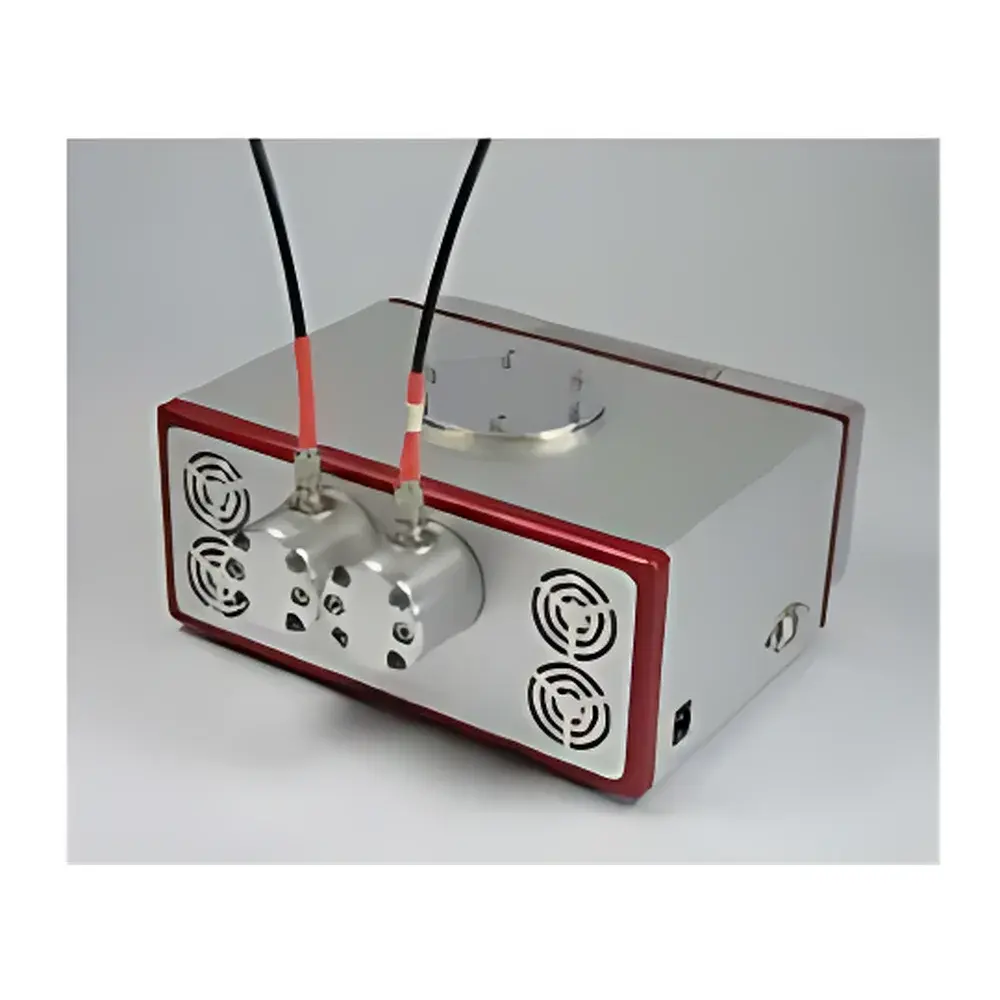
Arcoptix FT-IR Rocket Miniature Fourier Transform Infrared Spectrometer with Integrated Source
| Brand | Arcoptix |
|---|---|
| Origin | Switzerland |
| Model | FT-IR Rocket |
| Detector | Thermoelectrically Cooled MCT (2-stage or 4-stage) |
| Spectral Range | Mid-IR (typically 2.5–12 µm / 4000–833 cm⁻¹, configuration-dependent) |
| Resolution | 4 cm⁻¹ or 8 cm⁻¹ |
| Coupling Options | Fiber-optic (SMA-905 or FC/PC) and Free-space |
| Light Source | Integrated Broadband IR Emitter |
| Compliance | CE-marked, RoHS-compliant |
| Software Interface | USB 2.0, SDK for LabVIEW, Python, MATLAB |
Overview
The Arcoptix FT-IR Rocket is a compact, robust, and field-deployable Fourier Transform Infrared (FT-IR) spectrometer engineered for mid-infrared (MIR) spectral analysis in research, industrial QA/QC, and embedded system integration. Unlike dispersive instruments, the FT-IR Rocket employs a permanently aligned Michelson interferometer with a solid-state reference laser for real-time path-length calibration—ensuring intrinsic wavenumber accuracy and long-term stability without manual recalibration. Its optical architecture is optimized for high-fidelity interferogram acquisition across the mid-IR range (typical coverage: 4000–833 cm⁻¹), enabled by a thermoelectrically cooled mercury cadmium telluride (MCT) detector operating at either two-stage (–40 °C) or four-stage (–80 °C) cooling. The integrated broadband infrared source eliminates external alignment dependencies and provides stable, repeatable illumination for consistent radiometric response—critical for quantitative chemometric modeling and spectral library matching.
Key Features
- Compact monolithic design (160 × 120 × 85 mm) with machined aluminum housing for thermal and mechanical stability
- Permanently aligned interferometer with solid-state HeNe or diode reference laser for sub-pixel phase correction
- Thermoelectrically cooled MCT detector offering selectable cooling stages (2-stage or 4-stage) to optimize signal-to-noise ratio (SNR) for low-flux applications
- Native spectral resolution options of 4 cm⁻¹ or 8 cm⁻¹—user-selectable via mirror velocity and scan duration configuration
- Dual optical input interface: detachable fiber coupler (SMA-905 or FC/PC) for flexible probe integration, plus free-space collimated input port
- Integrated broadband IR source with stable output spectrum and <0.5% intensity drift over 2 hours (25 °C ambient)
- USB 2.0 interface with vendor-provided drivers and cross-platform SDK (C/C++, Python, MATLAB, LabVIEW)
Sample Compatibility & Compliance
The FT-IR Rocket supports transmission, reflection, and attenuated total reflectance (ATR) configurations when paired with compatible accessories. It accommodates liquid cells (CaF₂ or BaF₂ windows), gas cells (path lengths from 10 cm to 10 m), thin polymer films, and solid powders (via KBr pellet or diamond ATR). All optical components are selected for minimal water vapor absorption in the MIR region. The instrument complies with EU Directive 2014/30/EU (EMC), 2011/65/EU (RoHS), and carries CE marking. While not certified for GMP environments out-of-the-box, its stable baseline, traceable wavenumber calibration, and audit-ready data logging (via optional timestamped HDF5 export) support GLP-aligned workflows. It meets ASTM E1421–22 requirements for FT-IR instrument performance verification and is suitable for method development under ISO 17025-accredited laboratories.
Software & Data Management
The included Arcoptix SpectraSoft suite provides real-time interferogram visualization, apodization selection (Happ-Genzel, Blackman-Harris), phase correction, and Fourier transformation with zero-filling up to 4×. Spectra are exported in standard formats (JCAMP-DX, CSV, HDF5) with full metadata embedding (date/time, resolution, detector temperature, source status). The SDK enables automated batch acquisition, spectral subtraction, peak integration, and PCA-based classification—facilitating integration into LIMS or MES platforms. Data integrity is preserved through built-in checksum validation and optional digital signature support. For regulated environments, the software architecture supports user access control, electronic signatures, and 21 CFR Part 11–compliant audit trails when deployed with validated IT infrastructure.
Applications
- Characterization of mid-IR laser sources and superluminescent LEDs—including linewidth measurement, mode structure analysis, and power spectral density mapping
- Quantitative analysis of organic functional groups in pharmaceutical excipients, polymers, and food matrices (e.g., fat oxidation, protein denaturation, carbohydrate profiling)
- In-line monitoring of chemical reactions via flow cells or fiber-coupled probes in process analytical technology (PAT) frameworks
- Mineral identification and geochemical fingerprinting in geological surveying and mining exploration
- Gas-phase detection of greenhouse gases (CH₄, CO₂, N₂O) and volatile organic compounds (VOCs) using multipass cells
- Authentication and adulteration screening in beverages (e.g., ethanol/water ratio, sugar composition, counterfeit detection)
FAQ
What spectral range does the FT-IR Rocket cover?
The standard configuration operates from approximately 4000 cm⁻¹ to 833 cm⁻¹ (2.5–12 µm), optimized for the fundamental vibrational bands of most organic and inorganic compounds.
Can the instrument be used for real-time process monitoring?
Yes—its fast scan capability (up to 10 spectra/sec at 8 cm⁻¹), low-power USB operation, and fiber-optic coupling make it suitable for embedded PAT applications with appropriate environmental enclosures.
Is the integrated source replaceable or tunable?
The broadband source is factory-aligned and sealed; replacement requires authorized service. It is not wavelength-tunable but delivers uniform spectral irradiance across the operational range.
Does the system support external triggering?
Yes—the USB interface includes TTL-compatible trigger input/output pins for synchronization with lasers, shutters, or motion stages.
How is wavenumber calibration maintained over time?
The solid-state reference laser continuously monitors mirror displacement during each scan, enabling dynamic correction of optical path difference (OPD) errors—no periodic recalibration is required under normal operating conditions.





