
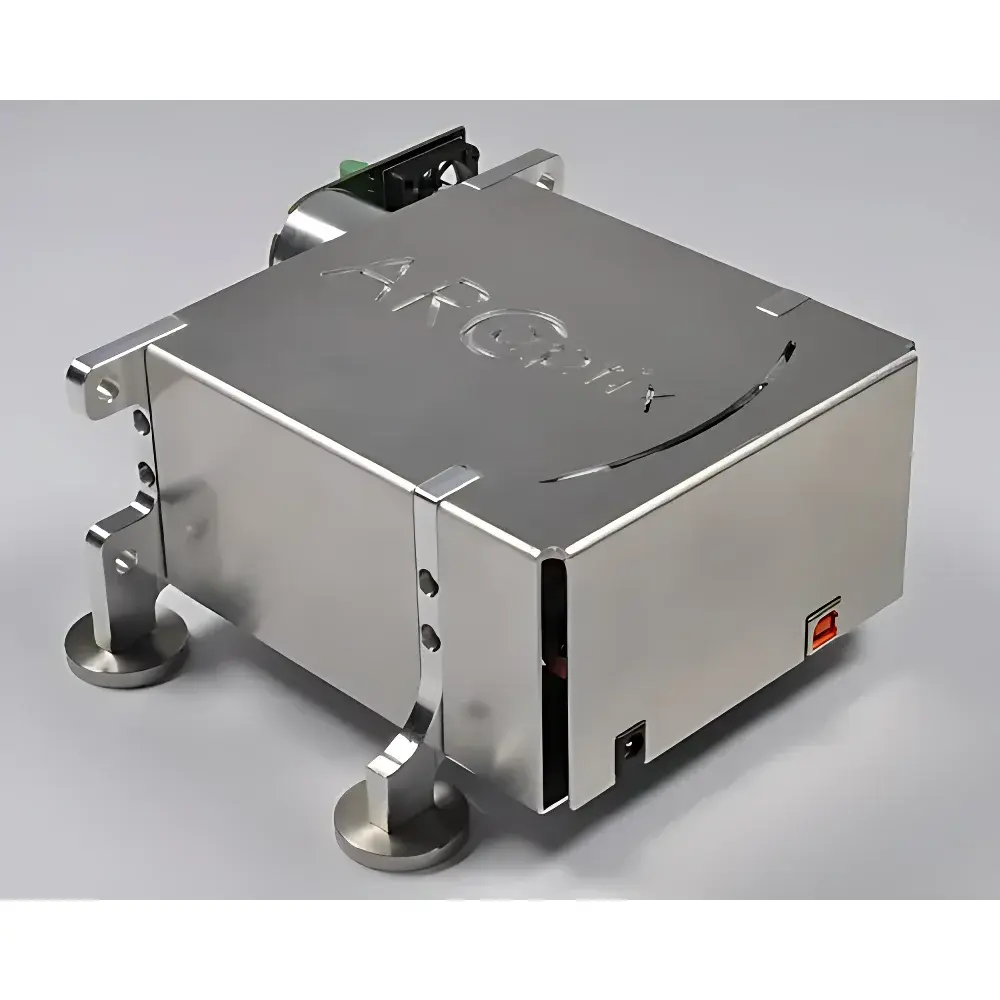
ARCoptix FTIR Rocket OEM Module maestro
| Brand | ARCoptix |
|---|---|
| Model | maestro |
| Origin | USA |
| Resolution | 4 cm⁻¹ (standard), down to 0.5 cm⁻¹ (optional) |
| Spectral Range | Configurable up to 5000–830 cm⁻¹ (2–12 µm) |
| Detector | TE-cooled MCT, Peltier-stabilized |
| Interferometer Type | Alignment-Insensitive Dual Retroreflector Design |
| Wavenumber Reproducibility | <10 ppm |
| Scan Rate | 1 spectrum/sec (continuous mode) |
| ADC | 24-bit |
| Interface | USB 2.0 |
| Power | 12 V / 8 W (interferometer only) |
| Operating Temperature | 10–40 °C |
| Dimensions | 180 × 160 × 80 mm |
| Weight | 1.8 kg |
| Software SDK | C, C#, LabVIEW, MATLAB APIs included |
| Compliance | Designed for integration into GLP/GMP- and ISO/IEC 17025-aligned systems |
| Fiber Compatibility | SMA-905, supports CIR (1–6 µm), PIR (4–18 µm), CaF₂/BK7 coupling optics |
Overview
The ARCoptix FTIR Rocket OEM Module maestro is a purpose-engineered, compact Fourier Transform Infrared (FTIR) spectrometer module designed for seamless integration into custom analytical, industrial process, or portable measurement platforms. At its core lies a permanently aligned dual retroreflector interferometer—based on monolithic corner-cube optics mounted on a flexure-driven oscillating arm—eliminating sensitivity to thermal drift and mechanical vibration. Unlike traditional Michelson designs requiring periodic realignment, this architecture ensures long-term optical stability without maintenance. A temperature-stabilized solid-state reference laser (850 nm) provides sub-ppm wavenumber calibration accuracy, enabling traceable, day-to-day spectral reproducibility essential for regulatory-compliant applications. The module integrates a high-sensitivity, thermoelectrically cooled mercury cadmium telluride (TE-MCT) detector, optimized for signal-to-noise performance across configurable mid-infrared (MIR) and near-infrared (NIR) bands—from 5000–1700 cm⁻¹ (2–6 µm) up to 5000–830 cm⁻¹ (2–12 µm). Its low power consumption (8 W at 12 V), USB 2.0 interface, and modular mechanical footprint (180 × 160 × 80 mm, 1.8 kg) support both benchtop prototyping and battery-powered field-deployable instrumentation.
Key Features
- Permanently aligned dual retroreflector interferometer with flexure-based mirror scanning—no recalibration required over lifetime.
- Integrated solid-state reference laser (850 nm) with active temperature stabilization (<10 ppm wavenumber drift).
- TE-cooled MCT detector options: three spectral response ranges (2–6 µm, 1.5–8.5 µm, or 2–12 µm) with Peltier thermal control.
- Configurable beam splitter materials: CaF₂ (0.9–8.5 µm) or ZnSe (2.0–14.0 µm) for optimal throughput across NIR/MIR bands.
- High-resolution spectral acquisition: standard 4 cm⁻¹ unapodized resolution, optionally down to 0.5 cm⁻¹.
- 24-bit analog-to-digital conversion with real-time interferogram digitization and on-board phase correction.
- USB 2.0 interface with deterministic timing; compatible with Windows 7/10 and embedded Linux via provided drivers.
- Standard SMA-905 fiber port; mechanically compatible with Thorlabs/Linos 30 mm cage systems and optical breadboards.
Sample Compatibility & Compliance
The maestro module supports transmission, reflection, and attenuated total reflectance (ATR) sampling configurations through external optical interfaces. It accommodates gas cells (e.g., 7.5 cm pathlength), liquid flow cells, and solid sample stages via customizable optical mounts. When integrated into end-user systems, the module meets foundational requirements for analytical traceability under ISO/IEC 17025, ASTM E1421, and USP . Its stable wavenumber scale and detector responsivity enable compliance with FDA 21 CFR Part 11 when paired with validated software environments supporting audit trails, electronic signatures, and data integrity controls. Optional accessories—including CIR (1–6 µm) and PIR (4–18 µm) infrared fibers, CaF₂/BK7 lens-based couplers, and reflective off-axis parabolic collimators—extend compatibility to harsh or spatially constrained sampling environments while preserving spectral fidelity.
Software & Data Management
The maestro ships with a free Windows-compatible GUI for hardware configuration, real-time spectral visualization, background subtraction (dark/white reference), and interferogram analysis (apodization, zero-filling, FFT processing). A comprehensive, royalty-free SDK includes documented DLLs and source-code examples in C++, C#, LabVIEW, and MATLAB—enabling full instrument control (scan parameters, gain, averaging, trigger modes) and raw data access. For advanced analytics, optional software modules developed in collaboration with Labcognition GmbH provide validated workflows: the Math Add-on delivers baseline correction, derivative spectroscopy, and multiplicative scatter correction (MSC); the Quant Add-on implements PLS and MLR regression for quantitative calibration; the Search Add-on enables spectral library indexing and full-text metadata retrieval; and IRAnalyze offers automated functional group assignment based on IUPAC-referenced band correlation tables. All software components support export to ASTM E131-compliant JCAMP-DX format.
Applications
The maestro module serves as the spectral engine in diverse OEM applications: real-time gas composition monitoring in semiconductor fab tools; inline polymer melt characterization in extrusion lines; handheld pharmaceutical ID devices for raw material verification; environmental VOC detection in UAV-mounted sensors; and miniature breath analyzers for clinical research. Its robust interferometer design ensures reliable operation in mobile or factory-floor settings where ambient temperature fluctuation and mechanical shock are unavoidable. Integration with infrared fiber probes enables remote sensing in hazardous or sterile environments—such as bioreactor headspace analysis or furnace exhaust stream profiling. Academic labs utilize the module for teaching FTIR fundamentals, developing novel chemometric models, or constructing hybrid instruments (e.g., FTIR-Raman co-localized platforms).
FAQ
Is the maestro module compliant with FDA 21 CFR Part 11 for regulated environments?
Yes—when deployed with validated third-party software implementing electronic signatures, audit trails, and role-based access control, the module satisfies core data integrity requirements. ARCoptix provides documentation packages to support IQ/OQ protocols.
Can I replace the detector or beam splitter in the field?
The flexible OEM variant supports hot-swappable detector and source modules. Interferometer, detector, and source are mechanically decoupled—allowing independent upgrades or repairs without system recalibration.
What spectral resolution options are available beyond the standard 4 cm⁻¹?
Optional firmware and scan parameter configurations support 2 cm⁻¹, 1 cm⁻¹, and 0.5 cm⁻¹ unapodized resolution—subject to detector noise floor and optical throughput trade-offs.
Does the module support synchronization with external triggers or clocks?
Yes—TTL-compatible trigger input/output ports enable precise temporal alignment with auxiliary sensors (e.g., pressure transducers, mass spectrometers) or process control systems.
Are calibration certificates and NIST-traceable validation reports available?
Upon request, ARCoptix supplies factory calibration reports including wavenumber accuracy verification against NIST SRM 2035 and detector responsivity characterization per ISO 13406-2 methodology.




