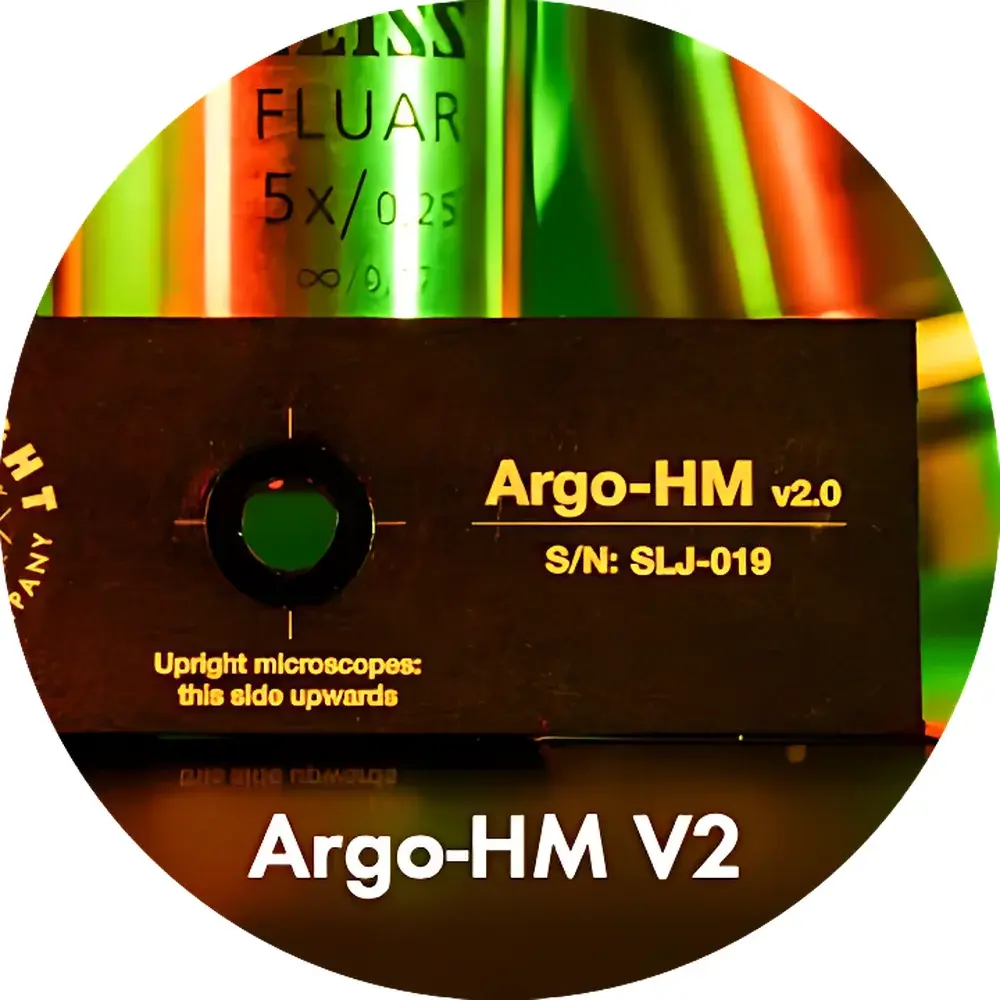
Argolight Argo-HM Slide V2 Confocal Fluorescence Microscopy Calibration Standard
| Brand | Argolight |
|---|---|
| Origin | France |
| Manufacturer | Argolight SAS |
| Model | Argo-HM Slide V2 |
| Substrate | AG03 ultra-pure fused silica core |
| Dimensions | 75 × 25 × 1.5 mm |
| Pattern Count | 16 embedded 3D fluorescent structures per slide |
| Excitation Range | 250–650 nm (continuous) |
| Emission Range | λₑₓ + 15 nm to 800 nm (continuous) |
| Photostability | Non-bleaching, lifetime-stable fluorescence |
| Damage Threshold | 50 GW/cm² (peak or average irradiance) |
| Immersion Compatibility | Dry, oil, water (no restrictions) |
| Objective Compatibility | All objectives ≤ 100× |
| Storage Conditions | 10–40 °C, 20–70 % RH |
| Imaging Modality Compatibility | Widefield, confocal, spinning disk, light-sheet, TIRF — excluding STED, RESOLFT, and multiphoton modalities |
| Traceability | Certified reference standard aligned with ISO/IEC 17025-accredited metrology labs (e.g., BAM) and ISO 21073:2019 |
Overview
The Argolight Argo-HM Slide V2 is a traceable, metrology-grade calibration standard engineered for quantitative quality assurance in fluorescence microscopy systems. Unlike conventional fluorescent beads or biological samples, it embeds 16 precisely defined, three-dimensional fluorescent patterns directly into an ultra-pure AG03 fused silica substrate using Argolight’s patented “Fluorescent Brush” technology—a nonlinear photonic process that induces stable, non-bleaching fluorophores in bulk glass via spatially controlled two-photon absorption. This enables absolute, long-term reproducibility of intensity, spatial distribution, and decay kinetics—critical for validating system performance across time, instruments, and laboratories. Designed specifically for high-magnification platforms (20×–100×), including commercial confocal systems (e.g., Zeiss LSM, Olympus FV, Nikon A1R, Andor Dragonfly, CrestOptics X-Light), the Argo-HM Slide serves as a primary reference for assessing resolution, point spread function (PSF) symmetry, chromatic aberration, axial drift, intensity linearity, and photobleaching resistance—without requiring user preparation or environmental stabilization.
Key Features
- Patented 3D internal fluorescent patterning: Patterns are permanently induced within the glass matrix—not coated or deposited—ensuring zero delamination, no batch-to-batch variation, and immunity to solvent, immersion media, or cleaning protocols.
- Full spectral coverage: Excitable from 250 nm to 650 nm; emission spans λₑₓ + 15 nm to 800 nm, enabling validation across UV, visible, and NIR fluorescence channels used in multi-color imaging.
- Sub-10 µm fabrication tolerance: All pattern geometries—including line widths, dot diameters, and depth profiles—are manufactured with ≤10 µm positional accuracy in all three dimensions, certified via interferometric and SEM-based metrology.
- Zero photobleaching under routine imaging conditions: Validated at irradiance levels up to 50 GW/cm² (peak), exceeding typical confocal laser power densities by >3 orders of magnitude.
- Standardized physical form factor: 75 × 25 × 1.5 mm anodized aluminum carrier with AG03 glass core—compatible with automated slide loaders, motorized stages, and standard microscope holders.
- Pre-calibrated reference values: Each pattern geometry and intensity profile is characterized against national metrology institute standards (e.g., BAM, PTB) and documented in the Argolight Daybook software with uncertainty budgets.
Sample Compatibility & Compliance
The Argo-HM Slide V2 is compatible with all fluorescence-based widefield, confocal, spinning-disk, and light-sheet microscopes operating within its excitation/emission envelope. It is explicitly excluded from use in stimulated emission depletion (STED), ground-state depletion (GSD), or multiphoton excitation systems due to fundamental differences in fluorophore activation mechanisms. The standard complies with ISO 21073:2019 (“Optical data for fluorescence confocal microscopes used in biological imaging”) and supports GLP/GMP-aligned quality control workflows. Its traceability chain is anchored to measurements performed at ISO/IEC 17025-accredited institutions, and all pattern specifications are provided with expanded uncertainties (k=2). Documentation includes full calibration certificates, material safety data (non-toxic, non-radioactive), and RoHS/REACH compliance statements.
Software & Data Management
The Argolight Daybook software provides a validated, audit-ready platform for image analysis and longitudinal quality tracking. It operates in two tightly coupled phases: (1) automated pattern recognition and metrological analysis—including PSF fitting, modulation transfer function (MTF) calculation, intensity uniformity mapping, and lateral/axial drift quantification—and (2) structured database storage with timestamped results, operator ID, instrument configuration metadata, and tolerance-based pass/fail classification. Algorithms are fully documented, version-controlled, and exportable in open formats (CSV, TIFF, JSON) without proprietary plugins. The software supports 21 CFR Part 11-compliant electronic signatures, audit trails, and role-based access control—making it suitable for regulated environments such as clinical diagnostics R&D and pharmaceutical imaging QC.
Applications
- Preventive maintenance scheduling: Detect optical misalignment, detector gain drift, or laser power degradation before they compromise experimental outcomes.
- Cross-platform validation: Benchmark performance consistency between identical instruments across core facilities or multi-site collaborations.
- System commissioning & requalification: Provide objective evidence for IQ/OQ/PQ documentation during microscope installation or after major service interventions.
- Training & competency assessment: Standardize operator proficiency evaluation using repeatable, quantitative metrics rather than subjective visual inspection.
- Method validation for quantitative imaging: Establish baseline performance for techniques requiring intensity linearity (e.g., FRET, FLIM, ratiometric Ca²⁺ imaging) or sub-diffraction localization precision.
- Regulatory submissions: Include calibrated reference data in FDA, EMA, or PMDA dossiers to demonstrate imaging system stability and measurement reliability over study duration.
FAQ
Is the Argo-HM Slide V2 suitable for multiphoton microscopy?
No. The embedded fluorophores are optimized for single-photon excitation. Multiphoton absorption cross-sections are not characterized, and pattern fidelity cannot be guaranteed under femtosecond pulsed illumination.
Can I use the same slide across different objective lenses?
Yes—provided total exposure per objective remains ≤20 minutes. The slide’s photostability exceeds operational demands for routine QC checks across dry, oil, and water immersion objectives.
Does the calibration require annual recalibration by Argolight?
No. The patterns are physically stable and do not degrade over time. However, users must verify slide integrity (e.g., scratches, contamination) before each use per SOP. Recertification is optional and available upon request.
How does this differ from NIST-traceable fluorescent beads?
Beads introduce variability from mounting medium, orientation, and out-of-focus signal. The Argo-HM Slide provides fixed, co-planar, 3D-defined features with known geometry and intensity distribution—enabling true system-level PSF reconstruction and aberration mapping.
Is Daybook software validated for use in FDA-regulated environments?
Yes. The software includes 21 CFR Part 11 functionality (electronic signatures, audit trail, change control), and validation packages—including IQ/OQ documentation and test scripts—are available under NDA.