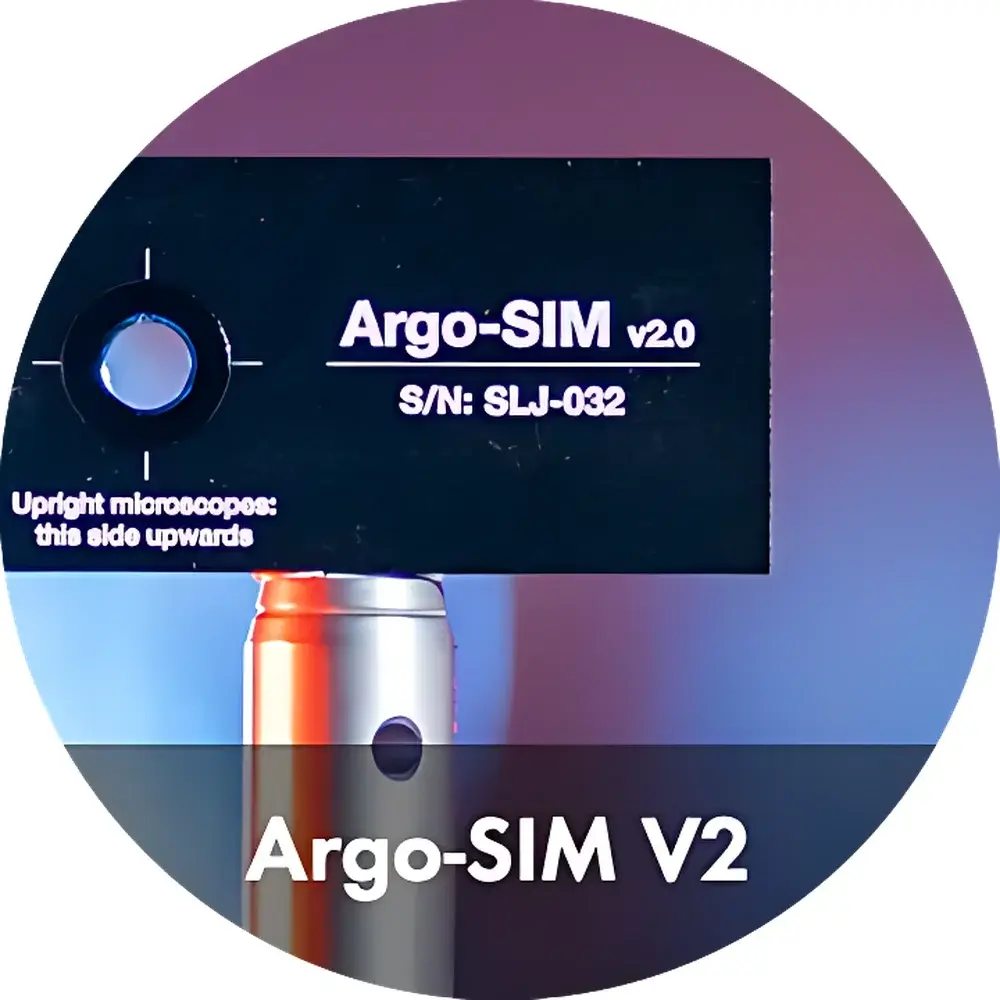
Argolight Argo-SIM V2 Super-Resolution Fluorescence Microscopy Calibration Slide
| Brand | Argolight |
|---|---|
| Model | Argo-SIM Slide V2 |
| Substrate | AG03 Glass Core in Anodized Aluminum Housing |
| Dimensions | 75 × 25 × 1.5 mm |
| Fluorescence Stability | Lifetime (Non-photobleaching) |
| Excitation Range | 250–650 nm (Continuous) |
| Emission Range | λₑₓ + 15 nm to 800 nm (Continuous) |
| Immersion Compatibility | Dry, Oil (Unrestricted), Water |
| Objective Exposure Limit | <20 min per objective |
| Storage Conditions | 10–40 °C, 20–70 % RH |
| Laser Damage Threshold | 50 GW/cm² (Peak or Average Irradiance) |
| Pattern Count per Slide | 27 Distinct Fluorescent Microstructures |
| Imaging Compatibility | All Fluorescence-Based Modalities Except STED and Multiphoton |
| Software | Argolight Daybook (Proprietary Image Analysis & QC Database Platform) |
Overview
The Argolight Argo-SIM V2 Super-Resolution Fluorescence Microscopy Calibration Slide is a metrology-grade reference standard engineered for quantitative performance verification of structured illumination microscopy (SIM), confocal, widefield, and other fluorescence-based imaging systems operating at 63× to 100× magnification. Unlike conventional fluorescent beads or biological samples—whose intensity, size, and photostability vary unpredictably—the Argo-SIM V2 integrates patented “Fluorescent Brush” technology to embed 27 precisely defined, three-dimensional fluorescent patterns directly into an ultra-pure AG03 glass core. These patterns are photophysically stable, non-bleaching, and traceable to fundamental optical parameters, enabling rigorous assessment of resolution, chromatic aberration, axial drift, lateral distortion, signal-to-noise ratio, and point-spread function (PSF) fidelity across the full field of view. Designed in accordance with principles established by national metrology institutes—including BAM (Federal Institute for Materials Research and Testing)—and validated against ISO/IEC 17025-aligned protocols, the Argo-SIM V2 serves as a primary reference for fluorescence imaging system qualification, routine quality control, and longitudinal instrument health monitoring.
Key Features
- Patented Fluorescent Brush technology: 3D fluorescent structures induced volumetrically within high-homogeneity AG03 glass—no dyes, no coatings, no degradation over time
- Lifetime fluorescence stability: No photobleaching under standard imaging conditions; usable indefinitely without recalibration
- 27 distinct, metrologically characterized patterns per slide: Including line pairs (for resolution validation), grid arrays (for distortion mapping), step-edge profiles (for PSF analysis), and intensity gradients (for dynamic range assessment)
- Broad spectral compatibility: Excitable from 250 nm to 650 nm; emission spans λₑₓ + 15 nm to 800 nm—compatible with DAPI, FITC, TRITC, Cy5, and Alexa Fluor dyes
- Robust mechanical architecture: Anodized aluminum carrier ensures dimensional stability (±10 µm tolerance in all axes) and thermal uniformity during long-term storage or repeated use
- Immersion-medium agnostic: Validated for dry, oil-immersion, and aqueous objectives—no refractive index mismatch artifacts
- Laser damage threshold ≥50 GW/cm²: Suitable for high-intensity SIM illumination sources including spatial light modulators (SLMs) and digital micromirror devices (DMDs)
Sample Compatibility & Compliance
The Argo-SIM V2 is compatible with all fluorescence-based modalities except stimulated emission depletion (STED) and multiphoton excitation, due to its intrinsic single-photon absorption profile. It has been independently verified by Carl Zeiss Microscopy and referenced in ISO 21073:2019 (“Optical data for fluorescence confocal microscopes used in bioimaging”) for resolution and intensity calibration traceability. Each slide undergoes full characterization using interferometric profilometry, spectral radiometry, and high-resolution scanning electron microscopy (SEM) prior to release. Batch-level certification includes uncertainty budgets compliant with GUM (Guide to the Expression of Uncertainty in Measurement) and supports GLP/GMP audit readiness. The physical form factor (75 × 25 × 1.5 mm) conforms to ANSI/ISO 8402 standards for microscope slide geometry, ensuring seamless integration into automated slide loaders and high-throughput scanning platforms.
Software & Data Management
The Argolight Daybook software provides a validated, auditable workflow for image analysis and quality data governance. It natively opens proprietary .argosim image files without third-party plugins and applies documented, peer-reviewed algorithms—including Fourier ring correlation (FRC), modulation transfer function (MTF) estimation, and centroid-based drift quantification. Processed metrics—including effective resolution (FWHM), chromatic shift (nm/pixel), and intensity linearity deviation (%)—are exported in open formats (CSV, JSON, TIFF metadata) for integration with LIMS or ELN systems. All processing steps are timestamped and logged with user ID, instrument ID, and environmental metadata, satisfying FDA 21 CFR Part 11 requirements for electronic records and signatures. Historical datasets are stored in a local SQLite database with version-controlled schema, enabling trend analysis across instruments, operators, and timepoints.
Applications
- Preventive maintenance: Detect sub-resolution drift or misalignment before impacting experimental outcomes
- Multi-instrument harmonization: Cross-validate performance between core facility microscopes or distributed research sites
- Regulatory documentation: Generate ISO 13485-compliant evidence for fluorescence imaging systems used in IVD development or preclinical imaging
- Method validation: Support USP and ICH Q5E guidelines for analytical method transfer in biologics characterization
- Training & proficiency testing: Standardized benchmarking for new users, service engineers, and QC personnel
- Publication-ready metrology: Provide traceable image quality metrics for figure supplements in journals requiring reproducibility reporting (e.g., Nature Methods, JCB)
FAQ
How does the Argo-SIM V2 differ from fluorescent bead standards?
Unlike polymer or silica beads—which exhibit batch variability, surface heterogeneity, and photobleaching—the Argo-SIM V2 features internally generated, monolithic fluorescent structures with certified dimensions, intensity profiles, and spectral response.
Can it be used for axial resolution validation?
Yes. The 3D pattern architecture includes calibrated depth-resolved features enabling Z-stack PSF characterization and spherical aberration quantification across immersion media.
Is calibration traceable to national standards?
Each production lot is certified against BAM reference measurements; full uncertainty budgets and traceability statements are provided in the Certificate of Conformance.
Does Daybook support automated batch processing?
Yes. Command-line interface (CLI) mode enables integration into CI/CD pipelines for unattended QC of daily acquisition logs.
What is the expected lifetime under routine lab use?
Indefinite—fluorescence intensity remains stable beyond 10⁶ cumulative exposure seconds under typical SIM illumination conditions.