Argolight Argo-WP Fluorescence Calibration Microplate for High-Content Screening Systems
| Brand | Auniontech (Distributor) |
|---|---|
| Origin | Shanghai, China |
| Model | Argo-WP Calibration Microplate |
| Application | QC/QA of fluorescence imaging systems (HCS/HTS/HCI) |
| Excitation Range | 350–650 nm |
| Emission Range | ~365–800 nm |
| Substrate | Patented photostable glass with embedded 3D fluorescent patterns |
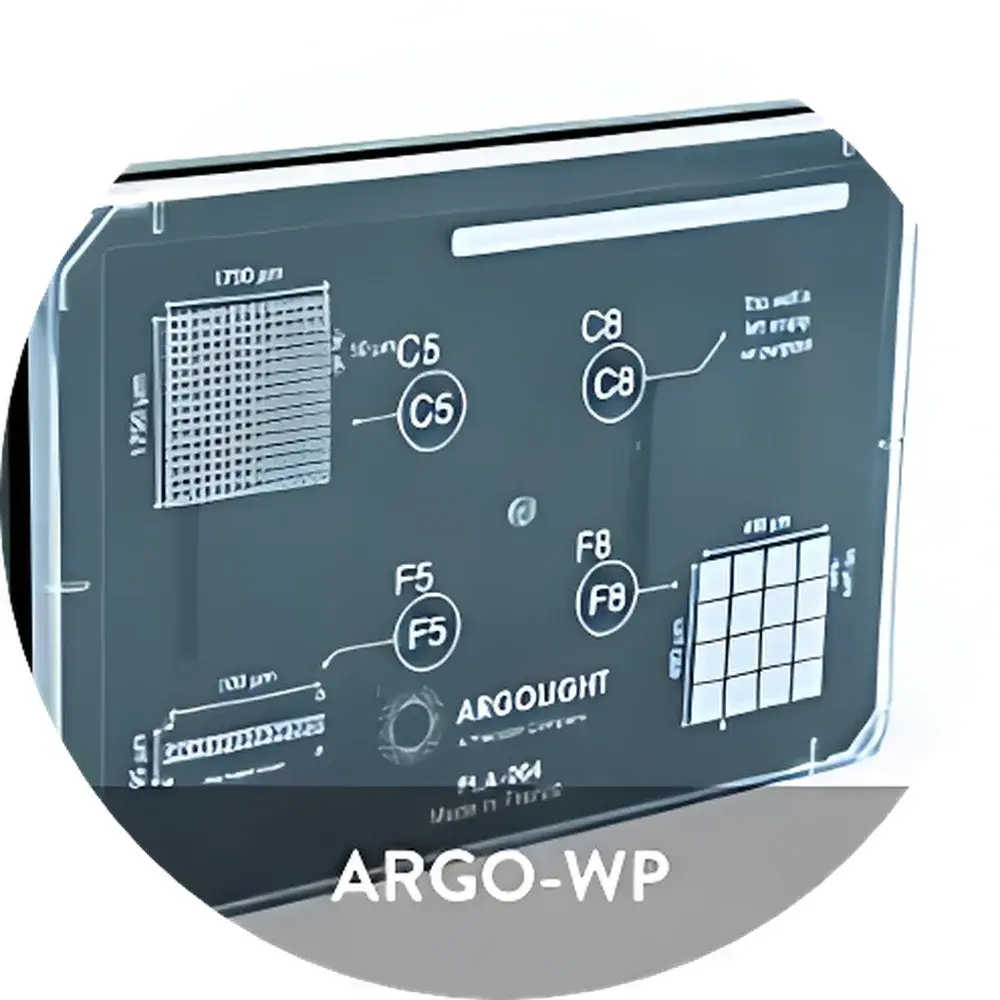
| Format | 4-well aluminum plate, each well containing one 75 mm × 25 mm × 1.5 mm Argolight glass slide |
| Pattern Stability | Non-bleaching, reusable, traceable to NMIs (e.g., BAM) |
| Compliance Support | IQ/OQ/PQ protocols, ASTM E3085, ISO 17025-aligned validation workflows |
| Software | Argolight Daybook v3.x (FDA 21 CFR Part 11-ready audit trail, open-format export, documented algorithms) |
Overview
The Argolight Argo-WP Fluorescence Calibration Microplate is a metrology-grade reference standard engineered specifically for performance verification and longitudinal quality assurance of fluorescence-based high-content screening (HCS), high-throughput screening (HTS), and high-content imaging (HCI) systems. Unlike conventional fluorescent beads or stained biological samples—whose intensity, photostability, and spatial reproducibility degrade over time—the Argo-WP employs Argolight’s patented “Fluorescent Brush” technology to embed stable, sub-micron-precise 3D fluorescent patterns directly into ultra-pure optical glass. This enables quantitative, repeatable assessment of key imaging parameters including spatial resolution, signal-to-noise ratio (SNR), pixel intensity uniformity, field-of-view flatness, chromatic registration, and photobleaching resistance—without reliance on biological variability or operator-dependent preparation. Designed to emulate critical features of cellular fluorescence (e.g., spot size, intensity gradient, spectral profile), the Argo-WP serves as a physical anchor for system calibration across instrument lifecycles, from installation qualification (IQ) through routine operational qualification (OQ) and performance qualification (PQ).
Key Features
- Patented 3D fluorescent patterning via multiphoton photochemistry—no dyes, no coatings, no photobleaching
- Four independent calibration wells per plate, each housing a rigorously characterized 75 mm × 25 mm × 1.5 mm Argolight glass slide
- Broad excitation compatibility (350–650 nm) and wide emission bandwidth (~365–800 nm), compatible with standard filter sets and LED/laser sources
- Micrometer-level pattern fidelity (<10 µm 3D positional accuracy) validated using NMI-traceable interferometric and spectrophotometric methods
- Traceable metrological documentation: Each slide includes unique serial number, spectral response certificate, and dimensional tolerance report
- Designed for integration into GLP/GMP-compliant workflows—supports FDA 21 CFR Part 11 requirements via Argolight Daybook software audit trails
Sample Compatibility & Compliance
The Argo-WP microplate is mechanically and optically compatible with all major commercial HCS platforms—including Yokogawa CV7000/CV8000, Molecular Devices ImageXpress Micro Confocal/CP, PerkinElmer Opera Phenix, Thermo Fisher CellInsight CX7/CX5, and Cytiva IN Cell Analyzer 2200/6000. Its standardized footprint and well geometry conform to ANSI/SBS microplate specifications (127.76 mm × 85.48 mm), ensuring seamless robotic handling and stage positioning. From a regulatory perspective, the Argo-WP supports full lifecycle validation: it fulfills IQ requirements by verifying optical alignment and illumination homogeneity at installation; enables OQ through periodic repeatability testing of focus stability, magnification consistency, and channel co-registration; and underpins PQ by establishing baseline metrics against which long-term drift (e.g., lens degradation, detector aging, lamp output decay) is quantified. Validation data generated with the Argo-WP align with ISO/IEC 17025 principles and have been cited in peer-reviewed literature on optical imaging QA (e.g., BAM Report 21073:2019, “Optical Data for Fluorescence Confocal Microscopes in Biological Imaging”).
Software & Data Management
Argolight Daybook software provides a closed-loop, auditable workflow for image acquisition, automated pattern analysis, and longitudinal trend reporting. The software implements peer-reviewed algorithms—fully documented and published—to extract quantitative metrics including modulation transfer function (MTF), line spread function (LSF), intensity uniformity (%CV across FOV), and spectral crosstalk between channels. All analyses are performed natively without third-party plugins; raw images (TIFF, PNG, ND2, CZI) are imported directly. Processed results—including pass/fail status relative to user-defined tolerances—are stored in an encrypted local database with immutable timestamps and operator attribution. Export options include CSV, PDF reports, and XML metadata compliant with MIAME and MIAPE standards. Audit trails meet FDA 21 CFR Part 11 requirements, supporting electronic signatures and role-based access control for regulated environments.
Applications
- Baseline calibration and post-maintenance verification of HCS/HCI instruments
- Root-cause analysis during image quality deviations (e.g., focal drift, vignetting, channel misalignment)
- Preventive and predictive maintenance scheduling based on statistically significant parameter drift
- Multi-site assay harmonization across distributed laboratories
- Vendor qualification and instrument procurement acceptance testing
- Training and competency assessment for imaging technicians and core facility staff
FAQ
Can the Argo-WP be used for both widefield and confocal HCS systems?
Yes. Its broadband excitation/emission profile and sub-diffraction-limit pattern features make it suitable for widefield epifluorescence, spinning disk, and laser-scanning confocal modalities.
How often should I perform Argo-WP verification?
Best practice recommends daily system check (quick scan), weekly full-parameter verification, and post-service comprehensive recalibration—aligned with ISO 13485 and GxP risk-based approaches.
Is the glass substrate compatible with immersion objectives or oil-based clearing agents?
No. The Argo-WP is intended for air-objective use only; immersion media may damage the proprietary glass surface coating and invalidate metrological traceability.
Does Argolight provide NIST-traceable calibration certificates?
While not NIST-certified (as NIST does not issue certificates for fluorescent pattern standards), Argolight certificates are traceable to BAM (Germany’s National Metrology Institute) and validated per ISO/IEC 17025-accredited procedures.
Can Daybook software integrate with LIMS or ELN platforms?
Yes—via RESTful API and configurable CSV/XML export templates, enabling automated ingestion into LabVantage, Benchling, and Veeva systems.