
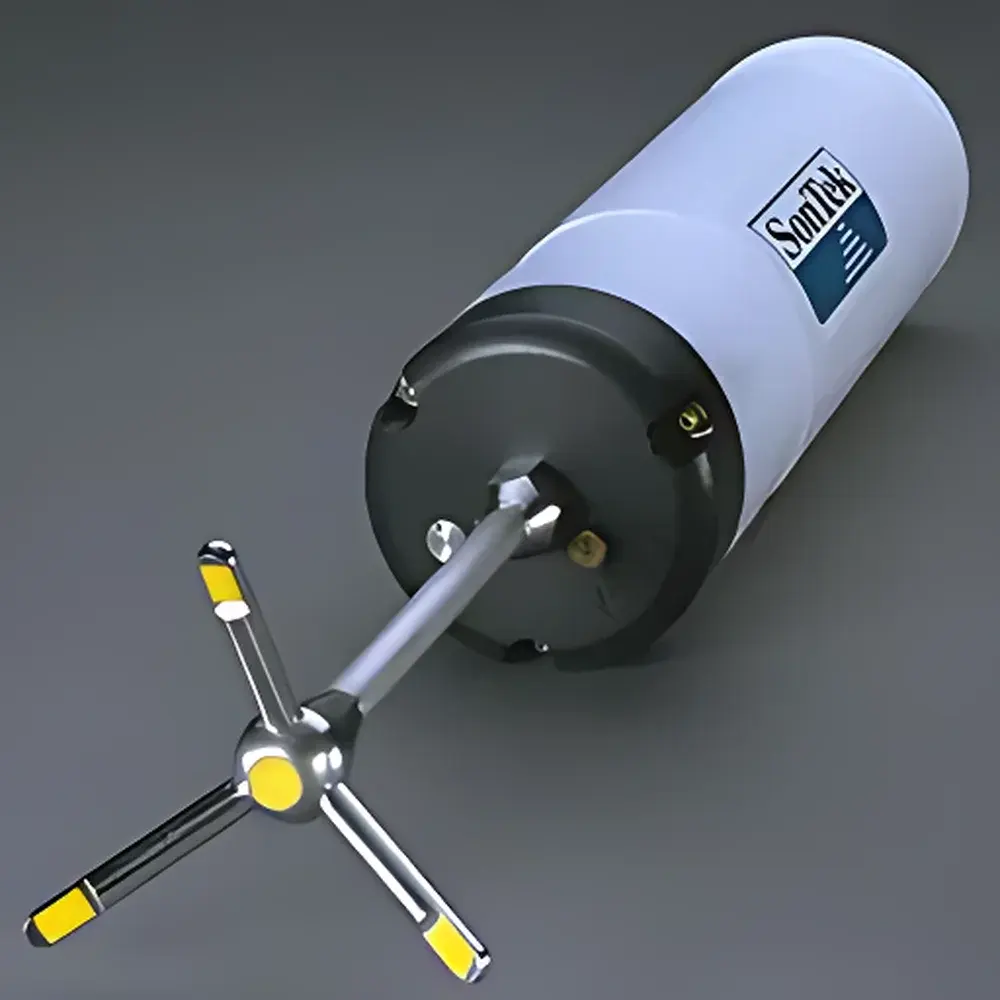
Argonaut-ADV Acoustic Doppler Velocimeter
| Origin | USA |
|---|---|
| Manufacturer Type | Authorized Distributor |
| Origin Category | Imported |
| Model | Argonaut |
| Pricing | Available Upon Request |
| Weight (Air/Water) | 3.18 kg / 0.45 kg |
| Pressure Rating | 60 m submersion |
| 3D Probe Circumference | 130 mm |
| 2D Probe Circumference | 147 mm |
| Sampling Volume | 0.25 cm³ at 10 cm from transducer |
| Sampling Interval | User-configurable |
| Internal Memory | 4 MB (≥200,000 samples) |
| Velocity Range | ±0.001–6 m/s |
| Velocity Resolution | 0.0001 m/s |
| Velocity Accuracy | ±1% of measured value or ±0.001 m/s (whichever greater) |
| Temperature Sensor Resolution | 0.01 °C |
| Temperature Accuracy | ±0.1 °C |
| Operating Temperature | −5 °C to +40 °C |
| Storage Temperature | −10 °C to +50 °C |
| Power Input | 6–30 V DC |
| Power Consumption (continuous) | 0.2–0.5 W |
| Pressure Sensor Options | Strain-gauge (±0.1% FS) or Resonant Pressure Transducer (RPT, ±0.01% FS) |
| Communication Interfaces | RS-232 (standard), SDI-12, 4–20 mA, RS-422/RS-485 (optional) |
| Optional Sensors | Compass/inclinometer, Sea-Bird CTD, YSI multiparameter probes, SonWave wave spectral package, pressure-based water level sensor |
Overview
The Argonaut-ADV Acoustic Doppler Velocimeter is an engineered solution for high-fidelity, single-point velocity measurement in shallow-water environments. Based on the principle of acoustic Doppler shift—where ultrasonic pulses transmitted into the water column are scattered by suspended particles and reflected back with frequency shifts proportional to flow velocity—the instrument delivers precise, time-resolved three-dimensional (3D) or two-dimensional (2D) velocity vectors. Its design prioritizes operational robustness in challenging field conditions: low-flow regimes (as low as 0.001 m/s), ultra-shallow depths (down to 2.5 cm with optional 2D side-looking configuration), and biologically active or sediment-laden waters typical of wetlands, treatment basins, irrigation channels, and nearshore ecological monitoring sites. Unlike profiling ADCPs, the Argonaut-ADV operates as a point-measurement velocimeter, eliminating spatial averaging artifacts and enabling direct correlation between velocity dynamics and localized physical or chemical parameters when integrated with co-located sensors.
Key Features
- Sub-centimeter depth capability: Standard 3D top-looking probe (15 cm stem) and optional 2D side-looking configuration enable deployment in water as shallow as 2 cm—ideal for flumes, constructed wetlands, and effluent discharge monitoring.
- Self-contained data acquisition: Onboard 4 MB flash memory stores over 200,000 velocity samples with timestamping; no external datalogger required for autonomous long-term deployments.
- Multi-interface communication architecture: RS-232 is standard; SDI-12, 4–20 mA analog output, and RS-422/RS-485 are available for integration into SCADA, PLC, or legacy environmental telemetry systems.
- Integrated environmental compensation: Built-in thermistor (±0.1 °C accuracy) enables real-time sound speed correction; optional RPT pressure sensor (±0.01% FS) supports high-accuracy water level derivation compliant with ISO 4064 and ASTM D5490.
- Low-power embedded operation: Draws only 0.2–0.5 W under continuous sampling—compatible with solar-charged battery systems for remote, off-grid installations exceeding 6-month autonomy.
- Modular sensor fusion: Standard acoustic altimeter and temperature sensor; optional compass/inclinometer for tilt-compensated vector orientation; expandable via industry-standard interfaces to Sea-Bird CTDs, YSI EXO or ProDSS multiparameter sondes, and SonWave spectral processing for turbulence and wave analysis.
Sample Compatibility & Compliance
The Argonaut-ADV is optimized for natural and engineered aquatic systems containing sufficient acoustic scatterers (e.g., suspended sediments, phytoplankton, or microbubbles). It performs reliably in turbid freshwater, brackish estuaries, and clarified secondary effluents—though signal-to-noise ratio may decrease in optically clear, particle-deficient water unless seeding is applied. The instrument meets IP68 ingress protection for 60 m submersion and operates within GLP-compliant temperature ranges (−5 °C to +40 °C). Its firmware architecture supports audit-trail-enabled logging and time-synchronized data stamping, facilitating traceability under EPA Method 1600-series guidelines and supporting validation per ISO/IEC 17025 for accredited environmental laboratories. Optional RPT pressure sensors comply with IEC 61290-3 for hydrostatic level measurement uncertainty budgets.
Software & Data Management
Data retrieval and configuration are managed via Argonaut’s native Windows-based software suite, which provides real-time visualization, spectral quality control metrics (e.g., correlation coefficient, signal amplitude, noise floor), and export to CSV, NetCDF, or MATLAB-compatible formats. The system supports automated batch processing for turbulence statistics (Reynolds stresses, TKE spectra) and integrates with third-party platforms—including Campbell Scientific LoggerNet, Aquatic Informatics AQUARIUS, and Python-based PyADCP libraries—via standardized ASCII protocols. Firmware updates preserve backward compatibility, and all stored datasets include embedded metadata (probe geometry, transducer frequency, sampling volume location, temperature-corrected sound speed), ensuring full reproducibility in peer-reviewed research or regulatory reporting contexts.
Applications
- Wastewater treatment plant hydraulics: Monitoring influent channel velocity profiles, clarifier scum layer movement, and effluent discharge uniformity to support NPDES permit compliance.
- Constructed wetland performance assessment: Quantifying subsurface flow velocities through gravel media and emergent vegetation zones to validate hydraulic retention time models.
- Stream restoration monitoring: Capturing low-velocity boundary layer dynamics adjacent to bioengineered banks and riffle-pool sequences for geomorphic feedback analysis.
- Regulatory compliance sampling: Supporting USGS NWIS, EPA STORET, and EU WFD monitoring programs where point-velocity data feed into load estimation algorithms (e.g., LOADEST, QWT).
- Academic hydrodynamic research: Enabling controlled turbulence measurements in flume studies, sediment transport threshold experiments, and biofilm–flow interaction investigations.
FAQ
What is the minimum detectable flow velocity, and under what conditions is it achievable?
The Argonaut-ADV resolves velocities down to ±0.001 m/s with a resolution of 0.0001 m/s. This lower limit assumes adequate acoustic backscatter (≥10 ppm suspended solids), stable temperature stratification, and proper probe alignment relative to mean flow direction.
Can the instrument operate continuously for extended periods without maintenance?
Yes—its solid-state design, corrosion-resistant titanium housing, and low-power electronics support unattended deployments up to 12 months when paired with appropriate power management (e.g., deep-cycle LiFePO₄ batteries and solar charging). Biofouling mitigation is recommended every 3–6 months in eutrophic environments.
Is the device compatible with existing telemetry infrastructure used by municipal utilities?
Absolutely. RS-232, SDI-12, and 4–20 mA outputs allow seamless integration with Campbell Scientific CR1000X, Delta-T Devices DL6, or Siemens Desigo CC controllers. Modbus RTU over RS-485 is available upon request for enterprise SCADA compatibility.
Does the system support calibration traceability to national standards?
Factory calibration is performed against NIST-traceable flow benches per ISO 7145. Users receive a certificate documenting velocity, temperature, and pressure channel calibrations; in-field verification kits (including portable flow calibrators and reference thermistors) are available for routine QA/QC.
How is data integrity ensured during transmission or storage?
All internal memory writes use wear-leveling flash management with CRC-32 checksum validation. When configured for polled telemetry, each packet includes sequence numbering and timestamp synchronization via GPS-disciplined oscillators (optional accessory), satisfying FDA 21 CFR Part 11 electronic record requirements for regulated applications.
Related Products







