
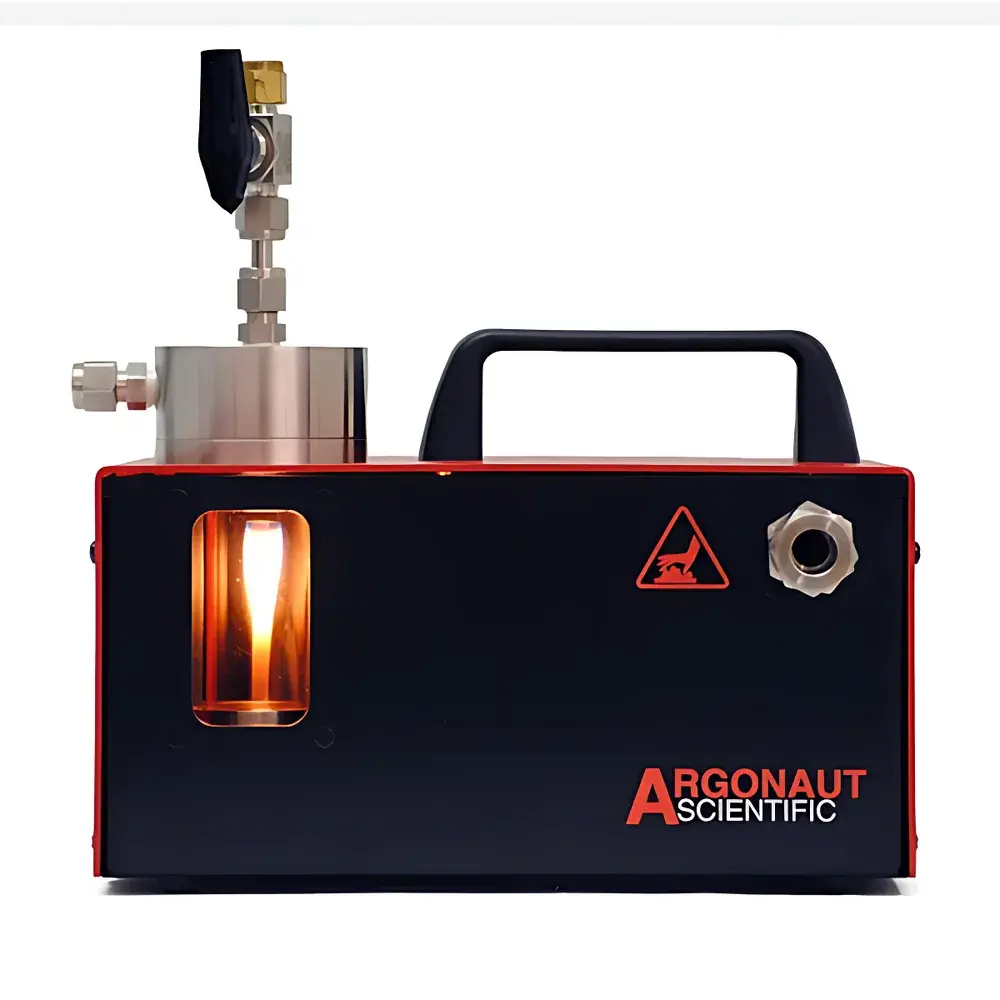
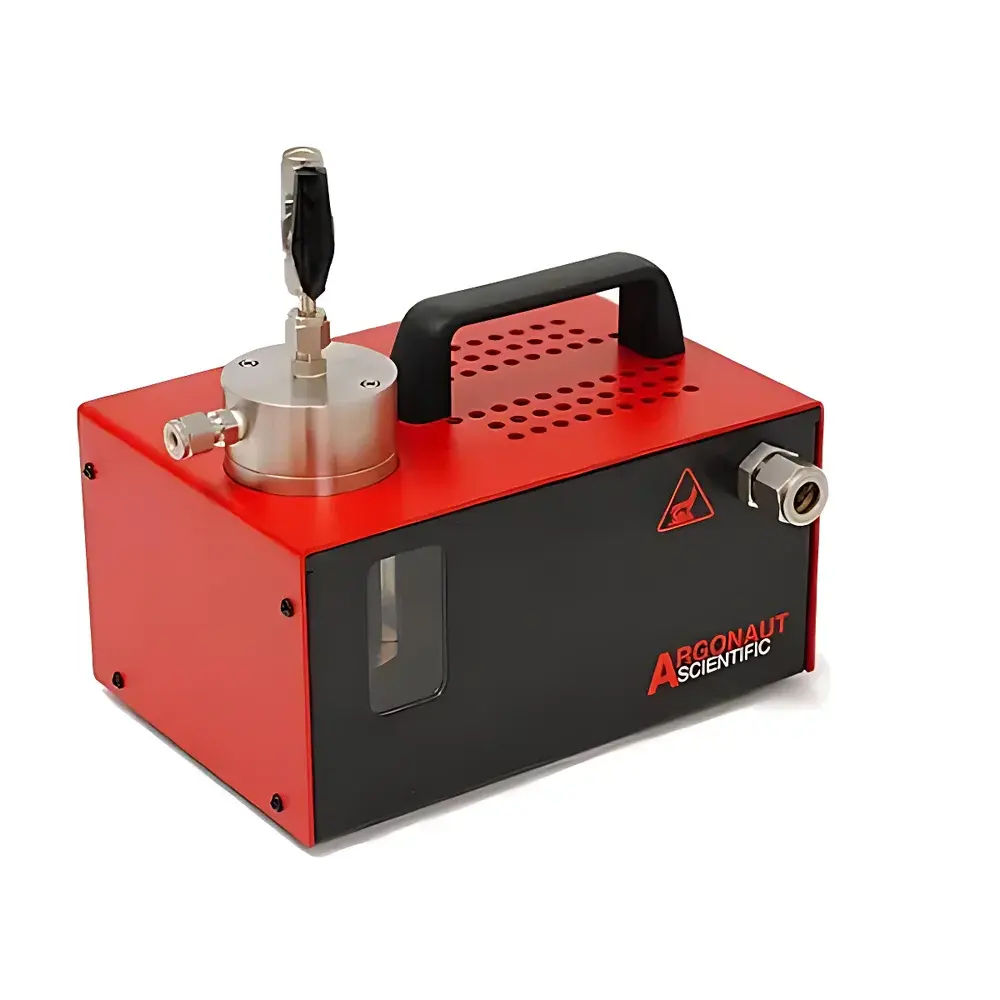
Argonaut MISG01 Miniature Inverted Soot Generator
| Brand | Argonaut |
|---|---|
| Origin | Canada |
| Model | MISG01 |
| Particle Type | Combustion-generated carbon black aerosol |
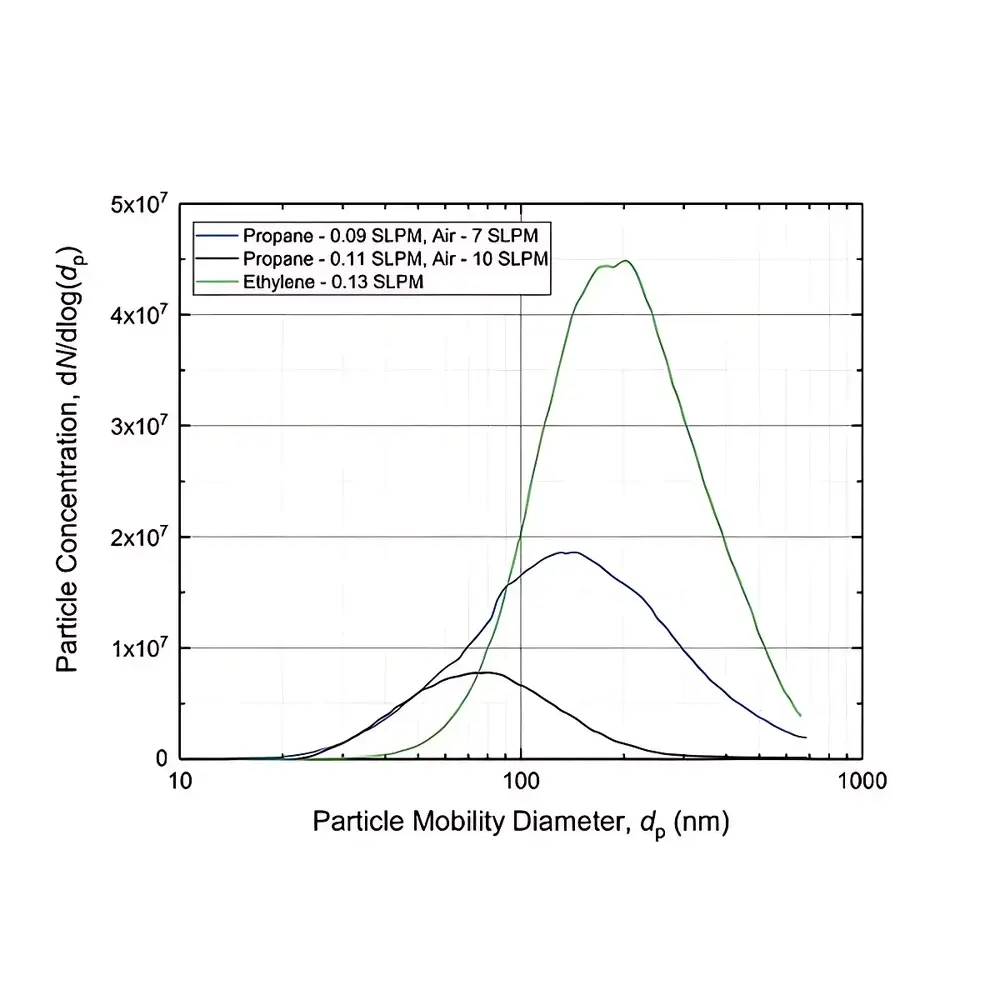
| Primary Particle Size Range | 20–700 nm (flow-dependent) |
| Number Concentration | Up to 10⁷ particles/cm³ (undiluted) |
| Soot Mass Output | ~100 mg/h |
| Fuel Gas Options | Ethylene, propane, ethane, or methane/nitrogen blends |
| Fuel Flow Rate | 0.06–0.13 L/min |
| Oxidizer/Dilution Air Flow Rate | 7–10 L/min |
| Operating Environment | Ambient temperature |
Overview
The Argonaut MISG01 Miniature Inverted Soot Generator is a laboratory-scale, diffusion-flame-based aerosol source engineered for reproducible, on-demand generation of carbon black nanoparticles under controlled combustion conditions. Unlike conventional soot generators relying on upward buoyant flames, the MISG01 employs an inverted, downward-flowing open diffusion flame geometry—enabling stable thermal and fluid-dynamic boundary conditions critical for high repeatability in aerosol production. Its design principle follows classical soot formation pathways: fuel pyrolysis in fuel-rich zones followed by particle nucleation, surface growth, and agglomeration in the post-flame region. This makes the MISG01 particularly suitable for fundamental studies of soot inception kinetics, oxidative aging, and heterogeneous coagulation—as well as for generating challenge aerosols with defined physicochemical properties in calibration and validation workflows.
Key Features
- Miniaturized inverted diffusion flame architecture ensures gravitational stabilization of flame position and consistent residence time distribution—key to minimizing batch-to-batch variability in primary particle size and aggregate morphology.
- Modular gas delivery system supports interchangeable fuel gases (ethylene, propane, ethane) and tunable fuel/air ratios, enabling systematic investigation of precursor chemistry effects on soot nanostructure and oxidation reactivity.
- High mass output (~100 mg/h) and number concentration (up to 10⁷ cm⁻³ undiluted) facilitate rapid accumulation of statistically significant particle samples for offline analysis (e.g., TEM, TGA-MS, Raman spectroscopy) without extended run times.
- Independent control of fuel flow (0.06–0.13 L/min) and oxidizer/dilution air flow (7–10 L/min) allows decoupled tuning of particle size distribution (20–700 nm modal diameter) and number concentration—supporting both high-fidelity instrument calibration and dynamic response testing.
- Compact footprint and ambient-temperature operation eliminate need for external cooling, vacuum pumps, or high-voltage power supplies—reducing infrastructure dependencies and enhancing integration into ISO 17025-accredited calibration labs or university combustion research facilities.
Sample Compatibility & Compliance
The MISG01 generates carbonaceous aerosols representative of incomplete hydrocarbon combustion—morphologically and chemically analogous to diesel exhaust particulate matter (DEP) and urban ambient soot. As such, it is widely adopted in laboratories performing compliance-related testing per ASTM D6243 (Standard Test Method for Determining the Mass Median Aerodynamic Diameter of Diesel Particulate Matter), ISO 8503-2 (Surface roughness characteristics of blast-cleaned steel substrates), and EPA Method 5I (Determination of Organic Carbon and Elemental Carbon in Ambient Particulate Matter). The generator’s output meets GLP-relevant traceability requirements when operated with certified gas standards and calibrated mass flow controllers. While not intrinsically compliant with IEC 61000-4-2 or ATEX directives, its use within ventilated fume hoods satisfies standard occupational exposure limits (ACGIH TLV® for elemental carbon: 0.02 mg/m³ TWA) when paired with appropriate exhaust filtration.
Software & Data Management
The MISG01 operates as a standalone hardware module with analog and digital I/O interfaces compatible with third-party data acquisition systems (e.g., National Instruments DAQmx, LabVIEW, MATLAB Data Acquisition Toolbox). It does not include embedded firmware or proprietary software; instead, it is designed for integration into existing lab automation frameworks where gas flow rates, thermocouple readings, and particle monitor outputs (e.g., from CPCs, SMPS, or optical particle sizers) are logged synchronously. This architecture supports full audit trail capability required under FDA 21 CFR Part 11 for regulated calibration environments—provided users implement validated electronic record systems with role-based access control, electronic signatures, and metadata-tagged raw data storage.
Applications
- Calibration and performance verification of optical smoke detectors, photoacoustic soot spectrometers (e.g., PASS-3), and laser-induced incandescence (LII) systems.
- Functional testing of diesel particulate filters (DPF), gasoline particulate filters (GPF), and electrostatic precipitators under realistic loading conditions.
- In situ evaluation of real-time aerosol instrumentation—including condensation particle counters (CPC), scanning mobility particle sizers (SMPS), and aerodynamic particle sizers (APS)—using monomodal or bimodal soot distributions.
- Fundamental research on soot oxidation kinetics via controlled exposure to O₂, NOₓ, or OH radicals in downstream reaction chambers.
- Development and benchmarking of computational fluid dynamics (CFD) models predicting soot formation in laminar and turbulent diffusion flames.
FAQ
What types of fuel gases are compatible with the MISG01?
Ethylene, propane, ethane, and pre-mixed blends of methane with nitrogen are validated for use. Pure hydrogen or syngas mixtures are not recommended due to altered flame stability and soot yield characteristics.
Can the MISG01 generate sub-30 nm particles suitable for nanoparticle inhalation toxicology studies?
Yes—by optimizing fuel flow rate and air dilution ratio, the device consistently produces primary particles with geometric mean diameters as low as 20 nm, meeting OECD Test Guideline 412 requirements for ultrafine aerosol generation.
Is the MISG01 suitable for continuous operation over 24 hours?
It is rated for uninterrupted operation up to 8 hours per session. Extended runs require periodic inspection of burner tip fouling and recalibration of mass flow controllers to maintain dimensional consistency.
Does the generator comply with ISO/IEC 17025 calibration traceability requirements?
When operated with NIST-traceable gas standards and flow meters calibrated per ISO 6145-7, its output supports metrological traceability chains required for accredited calibration laboratories.
How is particle concentration measured and verified during operation?
Concentration is typically quantified using a calibrated condensation particle counter (CPC) upstream of any dilution stage; cross-validation with gravimetric filter sampling and thermal-optical analysis (TOR) is recommended for mass-based reporting.







