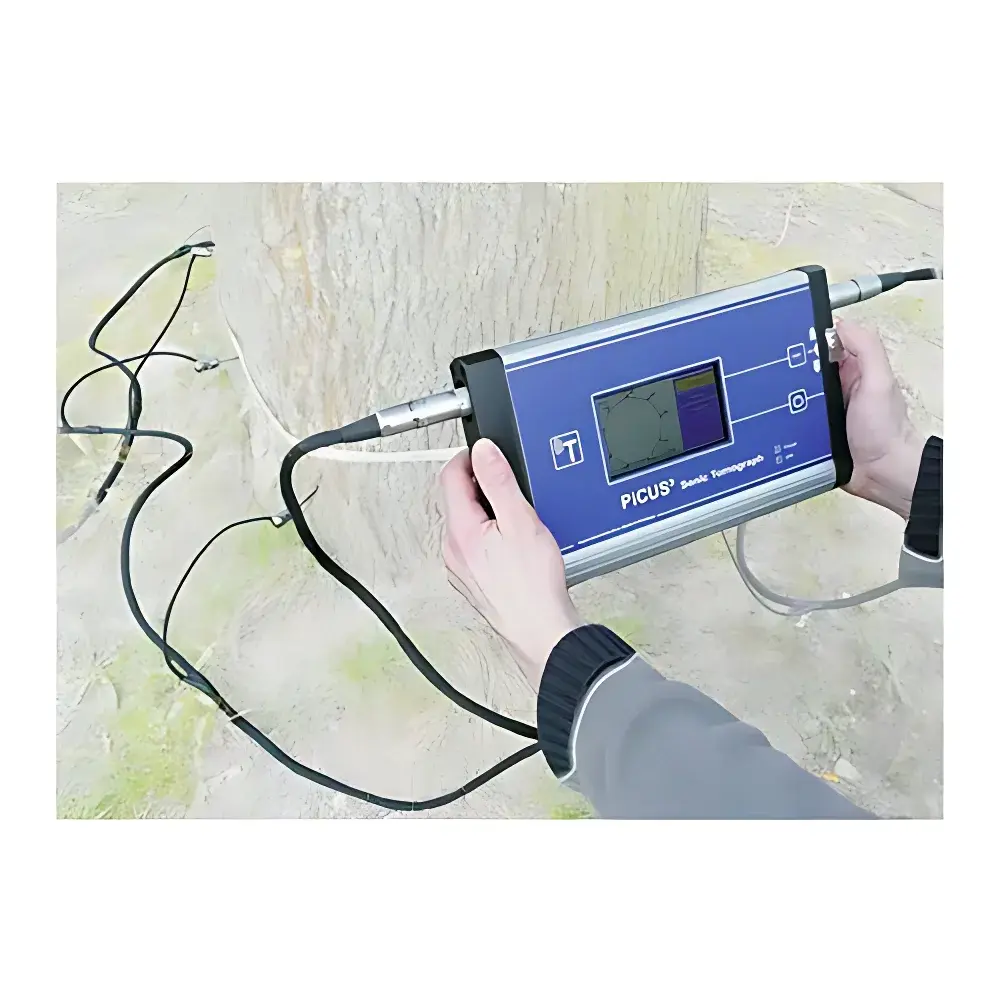
Argus PiCUS-3 Elastic Wave Tree Tomography Diagnostic System
| Brand | Argus |
|---|---|
| Origin | Germany |
| Model | PiCUS-3 |
| Sensor Count | 6 or 12 |
| Sensor Cable Length | 3.5 m |
| Measurement Principle | Elastic Wave Propagation Time-of-Flight Tomography |
| Spatial Resolution | 1 µs time resolution |
| Operating Battery Life | >6 h |
| Charging Time | 2 h |
| GPS Accuracy | 0–20 m |
| Display | Color LCD (real-time tomographic visualization) |
| Data Transfer | USB 2.0 or Bluetooth (range: 0.5–10 m) |
| Dimensions | 55 × 42 × 13 cm |
| Weight | 8.9 kg |
| Integrated Height Measurement | Yes |
| Optional Electronic Caliper Range | 160–2150 mm (stainless steel) |
Overview
The Argus PiCUS-3 Elastic Wave Tree Tomography Diagnostic System is an advanced, field-deployable non-destructive testing (NDT) instrument engineered for quantitative internal assessment of woody stems and trunks. It operates on the physical principle of elastic wave propagation tomography—specifically, time-of-flight (ToF) analysis of stress waves generated by controlled mechanical impact. When an electronic hammer strikes a predefined point on the trunk surface, compressional (P-) waves propagate through the xylem. Variations in local wood density, moisture content, and structural integrity—including decay, cavitation, or insect-induced tunneling—alter wave velocity and attenuation. By measuring arrival times across a distributed sensor array (6 or 12 geophones), the PiCUS-3 reconstructs two-dimensional cross-sectional velocity maps (tomograms) that spatially resolve sound vs. compromised tissue. Designed for arborists, forest pathologists, and urban forestry managers, it supports ISO 17225-compliant tree risk assessment protocols and integrates with EU-level tree health monitoring frameworks.
Key Features
- Real-time field tomography: On-device color LCD display renders cross-sectional velocity maps during acquisition—no external laptop required.
- Hybrid connectivity: Sensors communicate directly to the main unit via integrated electronics; no external amplifier box needed. Electronic hammer connects via Bluetooth (0.5–10 m range) or wired interface, with LED-assisted point identification and built-in NiMH battery (500 mAh).
- Flexible measurement geometry: Supports both 3-point rapid screening mode and full perimeter point-to-point acquisition for high-fidelity reconstruction.
- Integrated metrology suite: Built-in clinometer-based height measurement, embedded GPS (0–20 m accuracy), and optional stainless-steel electronic caliper (160–2150 mm range) for precise DBH and positional logging.
- Robust standalone operation: Internal storage accommodates >100 complete scan datasets; 8.9 kg total system weight enables single-operator mobility in complex terrain.
- Sub-microsecond timing fidelity: 1 µs resolution in wave arrival time measurement ensures detection of subtle velocity gradients associated with early-stage decay.
Sample Compatibility & Compliance
The PiCUS-3 is validated for use on broadleaf and coniferous species with trunk diameters from 30 cm to 5 m at measurement height—typically at breast height (1.3 m) or near-ground level where decay initiation is most frequent. Its non-invasive methodology complies with DIN EN 16772:2017 (Assessment of tree stability) and supports documentation requirements under national tree protection ordinances (e.g., German Baumschutzsatzung). Data output meets GLP-aligned traceability standards: each scan records timestamp, GPS coordinates, sensor configuration, hammer impact energy (via calibrated acceleration feedback), and raw ToF matrix—enabling retrospective reprocessing and audit-ready archiving.
Software & Data Management
Acquired data are stored natively in binary format (.picus) and exportable to ASCII CSV or GeoJSON for GIS integration. The proprietary PiCUS Software Suite (Windows-based, included) provides post-acquisition tools including SOT (Soundness Overview Tomogram), ERT-3D (Elastic Resonance Tomography volumetric rendering), and TreeSA static stability modeling. Version-controlled file handling supports FDA 21 CFR Part 11–compliant electronic signatures when used in municipal or institutional risk management workflows. Batch processing functions allow automated velocity thresholding, decay volume quantification, and longitudinal change detection across multi-year monitoring campaigns.
Applications
- Urban forestry: Prioritization of high-risk trees adjacent to infrastructure or pedestrian zones.
- Conservation biology: Monitoring decay progression in ancient or heritage trees (e.g., documented beech decline from 2004–2011).
- Plant pathology research: Correlating elastic wave anomalies with histological validation of fungal hyphal invasion or larval galleries.
- Forestry certification: Supporting FSC® and PEFC™ sustainability audits through objective, repeatable internal quality metrics.
- Arboricultural consultancy: Generating standardized reports compliant with ISA (International Society of Arboriculture) Best Management Practices.
FAQ
What physical principle does the PiCUS-3 rely on for internal assessment?
It uses time-of-flight tomography of mechanically induced elastic waves—measuring differential propagation velocities through heterogeneous xylem tissue.
Can the system operate without a computer in the field?
Yes. All acquisition, real-time visualization, storage, and basic analysis occur autonomously on the integrated main unit.
Is GPS data embedded in exported scan files?
Yes. Each dataset includes georeferenced metadata (WGS84 coordinates) and altitude-corrected elevation data.
How does the PiCUS-3 differentiate between moisture-related velocity changes and true decay?
Through multi-angle acquisition geometry and velocity gradient analysis—true decay exhibits localized, asymmetric velocity reduction uncorrelated with radial moisture gradients.
Does the system support long-term monitoring of the same tree?
Yes. Repeat scans can be registered using GPS + manual landmark alignment; software calculates Δ-velocity maps to quantify temporal deterioration rates.