
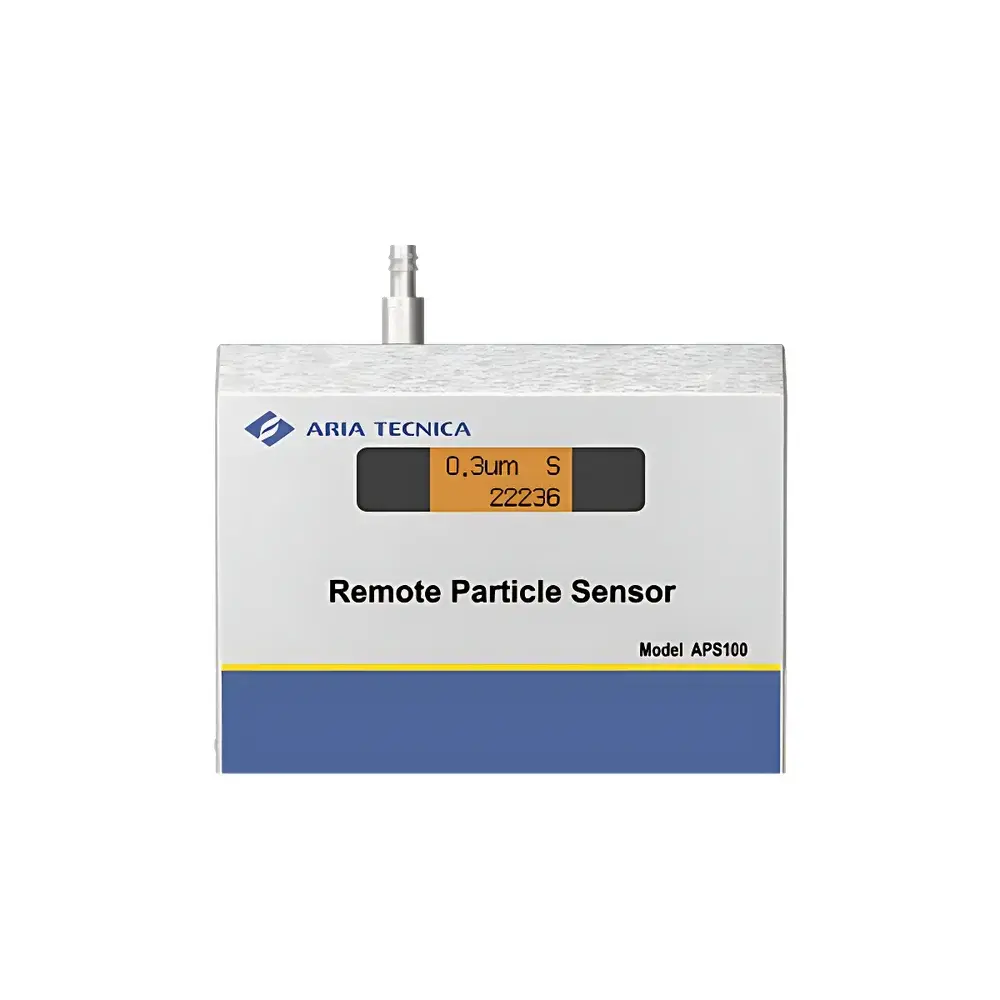
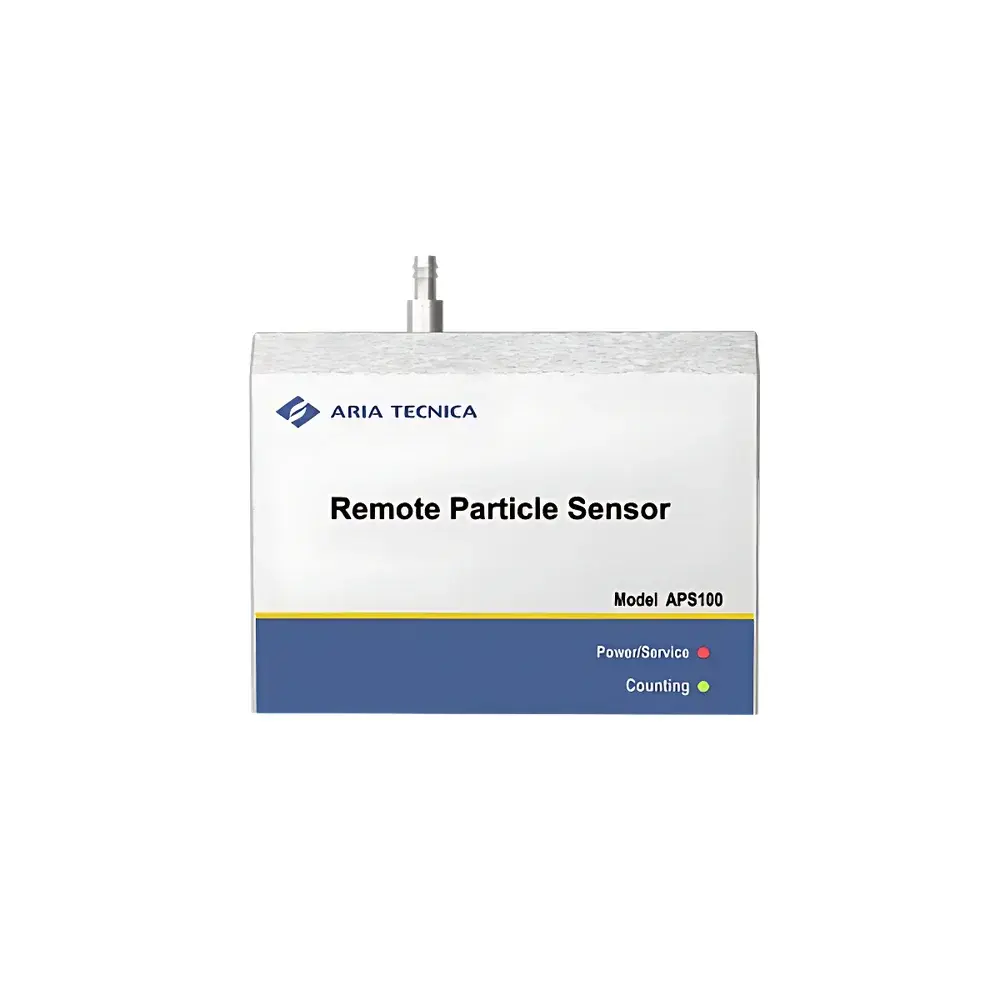
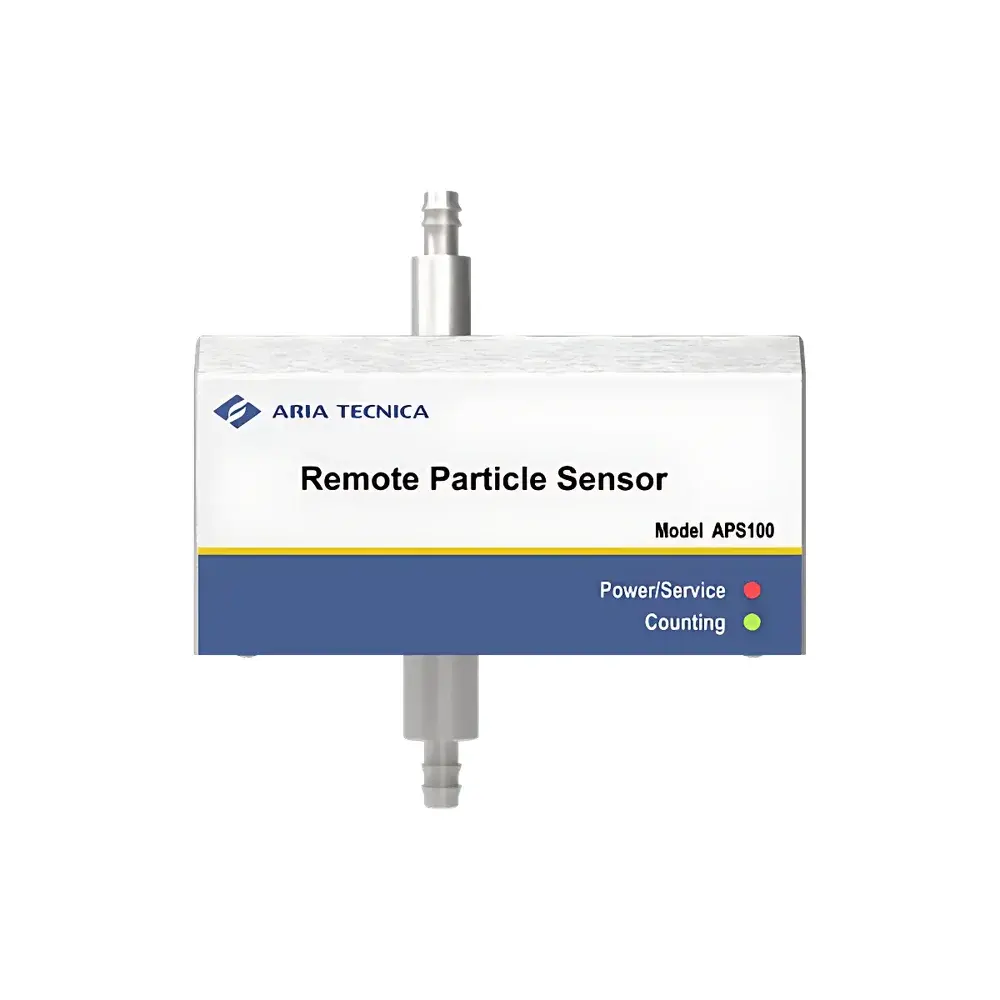
Aria APS100 Series 2.83 L/min Laser Particle Counter
| Brand | Aria |
|---|---|
| Origin | Japan |
| Model | APS100 Series |
| Flow Rate | 2.83 L/min (1 CFM) ±5% |
| Timing Accuracy | ≤±1 s over 6-min sampling |
| Repeatability | ≤±10% FS |
| Particle Size Distribution Error | ≤±30% |
| Indication Error | ≤±30% FS |
| Counting Efficiency | 0.3 μm (50±20)%, 0.5 μm (100±10)%, 1.0 μm (100±10)% |
| Max. Concentration | 5×10⁷ particles/m³ (≤10% coincidence loss) |
| Zero Count Level | <1 count per 5 minutes |
| Light Source | Long-life laser diode |
| Communication | Modbus RTU |
| Analog Output | 4–20 mA (dual-channel configurable) |
| Power Supply | 12–24 VDC |
| Operating Environment | 5–35 °C, 20–95% RH (non-condensing) |
| Housing Material | SUS316L stainless steel |
| Dimensions (APS100) | 107×56×49 mm |
| Weight (APS100) | ~420 g |
| Warranty | 2 years (excludes internal pump) |
Overview
The Aria APS100 Series is a compact, high-reliability laser particle counter engineered for continuous, real-time airborne particulate monitoring in critical environmental and controlled industrial settings. Utilizing single-particle light scattering (SPLS) principle with a long-life laser diode excitation source, the instrument detects and sizes individual particles by measuring the intensity and angular distribution of scattered light pulses. Designed for integration into cleanroom HVAC systems, pharmaceutical manufacturing environments, semiconductor fabrication facilities, and ISO Class 3–8 cleanspaces, the APS100 operates at a calibrated volumetric flow rate of 2.83 L/min (1 cubic foot per minute), meeting fundamental requirements for standardized airborne particle sampling per ISO 21501-4 and JIS B 9921. Its robust SUS316L stainless-steel housing ensures corrosion resistance and compatibility with stringent cleaning protocols, while its low-power DC input (12–24 VDC) supports flexible deployment in distributed sensor networks.
Key Features
- High-stability laser diode optical system with documented lifetime exceeding 10,000 operating hours
- Configurable multi-channel detection: 2-channel (e.g., 0.3/0.5 µm or 0.5/5.0 µm) and 4-channel (0.3, 0.5, 1.0, 5.0 µm) models available to match application-specific size thresholds
- Flow-controlled sampling at 2.83 L/min ±5%, validated via traceable calibration against NIST-traceable flow standards
- Dual analog 4–20 mA outputs (CH1/CH2), each assignable to independent particle size channels for PLC or DCS integration
- Modbus RTU serial communication protocol (RS-485) enabling remote configuration, data polling, and firmware diagnostics
- Low zero-count performance: <1 false count per 5-minute interval, verified under HEPA-filtered air conditions
- Compact form factor (as small as 107 × 56 × 49 mm) with minimal footprint—ideal for embedded installations in ductwork, fan filter units (FFUs), or laminar flow hoods
Sample Compatibility & Compliance
The APS100 Series is designed exclusively for ambient and process air sampling—no liquid or aerosolized chemical compatibility. It complies with key international standards governing particle counter performance, including ISO 21501-4:2018 (Determination of particle size distribution—Calibration and verification of airborne particle counters), JIS B 9921:2010 (Method for evaluating performance of airborne particle counters), and IEST-RP-CC007.2 (Testing Cleanrooms). While not intrinsically rated for hazardous locations, its construction meets IP54-rated ingress protection when installed with supplied dust caps and sealed conduit entries. The device supports GLP/GMP-aligned operation through optional calibration documentation packages—including NIST-traceable calibration reports and metrological chain-of-custody certificates—facilitating audit readiness for FDA 21 CFR Part 11-compliant environments.
Software & Data Management
The APS100 operates as a stand-alone sensor node without bundled proprietary software; instead, it delivers raw channel counts and status flags via Modbus registers (e.g., holding register 40001–40016 for particle counts per channel, flow status, error codes). This architecture enables seamless integration with industry-standard SCADA platforms (e.g., Ignition, Siemens Desigo, Honeywell Experion), cloud-based IIoT gateways (e.g., AWS IoT Core, Azure IoT Hub), or custom Python/C# data acquisition scripts. All analog outputs are fully scalable and linearized per channel, supporting direct connection to analog input modules in programmable logic controllers. Optional factory calibration reports include uncertainty budgets aligned with ISO/IEC 17025 requirements, and zero-count validation data is archived in the出厂 report provided with each unit.
Applications
- Continuous ISO-classified cleanroom monitoring (ISO 14644-1 compliance verification)
- In-line particle surveillance in sterile pharmaceutical filling lines and lyophilization suites
- Real-time feedback control for ULPA/HEPA filter integrity testing and leak detection
- Environmental qualification of microelectronics fabrication tools and photolithography bays
- Baseline particulate mapping during facility commissioning and periodic requalification
- Integration into building management systems (BMS) for HVAC optimization based on real-time particle load trends
FAQ
What particle size channels are supported?
The APS100 series offers two hardware configurations: 2-channel models (selectable pairs: 0.3/0.5 µm or 0.5/5.0 µm) and 4-channel models (0.3, 0.5, 1.0, and 5.0 µm). Channel selection is fixed at time of manufacture.
Is an external vacuum source required?
Yes—the APS100 requires an external vacuum pump capable of sustaining ≥38.1 cm Hg (15 in Hg) vacuum at the inlet. Internal pump variants (APS100P, APS100PD) are available but excluded from the base APS100 model.
Can the device operate unattended for extended periods?
Yes—designed for continuous 24/7 operation within specified temperature/humidity limits (5–35°C, 20–95% RH non-condensing), with mean time between failures (MTBF) exceeding 25,000 hours under typical cleanroom duty cycles.
How is calibration traceability established?
Each unit ships with a factory calibration report referencing PSL (polystyrene latex) standard particles traceable to NIST SRM 1963 and SRM 2877. Optional third-party calibration certificates are available upon request.
Does the APS100 support alarm relay outputs?
No—alarm functionality must be implemented externally via PLC logic using Modbus status registers or analog threshold comparisons in the host SCADA system.
Related Products







