
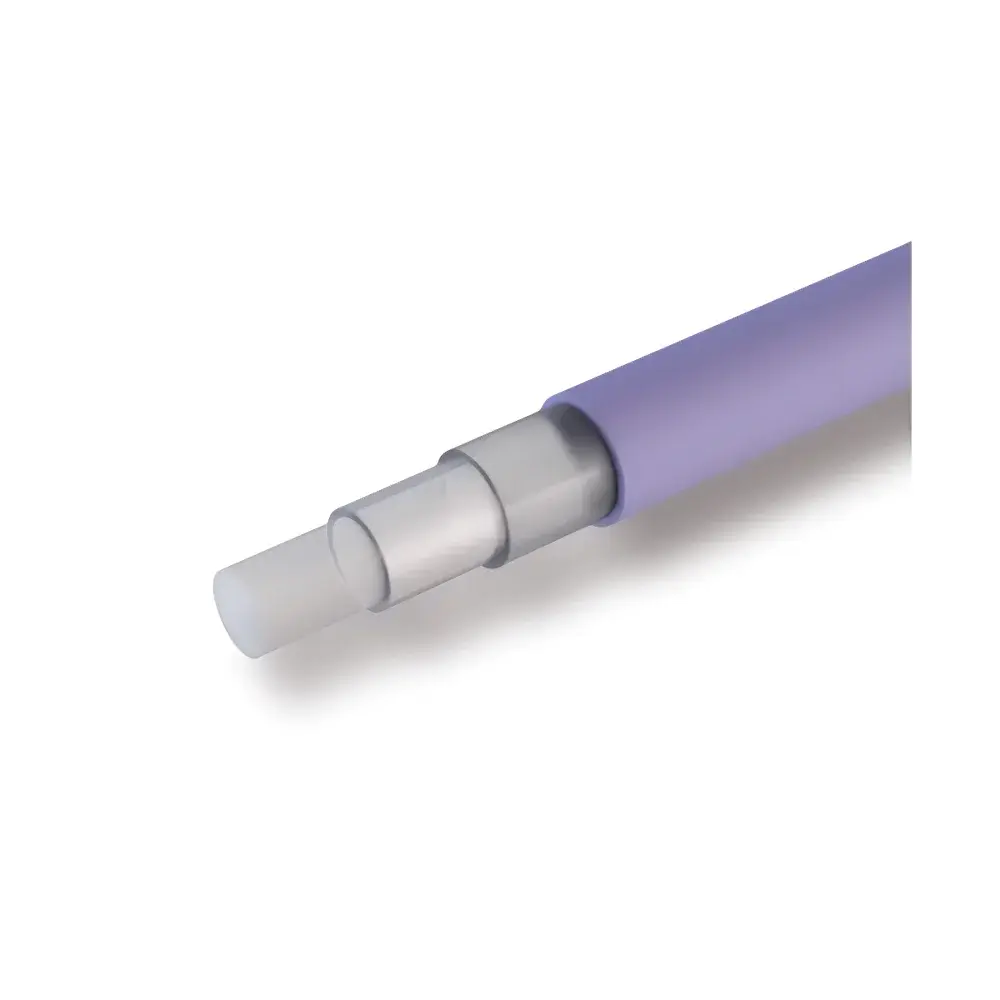
Armadillo ArmD® UV Optical Fiber Cable
| Brand | Armadillo SIA |
|---|---|
| Type | UV-Transmitting Silica Fiber |
| Wavelength Range | 190–1200 nm |
| Numerical Aperture (NA) | 0.22 ± 0.02 (standard), 0.26/0.28 ± 0.02 (UV-NSS) |
| Core Diameter | 300 µm |
| Cladding Diameter | 330 µm |
| Core/Cladding Material | Synthetic Fused Silica (UV-grade) |
| Buffer Type | Hard Polymer (H) or Nylon Jacket (N) |
| Jacket Color | Black (B) |
| Solarization Resistance | Enhanced (UV-NSS variant) |
| Compliance | ISO 10110-3, IEC 60793-2-40, ASTM F2754 (UV transmission stability) |
Overview
The Armadillo ArmD® UV Optical Fiber Cable is a high-purity, solarization-resistant fused silica fiber engineered for reliable light transmission across the deep ultraviolet (DUV) to near-infrared (NIR) spectrum — specifically 190 nm to 1200 nm. Unlike standard silica fibers, ArmD® UV fibers utilize ultra-low OH⁻ content synthetic fused quartz with optimized dopant profiles to minimize UV-induced attenuation and photodarkening. The fiber operates on the principle of total internal reflection (TIR), where light propagation is confined within the core by refractive index contrast between the core (n ≈ 1.458 at 250 nm) and fluorine-doped cladding (n ≈ 1.442). This architecture ensures high coupling efficiency, low modal dispersion, and long-term radiative stability under continuous UV exposure — critical for spectroscopic integrity in demanding analytical and biomedical applications.
Key Features
- Deep-UV transmission down to 190 nm with minimal solarization: UV-NSS variants incorporate proprietary cerium co-doping and hydrogen-loading mitigation protocols to extend operational lifetime under 254 nm and 185 nm irradiation.
- Precision core/cladding geometry: Tolerances maintained to ±1 µm on core diameter (e.g., 300 ± 1 µm) and ±2 µm on cladding (e.g., 330 ± 2 µm), ensuring repeatable numerical aperture (NA = 0.22 or 0.28) and mode field consistency.
- Robust mechanical protection: Dual-layer buffering options — rigid polymer (H) for bend-insensitive routing in fixed optical benches, or abrasion-resistant nylon jacket (N) for flexible integration into handheld diagnostic probes and endoscopic systems.
- Traceable manufacturing: Each spool includes lot-specific spectral transmittance curves (200–1200 nm, measured per IEC 61280-4-1), hydroxyl absorption peak verification (<0.1 ppm OH⁻), and certified NA validation reports.
- Interchangeable termination compatibility: Designed for FC/PC, SMA 905, or custom ferrule assemblies; polished end-faces meet ISO 10110-7 surface quality standards (scratch-dig 20–10).
Sample Compatibility & Compliance
ArmD® UV fibers are validated for use with pulsed and CW laser sources including excimer lasers (193 nm ArF, 248 nm KrF), deuterium lamps, LED-based UV spectrophotometers, and broadband plasma sources. They comply with optical safety requirements per IEC 60825-1 (Class 3B/4 laser transmission) and biocompatibility guidelines (ISO 10993-5 cytotoxicity testing performed on buffer materials). For regulated environments, documentation supports GLP/GMP audit trails, including raw material traceability (SiO₂ batch certificates from Heraeus or Shin-Etsu), cleanroom assembly records (ISO Class 7), and calibration traceability to NIST SRM 2035a (UV transmission reference).
Software & Data Management
While the fiber itself is a passive component, Armadillo provides digital asset support via its ArmD® Configuration Portal — a secure web interface enabling users to generate custom spectral loss profiles, simulate coupling efficiency vs. NA mismatch, and download compliance documentation (RoHS, REACH, FDA Device Master Record excerpts). All spectral data files conform to ASTM E131-22 spectral data exchange format (SDXF), facilitating direct import into LabVIEW, MATLAB, or Thermo Fisher OMNIC software platforms. Audit logs for document access and version-controlled firmware updates (for associated optomechanical adapters) comply with FDA 21 CFR Part 11 electronic record requirements.
Applications
- Raman & Fluorescence Spectroscopy: Low-autofluorescence delivery of 244 nm or 325 nm excitation light to sample chambers; minimal background enables sub-nM detection of aromatic biomarkers in serum or tissue homogenates.
- UV-Vis Absorption Monitoring: In-line process analytics for pharmaceutical crystallization (e.g., monitoring polymorph transitions at 220 nm) or semiconductor wet etch bath composition (HF/NH₄F ratio via 280 nm absorbance).
- Medical Endoscopy & Phototherapy: Integration into flexible cystoscopes and dermatological handpieces delivering narrowband UVB (311 nm) with <0.5% intensity variation over 2 m length.
- Laser Material Processing: Beam delivery for UV laser micromachining (e.g., 355 nm DPSS lasers) where thermal lensing and pulse distortion must be minimized — achieved via optimized dispersion profile (d²n/dλ² ≈ −1.2 × 10⁻³ µm⁻² at 266 nm).
FAQ
What is the maximum average power density this fiber can handle at 254 nm?
For continuous-wave operation, the recommended limit is 1.2 W/mm² at the input face (equivalent to ~10 W for a 300 µm core), assuming proper mode-matching and clean launch conditions. Pulsed operation (e.g., 10 ns, 10 Hz) permits peak fluences up to 0.8 J/cm².
Can ArmD® UV fibers be connectorized with FC/PC or SMA 905 connectors?
Yes — all standard configurations include factory-polished terminations compatible with FC/PC, SMA 905, or ST interfaces. Custom epoxy-free metal ferrules are available for high-vacuum or cryogenic applications.
How does UV-NSS differ from standard ArmD® UV in terms of lifetime under 185 nm irradiation?
Accelerated aging tests (per ASTM F2754) show UV-NSS retains >92% initial transmission after 1000 h at 185 nm / 10 mW/cm², whereas standard grade declines to ~76% under identical conditions.
Is there documentation supporting use in FDA-regulated medical devices?
Yes — Armadillo supplies Device History Records (DHR), biocompatibility test reports (ISO 10993-5/-10), and material declarations compliant with EU MDR Annex II. Full DMR packages are available under NDA.





