
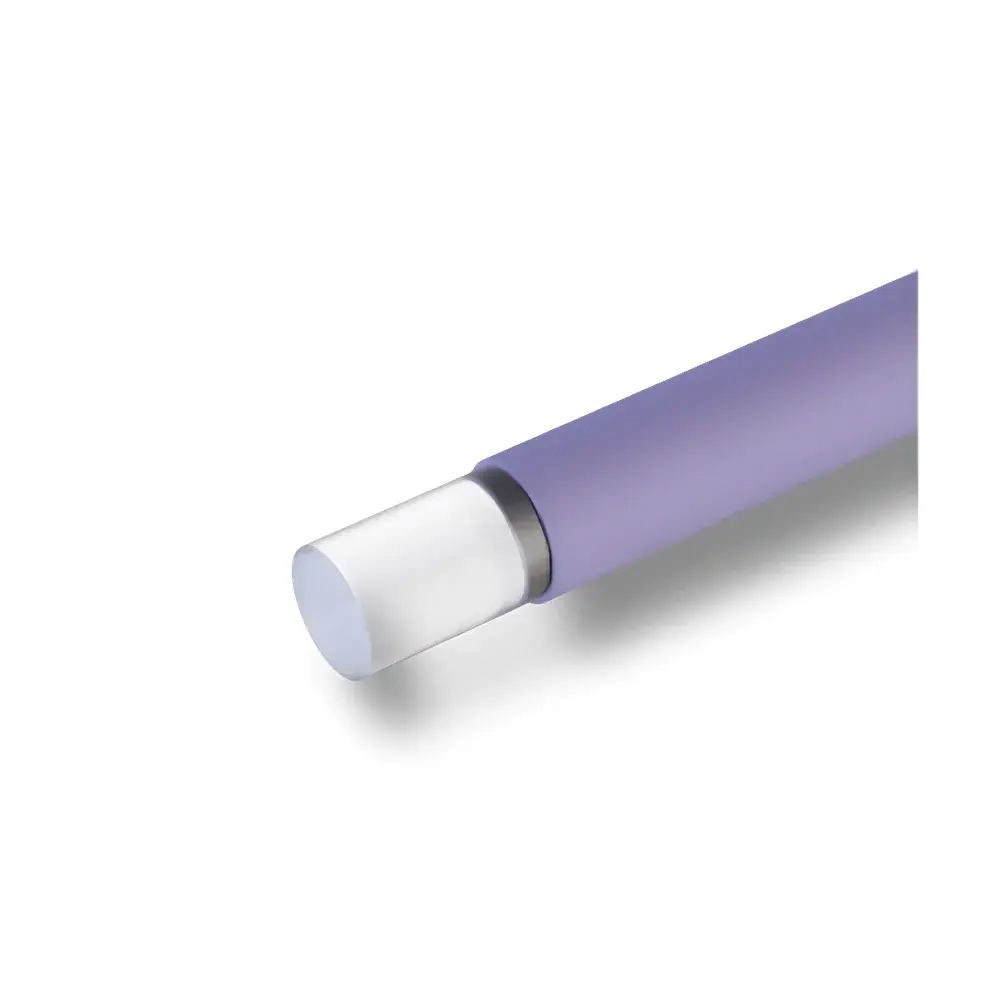
Armadillo SIA High-NA Optical Fiber Assembly
| Brand | Armadillo SIA |
|---|---|
| Type | High Numerical Aperture (NA) Multimode Fiber |
| Core Diameter | 25–3000 µm (configurable) |
| NA Range | 0.22 ± 0.02 to 0.87 ± 0.02 |
| Wavelength Range | 350–2400 nm (material-dependent) |
| Cladding Materials | Hard Polymer (HC), Silicone (UV), Germanium-doped Silica, Borosilicate Glass |
| Jacket Options | Black hard polymer buffer (H), Nylon overjacket (N) |
| Compliance | ISO 10993-5 biocompatibility tested |
| Customization | Available for core/clad geometry, length, termination, and connectorization |
Overview
Armadillo SIA High-NA Optical Fiber Assemblies are engineered for demanding photonic applications requiring high light-gathering efficiency, minimal coupling loss, and stable transmission across broad spectral bands. These fibers operate on the principle of total internal reflection within a precisely controlled refractive index gradient between core and cladding materials. With numerical apertures up to 0.87 — among the highest commercially available for silica- and polymer-based multimode fibers — they deliver exceptional étendue and angular acceptance, enabling efficient coupling from low-brightness or highly divergent sources such as LEDs, laser diodes, and broadband lamps. Designed for integration into analytical, biomedical, and industrial optical systems, these fibers maintain mechanical robustness and thermal stability under repeated bending, sterilization cycles, and extended operational duty cycles.
Key Features
- Numerical aperture tunable from 0.22 ± 0.02 to 0.87 ± 0.02, optimized for specific source matching and collection efficiency requirements
- Multi-material platform: Hard-clad polymer (HC), UV-grade silicone-jacketed, germanium-doped silica, and borosilicate glass variants — each selected for spectral transmission, biocompatibility, and environmental resilience
- Core diameters spanning 25 µm to 3000 µm, supporting both high-resolution spectroscopic sampling and high-power delivery applications
- ISO 10993-5 cytotoxicity-tested construction, validated for in vitro and non-invasive in vivo use in photodynamic therapy (PDT) and diagnostic illumination
- Standardized buffer configurations including black hard polymer (H) and nylon-reinforced (N) jackets, with custom termination options (SMA-905, FC/PC, bare fiber, or ferrule-polished ends)
- Batch-certified dimensional tolerances and NA uniformity per ITU-T G.651.1 and IEC 60793-2-10 specifications
Sample Compatibility & Compliance
These fibers are routinely deployed in regulated environments where traceability and material safety are critical. The HC and UV variants meet ISO 10993-5 biocompatibility standards for short-term mucosal and skin contact. Germanium-doped and borosilicate fibers comply with RoHS 2011/65/EU and REACH Annex XVII restrictions on hazardous substances. All assemblies undergo 100% visual inspection and spectral attenuation verification (350–2400 nm) prior to shipment. Documentation includes material declarations, NA certification reports, and batch-specific test summaries suitable for GLP/GMP audit trails. While not inherently FDA-cleared devices, the fibers serve as Class I components compliant with 21 CFR §809.10(b) for incorporation into IVD and therapeutic light delivery systems.
Software & Data Management
Armadillo SIA provides optional calibration-ready spectral response profiles (measured using NIST-traceable spectroradiometers) in CSV and HDF5 formats. These datasets support radiometric correction in downstream software environments including MATLAB, Python (SciPy/NumPy), LabVIEW, and commercial spectroscopy platforms (e.g., Ocean Insight OceanView, Avantes ASE). No proprietary firmware or driver installation is required; all fibers operate passively and integrate seamlessly into existing optical architectures. For OEM integration, Armadillo offers design-in support packages including mechanical drawings (STEP/IGES), thermal expansion coefficients, and bend-loss characterization curves at 5 mm and 10 mm radii.
Applications
- Photodynamic Therapy (PDT): High-NA delivery of 630–690 nm activation light via flexible, sterilizable HC fibers with low autofluorescence and minimal thermal load
- Remote Illumination: Coupling of broadband halogen or xenon sources to microscopes, endoscopes, and macro-imaging setups with >92% power throughput at 550 nm
- Spectroscopic Sampling: Light collection from diffuse reflectance, fluorescence, or Raman probes — especially in low-signal scenarios requiring maximal étendue
- Laser Material Processing: Delivery of pulsed or CW diode lasers (up to 50 W average power, depending on core size and NA) for localized heating, ablation, or photochemical initiation
- Environmental & Industrial Sensing: Integration into fiber-optic chemical sensors, distributed temperature sensing (DTS), and combustion diagnostics where wide-angle collection improves signal-to-noise ratio
FAQ
What is the maximum continuous power rating for these fibers?
Power handling depends on core diameter, NA, wavelength, and cooling conditions. For example, a 600 µm HC fiber at 532 nm can transmit up to 15 W CW with forced-air convection; derating applies above 800 nm due to increased OH absorption. Detailed thermal modeling data is provided upon request.
Can these fibers be autoclaved?
Hard-clad polymer (HC) variants withstand up to 5 cycles of steam sterilization (121°C, 15 psi, 20 min) without NA degradation or jacket delamination. Silicone-jacketed versions are limited to ethylene oxide or gamma irradiation (25 kGy max).
Do you offer polarization-maintaining versions?
Standard offerings are non-PM multimode fibers. Polarization-preserving designs are available as custom-engineered solutions using elliptical-core or stress-applying structures — lead time and minimum order quantities apply.
Is there documentation for regulatory submissions?
Yes. Armadillo SIA supplies technical files including ISO 10993 test reports, RoHS/REACH compliance statements, dimensional inspection records, and spectral attenuation certificates — all formatted for inclusion in 510(k), CE-IVDR, or MDR technical documentation dossiers.
How is NA measured and certified?
NA is determined per IEC 61300-3-12 using far-field intensity distribution scanning at multiple wavelengths. Each production lot includes a certificate listing mean NA, standard deviation, and measurement uncertainty (k=2, coverage factor).




