
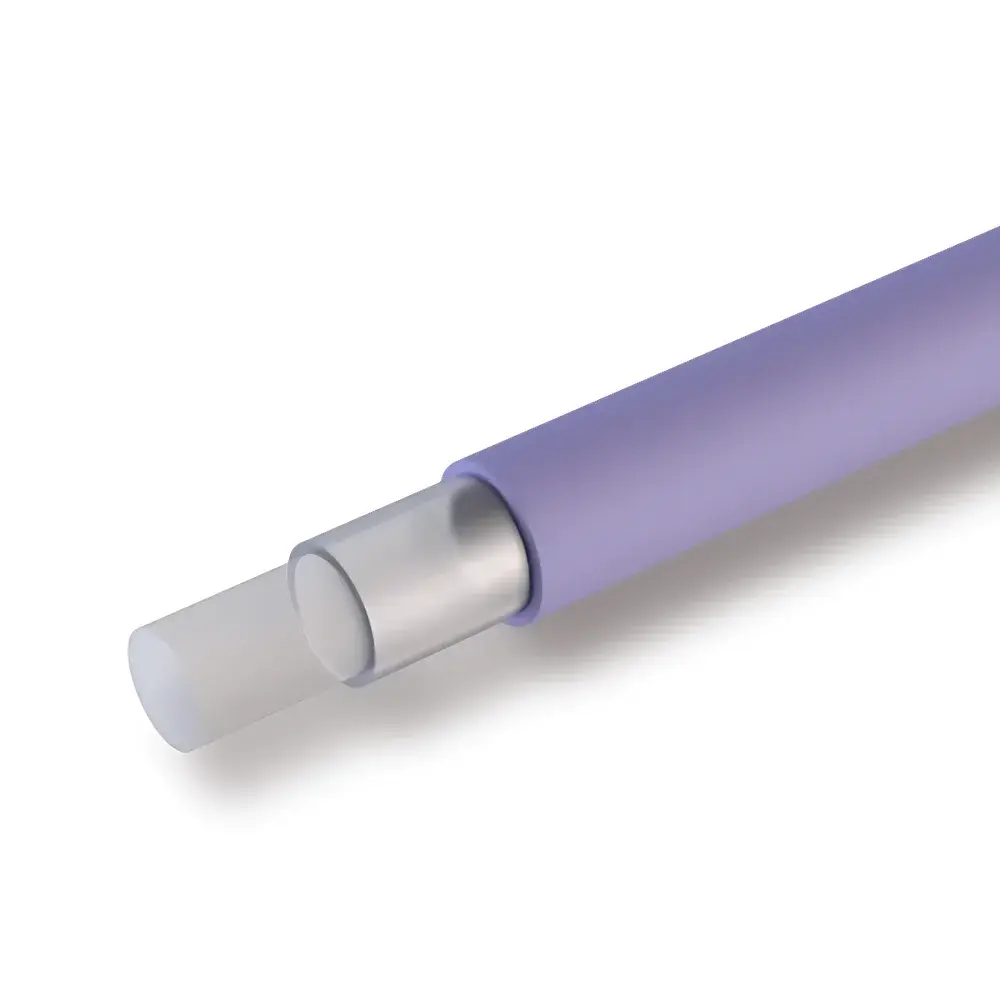
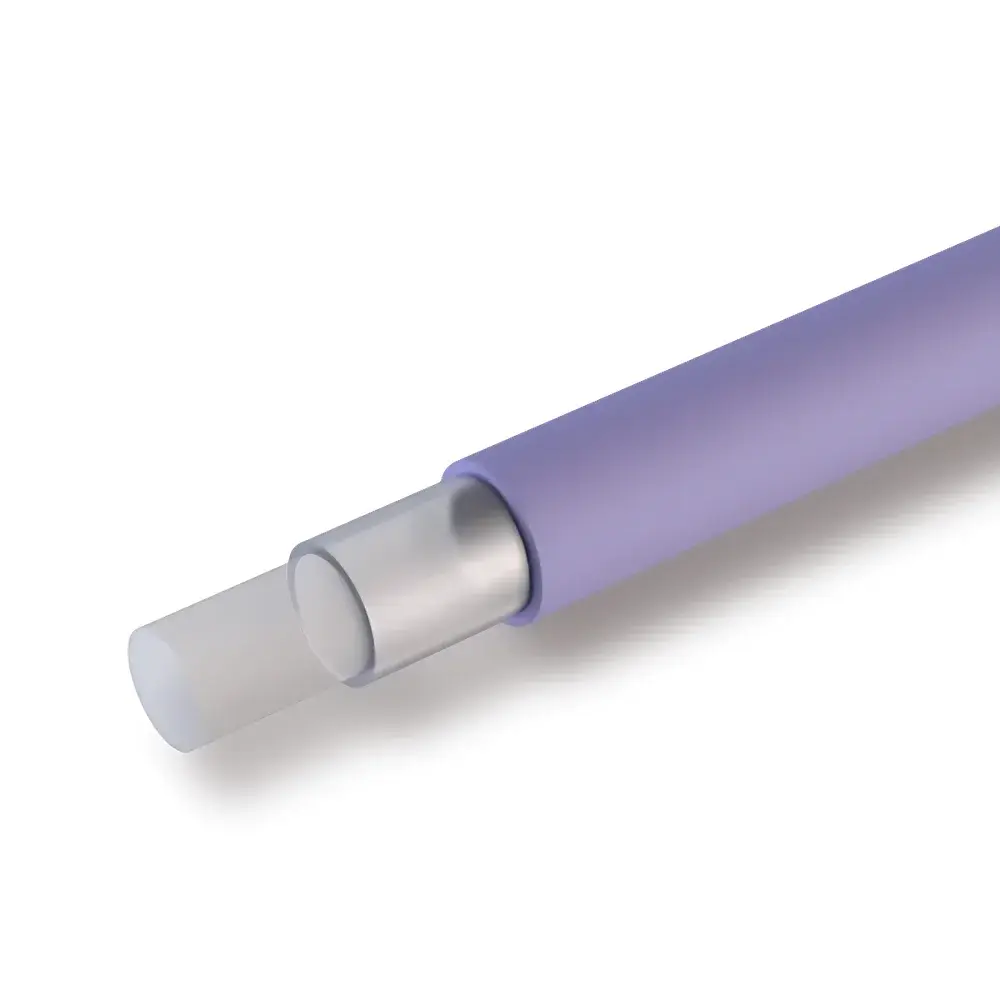
Armadillo SIA MIR3 Series Mid-Infrared Silver Halide Optical Fiber
| Brand | Armadillo SIA |
|---|---|
| Type | Silver Halide (AgCl/AgBr) Polycrystalline Fiber |
| Wavelength Range | 3–17 µm |
| Numerical Aperture | 0.13 ± 0.02 (MIR3), 0.25 ± 0.02 (MIR300/330), 0.35 ± 0.02 (custom variants) |
| Core Diameter | 20–3000 µm |
| Cladding Material | Polymeric (Hard Polymer Buffer for MIR300/330-H |
| Core/Cladding Ratio | Standardized per model (e.g., 300/330 µm) |
| Operating Temperature | Up to 80 °C (continuous), short-term up to 120 °C |
| Bend Radius | ≥15× outer diameter (static), ≥30× (dynamic) |
| Attenuation | <0.2 dB/m @ 10.6 µm (typ.), <0.5 dB/m across 4–12 µm band |
Overview
The Armadillo SIA MIR3 Series mid-infrared (MIR) optical fiber is a polycrystalline silver halide (AgClxBr1−x) waveguide engineered for high-transmission delivery of broadband infrared radiation in the 3–17 µm spectral region. Unlike silica-based fibers, which exhibit strong multiphonon absorption beyond 2.2 µm, AgCl/AgBr fibers leverage intrinsic lattice transparency in the mid-IR, enabling low-loss propagation where conventional optics fail. The fiber operates on the principle of total internal reflection (TIR) within a crystalline core surrounded by a lower-index polymeric cladding or buffer layer. Its transmission profile is particularly suited for molecular vibrational spectroscopy—where fundamental rovibrational transitions (e.g., C=O stretch at ~5.8 µm, O–H bend at ~6.3 µm, C–F stretch at ~9.5 µm) reside—and for power delivery from quantum cascade lasers (QCLs), CO2 lasers (10.6 µm), and optical parametric oscillators (OPOs). Designed for laboratory and industrial integration, the MIR3 fiber maintains mechanical flexibility while preserving thermal and chemical stability under controlled ambient conditions.
Key Features
- Ultra-low attenuation (<0.2 dB/m at 10.6 µm) across the critical 4–12 µm atmospheric window
- Polycrystalline AgCl/AgBr core with precisely controlled stoichiometry for optimized IR transparency and reduced scattering losses
- Standardized core/cladding geometries—including 300/330 µm configurations—with tight tolerances on numerical aperture (NA = 0.13–0.35)
- Hard polymer buffer (H-type) or nylon-jacketed (B-type) variants for enhanced mechanical robustness and EMI immunity
- Compatible with standard SMA-905, FC/PC, or custom ferrule terminations for seamless coupling to spectrometers, detectors, and laser sources
- Thermally stable up to 80 °C continuous operation; suitable for in-situ high-temperature process monitoring when paired with appropriate thermal shielding
Sample Compatibility & Compliance
The MIR3 fiber is compatible with gaseous, liquid, and solid-phase samples in transmission, attenuated total reflectance (ATR), and remote sensing configurations. It supports direct coupling to Fourier-transform infrared (FTIR) spectrometers, photoacoustic cells, and mercury cadmium telluride (MCT) or thermopile detectors. While not intrinsically certified for hazardous environments, its construction complies with ISO 10110-7 (optical material homogeneity) and meets RoHS Directive 2011/65/EU for restricted substances. For regulated applications—including pharmaceutical QC or environmental emissions monitoring—the fiber may be integrated into systems validated per ASTM E1421 (standard practice for FTIR quantitative analysis) or ISO 17025-accredited workflows. Documentation packages include batch-specific spectral attenuation curves and NA verification reports traceable to NIST-calibrated reference standards.
Software & Data Management
As a passive optical component, the MIR3 fiber does not incorporate embedded firmware or digital interfaces. However, it is fully interoperable with industry-standard spectroscopic data acquisition platforms—including Thermo Fisher OMNIC, Bruker OPUS, and MATLAB-based custom scripts—when used with compatible spectrometers and detectors. Armadillo SIA provides detailed coupling efficiency calculators and beam propagation models (based on scalar diffraction theory) to assist users in optimizing throughput and minimizing modal noise. All technical documentation—including spectral loss charts, bending loss nomograms, and termination alignment guides—is delivered in English PDF format with version-controlled revision history. Audit trails for calibration certificates and material safety data sheets (MSDS) are maintained per GLP-compliant record retention protocols.
Applications
- Remote MIR spectroscopy of corrosive or high-temperature industrial process streams (e.g., NH3, HCl, SO2 monitoring in flue gas)
- Fiber-coupled quantum cascade laser (QCL) delivery for standoff detection of explosives or chemical warfare agents
- Flexible endoscopic MIR imaging for biomedical tissue characterization (e.g., lipid/protein ratio mapping in ex vivo biopsies)
- Cooling-trap interfaces in atomic physics setups requiring low-background IR illumination below 10 K
- In-line quality control of polymer extrusion via real-time carbonyl index tracking at 5.8 µm
- Calibration transfer between benchtop and portable FTIR instruments using matched fiber path lengths
FAQ
Can the MIR3 fiber transmit CO2 laser radiation at 10.6 µm?
Yes—its attenuation is typically <0.2 dB/m at 10.6 µm, supporting multi-watt CW delivery with proper beam conditioning and thermal management.
Is the fiber sensitive to humidity or UV exposure?
AgCl/AgBr fibers are hygroscopic and photolabile; they must be operated and stored under dry nitrogen or argon purge, and shielded from ambient UV to prevent halide oxidation and darkening.
What is the minimum bend radius for repeated flexing?
For dynamic applications, maintain a bend radius ≥30× the outer diameter; static routing may use ≥15× OD, provided no tensile stress exceeds 5 MPa.
Are custom core diameters or NA values available?
Yes—Armadillo SIA offers tailored specifications including 50 µm, 1000 µm, and 2000 µm cores, as well as NA tuning between 0.10 and 0.40 upon request and feasibility review.
Does the fiber require special cleaning procedures?
Yes—use only anhydrous ethanol or methanol with Class 100 cleanroom-grade lint-free wipes; avoid aqueous solutions, acetone, or ultrasonic baths to prevent intergranular corrosion.




