
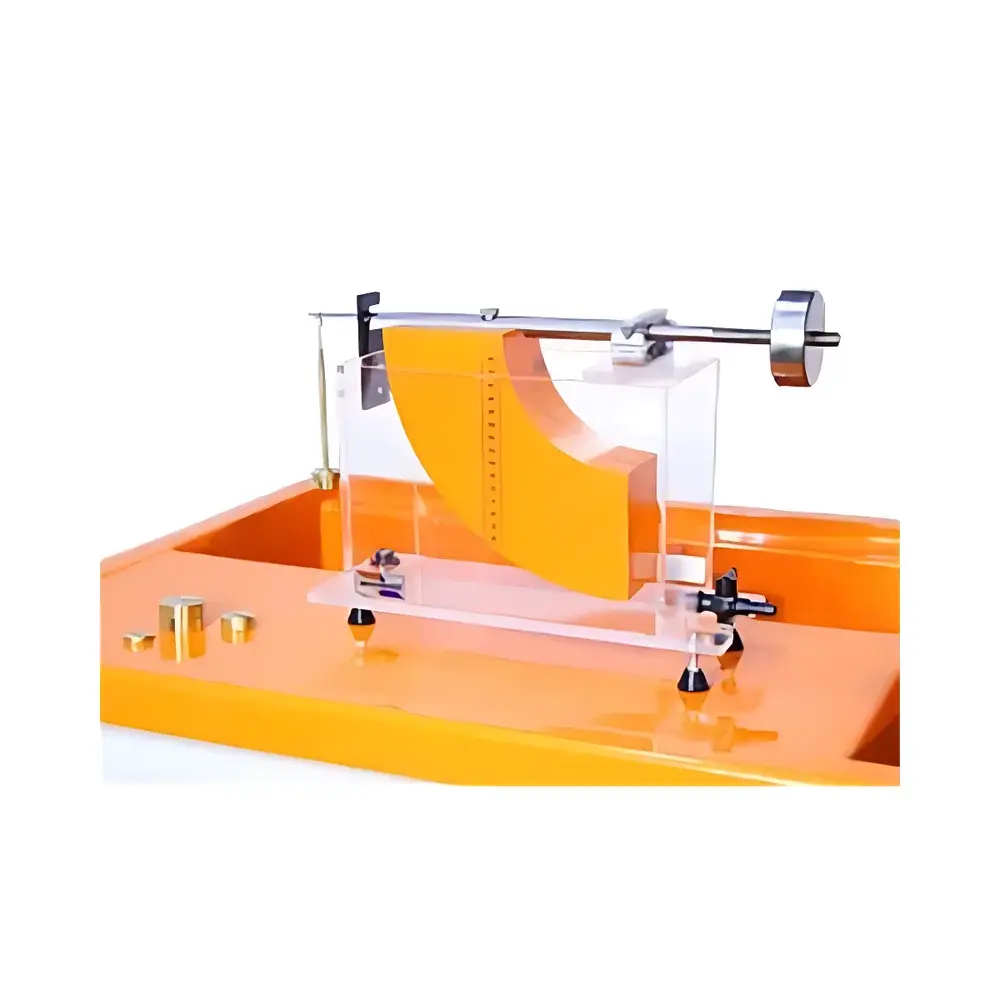
Armfield F1-12 Hydrostatic Pressure Apparatus
| Brand | Armfield |
|---|---|
| Origin | United Kingdom |
| Model | F1-12 |
| Type | Educational Hydraulics Teaching Equipment |
| Application | Fundamental Hydrostatics Laboratory Experiment |
| Compliance | Designed to ASTM D4439 / ISO 10521-1 educational verification standards |
Overview
The Armfield F1-12 Hydrostatic Pressure Apparatus is a precision-engineered teaching instrument designed for undergraduate and postgraduate fluid mechanics laboratories. It operates on the fundamental principles of hydrostatics—specifically, the distribution of pressure in an incompressible, static fluid—and enables quantitative verification of theoretical predictions regarding resultant hydrostatic force magnitude and center of pressure location on submerged planar surfaces. The apparatus features a quadrant-shaped acrylic surface mounted on a pivoting balance arm, with its pivot point precisely aligned to the center of curvature of the quadrant’s arc. This geometric alignment ensures that only the normal hydrostatic pressure acting on the vertical face contributes to the moment about the pivot—eliminating buoyancy, friction, and structural loading artifacts. The system is housed within a transparent acrylic water tank equipped with calibrated water-level markings, adjustable leveling feet, and an integrated spirit level for rigorous experimental setup reproducibility.
Key Features
- Quadrant geometry with precisely machined 200 mm radius arc and vertical flat face (100 mm height × 150 mm width) optimized for first- and second-moment-of-area calculations
- Knife-edge pivot mechanism with hardened steel bearing surface, delivering <0.02° angular resolution in balance arm positioning
- Integrated counterweight system allowing direct calibration via known mass application at defined lever arms
- Transparent acrylic tank (300 mm × 200 mm × 250 mm L×W×H) with engraved mm-scale water depth scale on quadrant side panel
- Stainless-steel drain valve and inlet port compatible with standard 8 mm ID laboratory tubing
- Adjustable leveling feet with lock-nut retention and bubble-level indicator for gravitational reference alignment
- Non-slip rubber base and rigid aluminum support frame ensuring mechanical stability during repeated student use
Sample Compatibility & Compliance
The F1-12 is intended for use with clean water as the working fluid; alternative Newtonian fluids (e.g., glycerol–water mixtures) may be employed under instructor supervision to explore density-dependent effects. The apparatus conforms to pedagogical safety requirements per BS EN 71-1:2014+A1:2018 (mechanical and physical properties) and is CE-marked for educational laboratory environments. All acrylic components meet ISO 7823-1 specifications for optical clarity and dimensional stability under sustained hydrostatic load. Experimental protocols align with ASTM D4439 Annex A1 (Hydrostatic Force Measurement) and support learning outcomes mapped to ABET Criterion 3(a)–(e), including application of integral calculus to fluid force derivation and uncertainty propagation in moment-arm measurements.
Software & Data Management
While the F1-12 is a manually operated, analog apparatus, it integrates seamlessly into modern lab curricula through optional digital augmentation. Armfield provides companion MATLAB® and Python-based data acquisition templates (available via licensed LabVIEW™ or Arduino-compatible load-cell upgrade kits). These enable time-stamped recording of mass–depth pairs, automated center-of-pressure calculation using numerical integration of pressure distribution, and statistical comparison against theoretical values (e.g., FR = ρg h̄ A; ycp = ȳ + Ixx,c/(ȳ A)). Audit trails, calibration logs, and student-submitted reports can be managed within LMS platforms compliant with IEEE 1471 documentation standards. For regulated academic environments, traceable calibration certificates (NIST-traceable mass standards) are available upon request.
Applications
- Verification of hydrostatic force magnitude on partially and fully submerged vertical plane surfaces
- Determination of center of pressure location versus theoretical prediction using parallel-axis theorem
- Experimental investigation of the effect of fluid density on resultant force and moment arm
- Quantitative error analysis comparing idealized assumptions (e.g., constant g, negligible surface tension) with measured deviations
- Foundation training for advanced topics: gate design in civil hydraulics, dam stability analysis, and subsea instrumentation packaging
- Integration into capstone projects involving sensor fusion (e.g., coupling with ultrasonic depth sensors or MEMS pressure transducers)
FAQ
Is the F1-12 suitable for research-grade hydrostatic measurements?
No—it is engineered for pedagogical accuracy and repeatability in controlled teaching labs, not metrological-grade uncertainty budgets. Its design prioritizes conceptual clarity over sub-0.5% full-scale precision.
Can the quadrant be replaced with custom geometries?
Armfield does not supply alternate quadrants; however, the mounting interface (M6 threaded holes on balance arm) permits faculty-designed inserts subject to mechanical compatibility review.
Does the apparatus include instructional manuals and lab worksheets?
Yes—comprehensive documentation includes ISO/IEC 17025-aligned calibration procedures, 8 structured laboratory exercises with pre-lab theory, step-by-step protocols, and post-lab assessment rubrics.
What maintenance is required for long-term classroom deployment?
Annual inspection of knife-edge wear, recalibration of spirit level, and verification of acrylic tank integrity against microcracking under cyclic loading.
Is the F1-12 compatible with Armfield’s larger hydraulics teaching systems (e.g., F1-10, F1-20)?
Yes—mechanical and dimensional interfaces are standardized across the F1 series, enabling modular expansion into compound hydrostatic/hydrodynamic experiments.





