
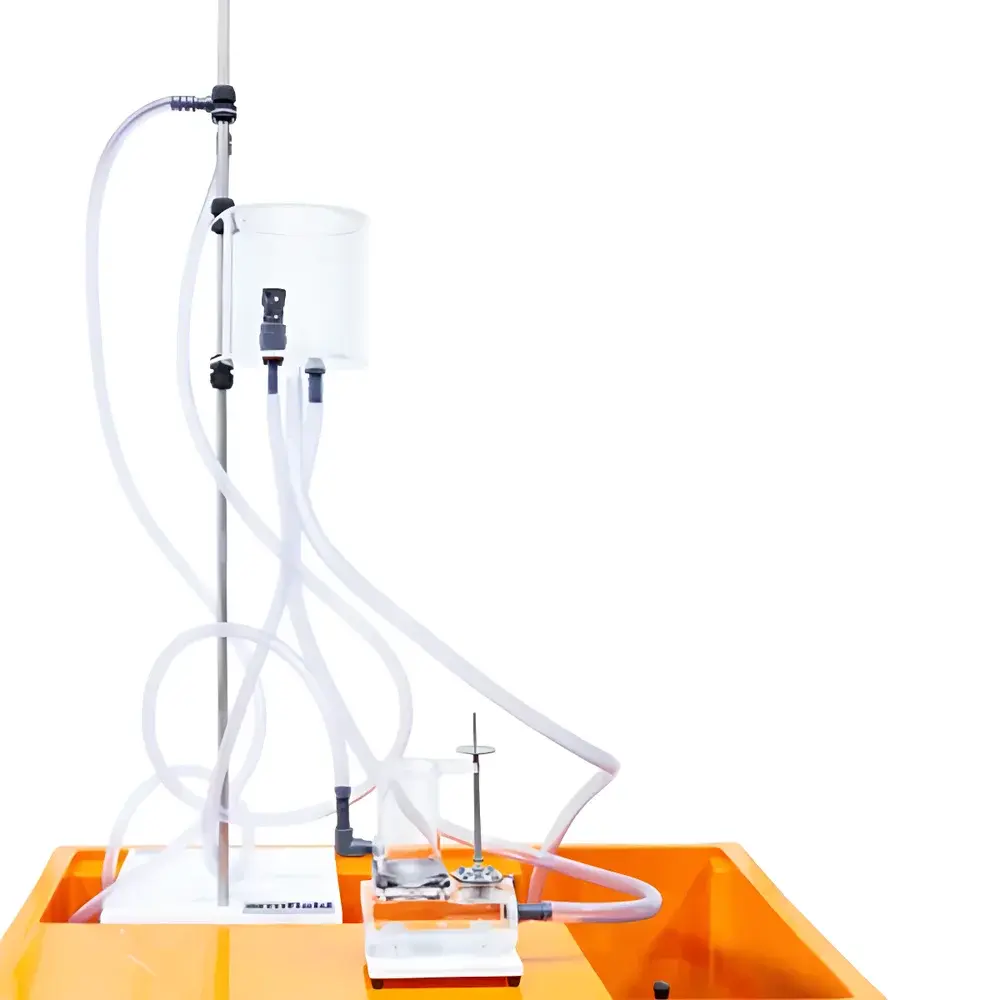
Armfield F1-24 Hydraulic Ram Pump Educational Unit
| Brand | Armfield |
|---|---|
| Origin | United Kingdom |
| Model | F1-24 |
| Construction | Transparent acrylic base with stainless steel impulse and check valves |
| Air chamber | Mounted above valve chamber to dampen pressure pulsations |
| Adjustable mass loading | Provided calibrated weights for impulse valve closure pressure tuning |
| Hydraulic supply interface | Quick-release coupling compatible with standard hydraulics workbenches |
| Accessories | Inlet/outlet flexible hoses, adjustable acrylic collection tank, optional educational software package |
Overview
The Armfield F1-24 Hydraulic Ram Pump Educational Unit is a fully transparent, bench-mounted experimental apparatus designed to demonstrate the fundamental principles of hydraulic ram pump operation—specifically, the conversion of low-head, high-flow water energy into intermittent high-head, low-flow delivery without external power input. Based on the water hammer phenomenon, the unit operates through cyclic acceleration and abrupt deceleration of water in a drive pipe, generating transient high-pressure surges that force water past a check valve into an elevated delivery system. The core physics involve momentum transfer, pressure wave propagation, and energy storage in a compressed air chamber—key concepts in unsteady open-channel and pipe flow dynamics. This device serves as a pedagogical platform for undergraduate and postgraduate courses in fluid mechanics, renewable energy systems, and sustainable water infrastructure design.
Key Features
- Optically clear acrylic construction enables real-time visualization of internal flow regimes, valve actuation sequences, and air chamber compression/expansion cycles.
- Stainless steel impulse and check valves ensure long-term corrosion resistance and mechanical repeatability under repeated hydraulic shock loading.
- Integrated air chamber mounted directly above the valve assembly functions as a pneumatic accumulator, smoothing out pressure fluctuations and stabilizing discharge flow rate.
- Calibrated stainless steel weights (supplied) allow systematic variation of impulse valve closure pressure—enabling parametric study of efficiency, cycle frequency, and lift ratio versus driving head.
- Quick-release hydraulic coupling permits rapid, leak-free connection to Armfield’s F1-10 Hydraulics Bench or equivalent laboratory-grade constant-head supply systems.
- Adjustable acrylic collection tank with graduated scale supports quantitative volumetric flow measurement and performance mapping over time.
Sample Compatibility & Compliance
The F1-24 is intended for use with clean, particle-free water at ambient temperatures (5–35 °C) and supply pressures up to 0.5 bar (gauge). It complies with BS EN ISO/IEC 17025:2017 requirements for calibration traceability of supplied weights and dimensional tolerances. All wetted components meet WRAS (Water Regulations Advisory Scheme) approval standards for potable water contact. The unit is CE-marked per Machinery Directive 2006/42/EC and conforms to IEC 61000-6-3:2019 for electromagnetic compatibility in educational laboratory environments. No hazardous materials are used in construction; all acrylic parts comply with ISO 7823-1 for optical clarity and impact resistance.
Software & Data Management
An optional Windows-based educational software package is available for data acquisition, real-time visualization, and performance analysis. The software interfaces via USB to analog sensors (pressure transducer, flow meter, and solenoid valve position feedback) and supports synchronized logging at up to 100 Hz. It provides preconfigured experiment templates aligned with ABET-accredited fluid mechanics learning outcomes—including determination of volumetric efficiency, hydraulic efficiency, and dimensionless cycle period correlation. Audit trails, user authentication, and export to CSV/PDF formats support GLP-compliant reporting. Software validation documentation is provided upon request and conforms to FDA 21 CFR Part 11 requirements for electronic records in academic research settings.
Applications
- Experimental validation of water hammer theory (Joukowsky equation) and surge pressure prediction models.
- Investigation of ram pump efficiency dependence on drive pipe length/diameter ratio, supply head, and air chamber volume.
- Comparative analysis of passive pumping systems for off-grid rural water supply in low-infrastructure contexts.
- Integration into capstone design projects focused on decentralized renewable energy harvesting from gravity-fed sources.
- Development of control logic for hybrid systems combining ram pumps with solar-powered booster stages.
- Case studies in historical engineering solutions—e.g., 19th-century irrigation systems and early hydro-mechanical automation.
FAQ
What is the minimum recommended drive head for stable operation?
A minimum static head of 0.5 m is required to initiate reliable cycling; optimal performance occurs between 1.0 m and 3.0 m drive head.
Can the unit operate continuously for extended durations during lab sessions?
Yes—the F1-24 is rated for continuous duty up to 8 hours per session, with thermal stability maintained via passive convection cooling of the air chamber.
Is the air chamber pre-charged, or must it be manually pressurized?
The chamber contains ambient air at atmospheric pressure; no manual charging is required—compression occurs naturally during each pumping cycle.
Are replacement valves or acrylic components available as spare parts?
Yes—Armfield supplies OEM-certified spare kits (F1-24-SK1), including stainless steel valve assemblies and dimensionally matched acrylic subassemblies, with full technical drawings provided.
Does the optional software support third-party sensor integration?
The software API allows integration of calibrated analog inputs (0–10 V or 4–20 mA) from external pressure, flow, or temperature sensors via standard DAQ hardware.




