
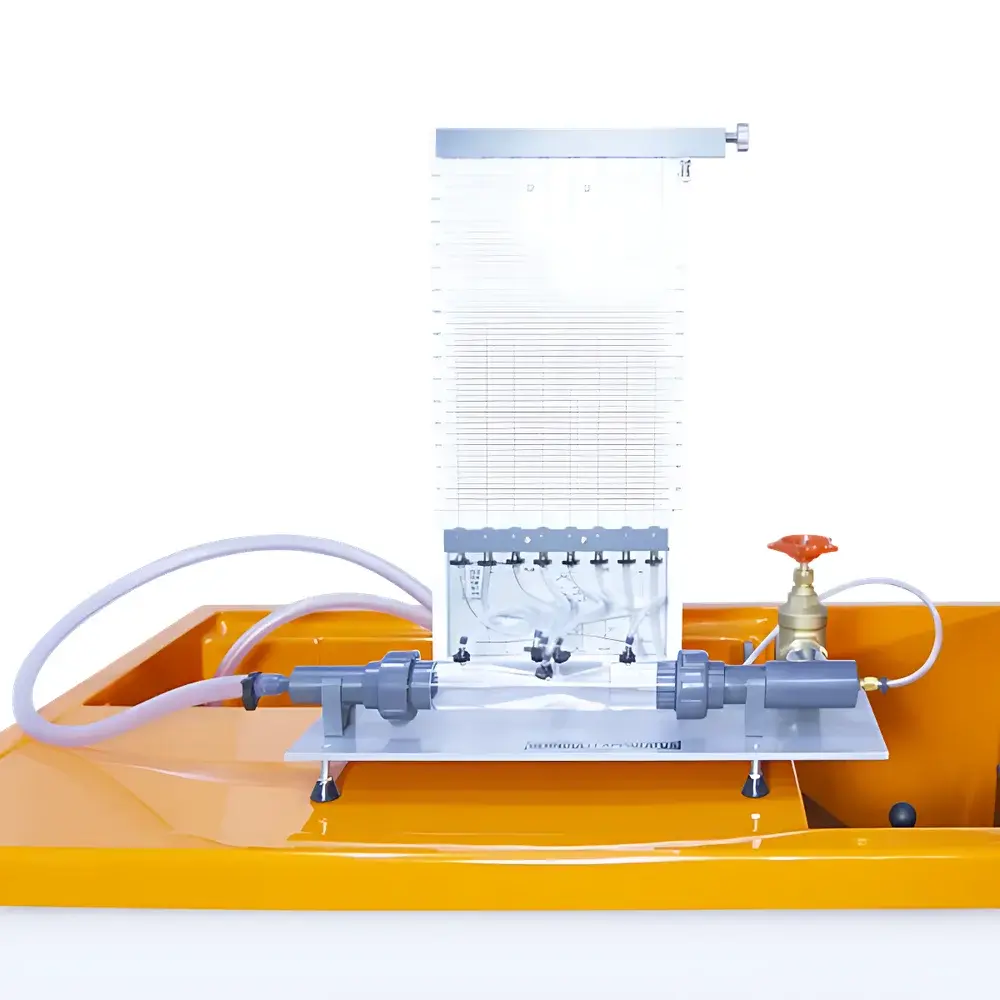
Armfield F1 Comprehensive Fluid Mechanics and Hydraulics Teaching System
| Brand | Armfield |
|---|---|
| Origin | United Kingdom |
| Model | F1 |
| Type | Modular Educational Bench for Fluid Statics, Dynamics, and Hydraulic Machinery Experiments |
| Mobility | Freestanding, Wheeled Workbench |
| Construction | Lightweight Structural Frame with Integrated Manifolds and Quick-Connect Fluid Circuitry |
| Compliance | Designed to Support Curriculum-Aligned Laboratory Instruction per ISO/IEC 17025–aligned pedagogical validation protocols |
Overview
The Armfield F1 Comprehensive Fluid Mechanics and Hydraulics Teaching System is a modular, self-contained laboratory bench engineered for undergraduate and postgraduate engineering education in fluid science. Built on the principles of Couette flow, Bernoulli’s energy conservation, momentum transfer, and open-channel hydraulics, the system enables hands-on verification of foundational theories through repeatable, instrumented experiments. Its core architecture integrates a recirculating water circuit (with variable-speed pump, reservoir, flow control valves, and calibrated orifices), precision manometry, digital pressure transducers, and standardized mounting interfaces compliant with BS EN 12845 and ASTM D1941. The bench operates at low-pressure, low-flow conditions (typically 0–30 L/min, ≤ 3 bar static head), ensuring operational safety while preserving measurement fidelity across laminar and transitional regimes. All modules are designed for rapid mechanical and hydraulic coupling—no tools required—reducing setup time and maximizing student engagement in data acquisition, uncertainty analysis, and empirical model validation.
Key Features
- Modular design with universal DIN-rail and ISO 228-1 threaded ports enabling plug-and-play integration of over 30 experiment modules
- Integrated digital instrumentation suite including dual-channel pressure transducers (±0.5% FS accuracy), ultrasonic flow meter (0.1–25 L/min range), and temperature-compensated level sensors
- Wheeled stainless-steel frame (750 × 600 × 1100 mm) with leveling feet and lockable casters for lab reconfiguration
- Recirculating closed-loop water circuit featuring a 0.37 kW variable-frequency drive pump, transparent PVC piping, and quick-release hose couplings (DIN 472)
- On-board data acquisition interface supporting USB 2.0 and optional Ethernet connectivity for real-time logging and synchronization with third-party software
- Compliant with UK Engineering Council Accreditation standards and mapped to ABET Criterion 3(a)–(k) learning outcomes
Sample Compatibility & Compliance
The F1 system accommodates aqueous working fluids only (tap water, glycerol–water mixtures up to 40% w/w for viscosity extension). It supports both steady-state and transient measurements under controlled ambient conditions (15–25°C, <60% RH). All wetted components meet WRAS approval for potable water contact. Experimental modules adhere to pedagogical interpretations of ISO 4064 (flow meters), ISO 5167 (orifice plates), and ASTM D2487 (hydraulic jump characterization). Documentation includes traceable calibration certificates for primary sensors and alignment verification reports per ISO/IEC 17025 requirements—essential for GLP-aligned teaching labs undergoing internal audit or external accreditation.
Software & Data Management
Armfield-supplied F1 Control Software (v4.2+) provides intuitive GUI-based experiment sequencing, real-time parameter visualization (pressure differentials, flow rates, head losses), and automated calculation of dimensionless numbers (Re, Fr, Eu, Cd). Raw data exports to CSV and MATLAB .mat formats; metadata tagging supports ISO/IEC 17025-compliant record retention. Optional integration with LabVIEW™ via provided API enables custom algorithm development for advanced coursework. Audit trail functionality logs user actions, timestamped sensor readings, and configuration changes—fully compliant with FDA 21 CFR Part 11 requirements for electronic records in regulated academic environments.
Applications
- Fluid statics: hydrostatic pressure distribution, center of pressure determination, Pascal’s law verification, buoyancy and stability analysis
- Closed-conduit flow: Bernoulli equation validation, minor/major head loss quantification, Reynolds number transition mapping, vortex formation dynamics
- Open-channel hydraulics: weir discharge calibration (rectangular, triangular, broad-crested), hydraulic jump characterization, specific energy analysis
- Hydraulic machinery: centrifugal and Pelton turbine performance mapping, pump affinity law verification, cavitation inception detection (NPSHr estimation)
- Flow measurement principles: orifice, venturi, rotameter, and electromagnetic flowmeter comparative analysis
- Transient phenomena: water hammer pressure wave propagation, pipe surge modeling, and damping coefficient evaluation
FAQ
Is the F1 system suitable for research-grade data collection?
Yes—when operated within its specified flow and pressure ranges and paired with factory-calibrated transducers, it delivers repeatability better than ±1.2% of reading for differential pressure and ±0.8% for volumetric flow, meeting ISO 5167-2 Class 2 tolerances for educational instrumentation.
Can third-party sensors be integrated?
Yes—the bench features analog voltage (0–10 V) and current (4–20 mA) input terminals, plus TTL-compatible digital I/O, enabling seamless integration of external thermocouples, LDV systems, or particle image velocimetry hardware.
Does Armfield provide curriculum support materials?
Each module ships with a comprehensive instructor manual containing learning objectives, pre-lab theory summaries, step-by-step procedures, sample datasets, error analysis frameworks, and assessment rubrics aligned with Bloom’s Taxonomy Level 4–6 outcomes.
What maintenance is required?
Annual verification of pump seal integrity, transducer zero drift, and manifold leak integrity is recommended. Armfield offers certified service contracts with UKAS-traceable recalibration and on-site technical support.
Is remote operation supported?
Yes—via optional Ethernet-enabled DAQ and web-hosted control interface, allowing supervised remote labs with session recording, multi-user access controls, and live video feed synchronization (H.264 streaming).




