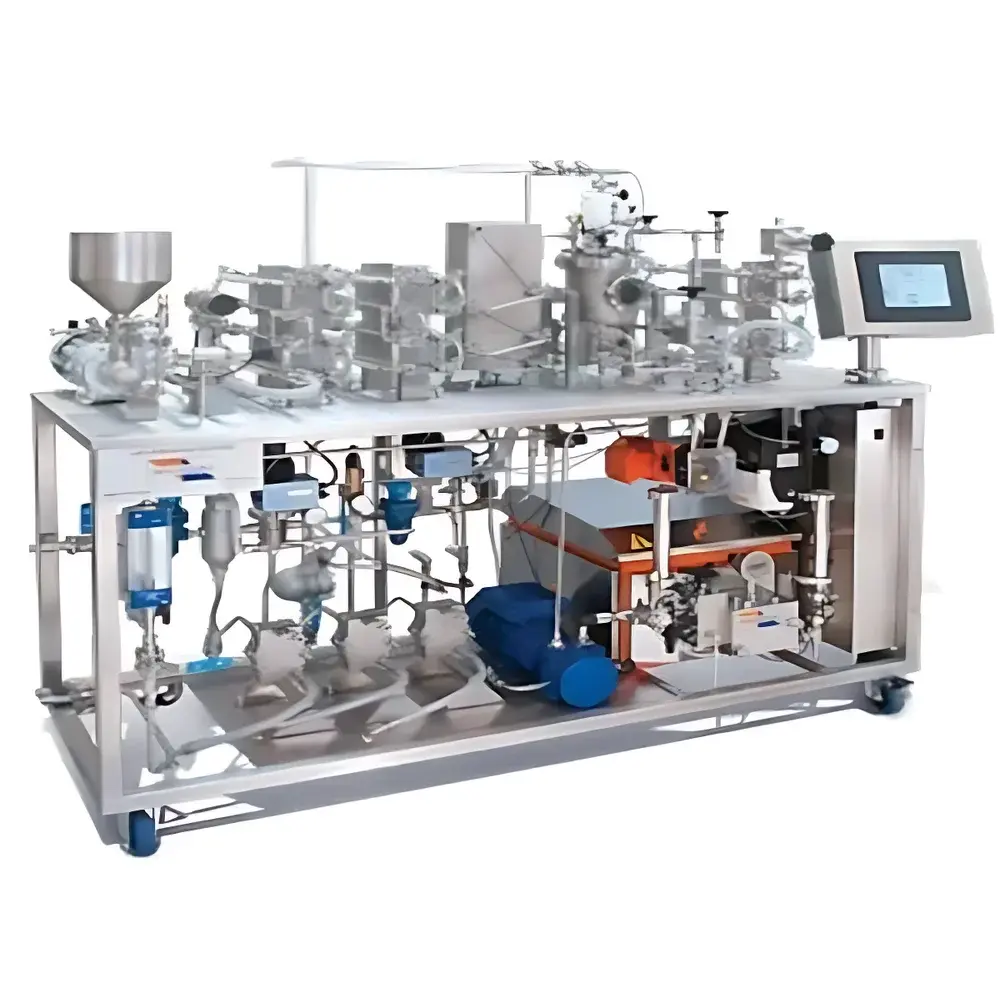
Armfield FT174X Modular Ultra-High Temperature Short-Time (UHT) Sterilization System
| Brand | Armfield |
|---|---|
| Origin | United Kingdom |
| Model | FT174X |
| Flow Rate | 12–60 L/h (water-equivalent) |
| Max Processing Temperature | >150 °C |
| Heating Methods | Direct steam injection (DSI) and/or indirect (tubular & plate heat exchangers) |
| Sterilization Mode | Aseptic processing capable |
| Configuration | Modular, reconfigurable via sanitary quick-connect fittings and flexible product tubing |
| Control Interface | Touchscreen HMI with stage-based operator prompts |
| Optional Modules | In-line homogenizer, pre-heater, condenser, CIP system, USB data logging, electronic flow meter |
| Compliance | Designed to meet hygienic design principles per EHEDG Guideline Doc. 8 and 3-A Sanitary Standards 01-05 |
Overview
The Armfield FT174X is a fully modular, bench-scale Ultra-High Temperature Short-Time (UHT) and High-Temperature Short-Time (HTST) thermal processing system engineered for precision teaching, pilot-scale process development, and aseptic validation studies in academic food science laboratories and R&D facilities. It operates on fundamental principles of continuous-flow thermal sterilization—where liquid or low-viscosity products are heated rapidly to ≥150 °C for precise residence times (typically 2–15 seconds for UHT), held in a sterile hold tube, then cooled under aseptic conditions. The system’s architecture supports both direct steam injection (DSI) for rapid, energy-efficient heating with minimal thermal degradation, and indirect heating via interchangeable tubular or plate heat exchangers—enabling comparative study of heat transfer efficiency, fouling behavior, and product quality retention across configurations.
Key Features
- Fully modular design with standardized 1.5-inch tri-clamp sanitary connections and food-grade silicone product tubing, enabling rapid reconfiguration between HTST, UHT, homogenization, and aseptic filling workflows.
- Dual heating capability: integrated direct steam injection module (with steam quality monitoring) and removable tubular/plate heat exchanger cartridges—each independently instrumented for temperature, pressure, and flow.
- Touchscreen human-machine interface (HMI) with stage-gated operation logic: automatically guides users through startup, sterilization, production, and shutdown sequences with real-time alerts for critical parameter deviations (e.g., hold-tube temperature drop, flow interruption).
- Low product hold volume (<1.2 L total system wetted volume) minimizes thermal stress and ensures representative residence time distribution—critical for kinetic modeling of microbial inactivation (e.g., F0, B* values) and enzyme denaturation studies.
- Optional integrated homogenizer (up to 1500 bar) allows investigation of post-sterilization particle size stabilization and fat globule disruption in dairy and plant-based emulsions.
- Embedded Clean-in-Place (CIP) circuit with programmable temperature, flow, and chemical concentration profiles—validated for removal of proteinaceous and carbohydrate-based residues per ISO 15883-5 and 3-A SSI 01-05 requirements.
Sample Compatibility & Compliance
The FT174X accommodates Newtonian and mildly non-Newtonian liquids with viscosity up to 200 mPa·s at 20 °C and particulate content ≤1 mm diameter (e.g., fruit pulp suspensions, broth-based media, flavored milk). Its hygienic construction complies with EHEDG Doc. 8 (2022) for equipment design, 3-A Sanitary Standards 01-05 (2023) for surface finish (Ra ≤ 0.8 µm), and FDA 21 CFR Part 11 readiness when paired with optional USB data logging and audit-trail-enabled software. All wetted materials are AISI 316L stainless steel, EPDM gaskets, and USP Class VI-certified elastomers—ensuring suitability for pharmaceutical excipient processing and clinical nutrition formulation.
Software & Data Management
The embedded control system records time-stamped process variables—including inlet/outlet temperatures (±0.3 °C), product flow rate (±1% FS), steam pressure, and hold-tube dwell time—at 1 Hz resolution. Data export via USB interface generates CSV files compatible with statistical process control (SPC) platforms (e.g., Minitab, JMP) and thermal process calculation tools (e.g., USDA’s Thermal Process Simulator). Optional firmware upgrade enables electronic signature capture, user-level access control, and automated generation of ALCOA+ compliant records (Attributable, Legible, Contemporaneous, Original, Accurate, Complete, Consistent, Enduring, Available).
Applications
The FT174X serves as a pedagogical and experimental platform for validating thermal death kinetics of Geobacillus stearothermophilus spores, Bacillus subtilis, and Escherichia coli in model systems; optimizing shelf-life extension of acidified beverages (pH 4.6); evaluating Maillard reaction progression in infant formula; and developing aseptic processing parameters for cell-culture media and probiotic suspensions. Its scalability supports correlation studies with industrial-scale UHT lines (e.g., Tetra Pak, SPX Flow), making it integral to food engineering curricula accredited by IFT and IFST.
FAQ
Can the FT174X be validated for regulatory submissions (e.g., FDA, EFSA)?
Yes—when operated with documented IQ/OQ protocols, calibrated sensors traceable to NIST standards, and integrated data logging, it meets foundational requirements for thermal process validation under FDA Guidance for Industry: “Thermal Processing of Low-Acid Foods in Hermetically Sealed Containers” and EFSA’s Q&A on UHT processing.
Is third-party calibration support available?
Armfield provides UKAS-accredited calibration certificates for all primary sensors (PT100 RTDs, Coriolis flow meters, pressure transducers) upon request; annual recalibration services are offered via authorized European service centers.
What training resources accompany the system?
The delivery package includes instructor-led onsite commissioning, a comprehensive SOP manual aligned with ISO/IEC 17025, and access to Armfield’s eLearning portal featuring video modules on DSI thermodynamics, hold-tube residence time distribution analysis, and CIP cycle optimization.