
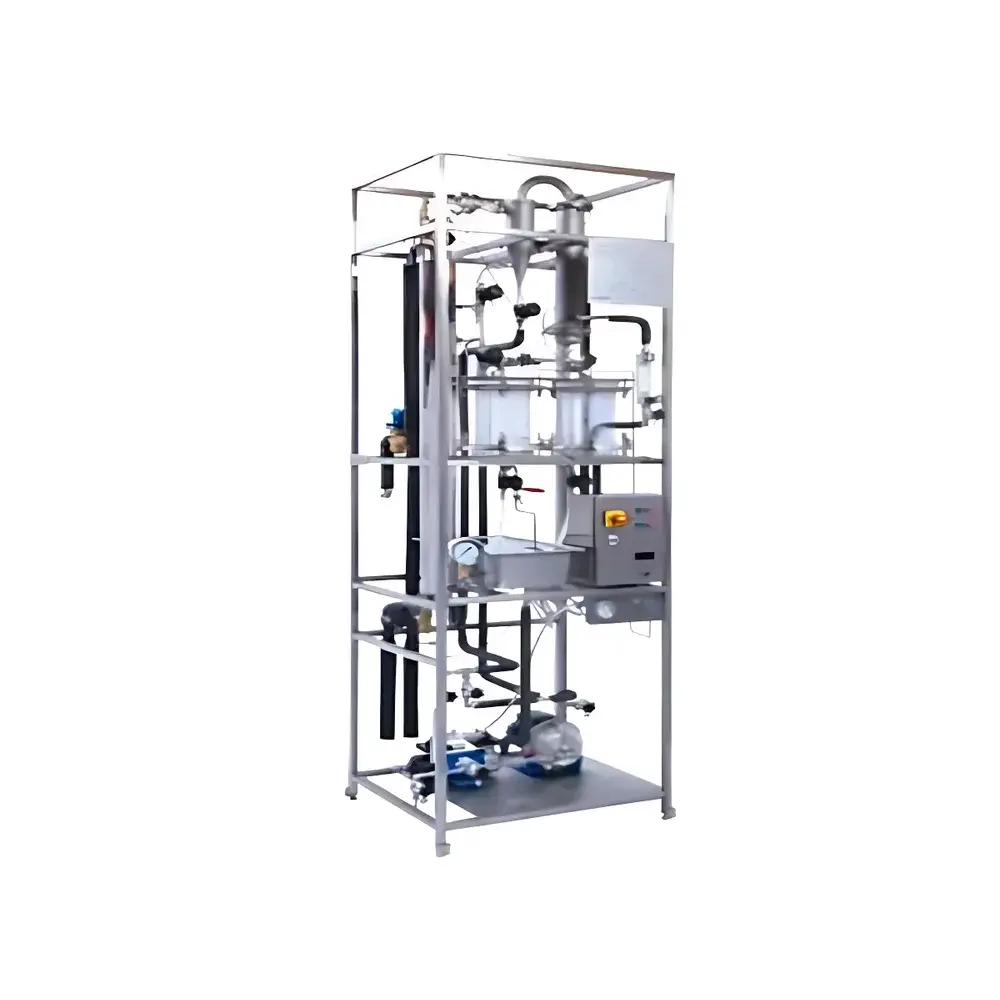
Armfield FT22 Rising Film Evaporator
| Brand | Armfield |
|---|---|
| Origin | United Kingdom |
| Model | FT22 |
| Evaporator Tube Length | 1.36 m |
| Heat Transfer Area | 0.08 m² |
| Evaporation Rate | 10 L/h |
| Steam Consumption | 15 kg/h |
| Operating Steam Pressure | 1.7 bar |
| Condenser Area | 0.17 m² |
| Feed Tank Capacity | 30 L |
| Concentrate Tank Capacity | 5.0 L |
| Condensate Tank Capacity | 5.0 L |
| CIP Pump Flow Rate | 8 L/min (20 ft H₂O) |
| System Vacuum | 225 mmHg |
| Power Supply (FT22-A) | 220–240 V / 1-phase / 50 Hz / 3 kW |
| Power Supply (FT22-B) | 120 V / 1-phase / 60 Hz / 3 kW |
| Height | 2.6 m |
| Width | 0.78 m |
| Depth | 0.65 m |
| Gross Weight | 330 kg |
| Shipping Volume | 2.40 m³ |
Overview
The Armfield FT22 Rising Film Evaporator is a compact, laboratory-scale thermal concentration system engineered for precise, low-volume processing of heat-sensitive liquid foods and functional ingredients. It operates on the principle of thin-film, countercurrent rising-film evaporation: feed solution enters the bottom of a vertical heated tube, where rapid vaporization induces upward flow under laminar-to-transitional flow conditions—forming a thin, high-velocity film along the inner wall. This configuration minimizes residence time (typically <60 seconds), reduces thermal degradation, and ensures high product integrity during concentration. Designed for pilot-scale process development and formulation optimization, the FT22 supports quantitative evaluation of evaporative efficiency, fouling behavior, and thermal stability under controlled vacuum and steam pressure conditions—making it an essential tool in dairy, juice, plant-based beverage, and nutraceutical R&D laboratories.
Key Features
- Single-tube stainless-steel evaporator with 1.36 m active heating length and 0.08 m² effective heat transfer area
- Controlled evaporation capacity of 10 L/h at nominal operating conditions (1.7 bar steam pressure, 225 mmHg absolute vacuum)
- Integrated Clean-in-Place (CIP) system featuring a dedicated 8 L/min centrifugal pump (20 ft H₂O head), enabling full internal sanitation without disassembly
- Dual-tank configuration: 30 L feed tank and 5.0 L concentrate tank, both fitted with level sensors and temperature monitoring ports
- Condenser with 0.17 m² surface area, optimized for efficient vapor recovery and minimal entrainment under sub-atmospheric operation
- Modular electrical architecture supporting dual voltage configurations (FT22-A: 220–240 V/50 Hz; FT22-B: 120 V/60 Hz), each rated at 3 kW total input power
- Structural footprint of 0.78 m (W) × 0.65 m (D) × 2.6 m (H), designed for integration into ISO-classified or GMP-aligned lab environments
Sample Compatibility & Compliance
The FT22 accommodates Newtonian and mildly non-Newtonian aqueous solutions typical of dairy permeates, fruit concentrates, whey protein hydrolysates, botanical extracts, and low-viscosity plant milks (≤50 mPa·s at 20°C). Its sanitary-grade 316L stainless-steel wetted surfaces comply with EHEDG Guideline Doc. 8 (2022) for hygienic equipment design and meet ASME BPE-2021 surface finish requirements (Ra ≤ 0.8 µm). All instrumentation—including pressure transducers, PT100 temperature probes, and level switches—conforms to IEC 61508 SIL 2 functional safety standards. When equipped with the optional FT22-90IFD data acquisition interface, the system supports audit-ready data logging compliant with FDA 21 CFR Part 11 (electronic records and signatures) and EU Annex 11 (computerized systems), including user authentication, change tracking, and immutable timestamped archives.
Software & Data Management
The FT22-90IFD interface module provides real-time bidirectional communication between the evaporator’s PLC and host Windows OS (Windows 98 through Windows XP, with legacy driver support extendable via virtual machine deployment). Acquired parameters include steam pressure, shell-side temperature, feed flow rate, vacuum level, concentrate density (via optional densitometer integration), and CIP cycle status. Data is logged at user-configurable intervals (1–60 s) and exported in CSV or Excel-compatible formats for downstream statistical analysis (e.g., ANOVA of evaporation efficiency across batch runs) or integration into LIMS platforms. The software includes built-in calculation tools for log-mean temperature difference (LMTD), overall heat transfer coefficient (U-value), and specific steam consumption (kg steam/kg water evaporated)—enabling direct correlation with thermodynamic models and scale-up projections per AIChE guidelines.
Applications
- Concentration kinetics studies of thermolabile bioactives (e.g., anthocyanins, lactoferrin, enzymes) under defined thermal history profiles
- Fouling resistance assessment of novel food matrices using repeated evaporation–CIP cycles with gravimetric deposit quantification
- Process validation for low-volume sterile concentrate production aligned with USP <1211> and ISO 22000:2018 requirements
- Design-of-experiments (DoE) trials evaluating interaction effects of steam pressure, vacuum level, and feed concentration on final solids content and color retention
- Training platform for undergraduate and postgraduate food engineering curricula covering mass/energy balances, heat transfer coefficients, and vacuum system dynamics
FAQ
What is the minimum recommended feed volume for stable rising-film operation?
A continuous feed volume of ≥5 L is required to maintain hydrodynamic stability in the evaporator tube; below this threshold, film continuity degrades and dry-wall heating risk increases.
Can the FT22 operate under full vacuum (≤10 mbar abs)?
The base configuration achieves 225 mmHg (~300 mbar abs); deeper vacuum requires cascaded vacuum pumping (e.g., FT22-VAC add-on), with maximum sustainable vacuum limited by boiling point depression and pump capacity.
Is sterilization-in-place (SIP) supported?
No—SIP is not implemented; only CIP is validated. Sterilization must be performed offline via autoclaving of removable components or chemical sporicidal treatment.
Does Armfield provide IQ/OQ documentation packages?
Yes—comprehensive Installation Qualification (IQ) and Operational Qualification (OQ) protocols are available upon request, aligned with ASTM E2500-13 and ISPE Baseline Guide Vol. 5 (2022).
What materials contact the product stream?
All wetted parts are 316L stainless steel; gaskets are FDA-compliant EPDM; sight glasses are borosilicate glass (DIN 7080); no elastomers contact product above 60°C.






