
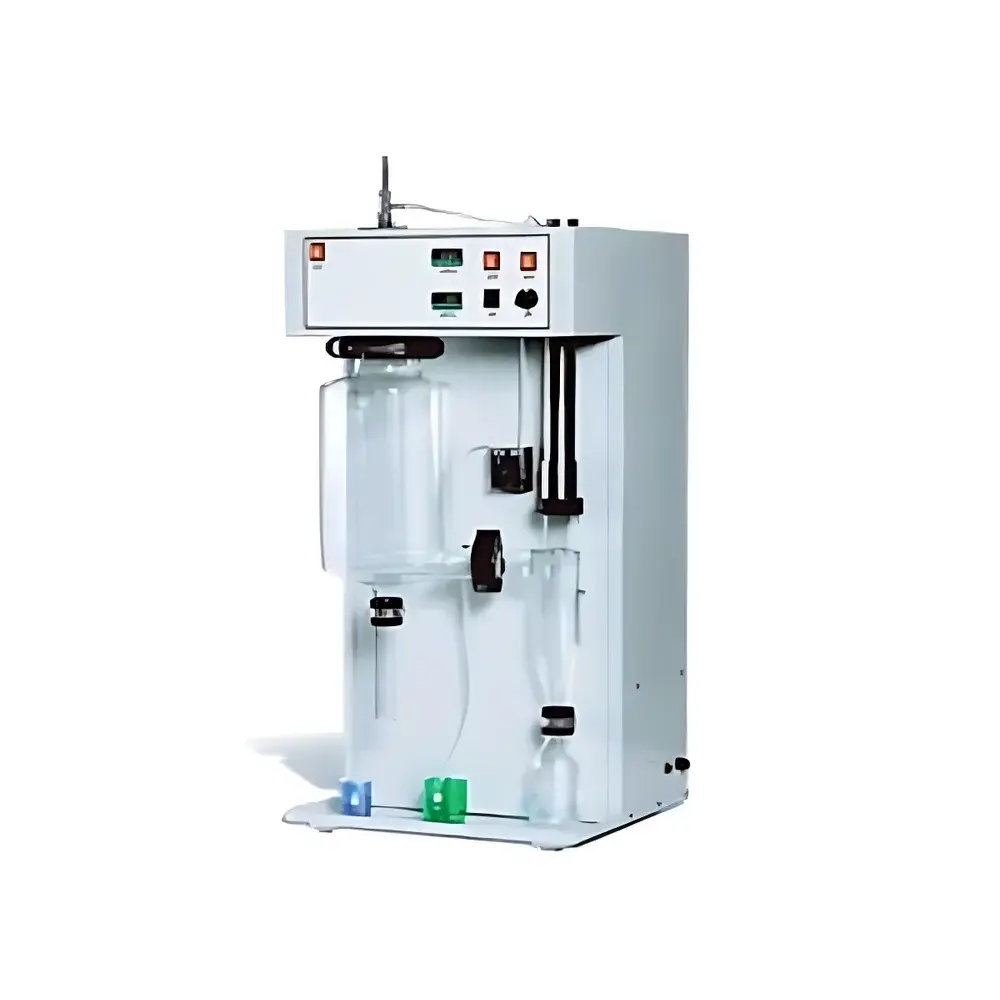
Armfield FT30MKIII Benchtop Spray Dryer
| Brand | Armfield |
|---|---|
| Origin | United Kingdom |
| Model | FT30MKIII |
| Construction | All-Glass Enclosure |
| Design Type | Benchtop Laboratory Spray Dryer |
| Observation Capability | Real-Time Visual Monitoring of Drying Process |
| Feed Capacity | Up to 500 mL/h (Typical Aqueous Solutions) |
| Inlet Temperature Range | 40–220 °C (Adjustable in 1 °C Increments) |
| Outlet Temperature Range | 30–120 °C |
| Atomization | Two-Fluid Nozzle (Compressed Air-Assisted) |
| Drying Chamber Diameter | 120 mm |
| Collection Efficiency | >95% for Particles >1 µm |
| Power Supply | 230 V AC, 50/60 Hz |
Overview
The Armfield FT30MKIII is a precision-engineered benchtop spray dryer designed for laboratory-scale development, formulation optimization, and process feasibility studies in pharmaceutical, food, chemical, and materials science research. It operates on the principle of flash evaporation—where a liquid feed solution or suspension is atomized into fine droplets within a heated drying chamber; rapid solvent removal yields dry, free-flowing microparticles in a single continuous step. Unlike industrial-scale units, the FT30MKIII features an all-glass construction—including cylindrical drying chamber, cyclonic separator, and collection vessel—enabling unobstructed optical access throughout the entire drying cycle. This transparency supports real-time visual assessment of atomization quality, droplet trajectory, wet wall formation, powder deposition dynamics, and agglomeration behavior—critical parameters for troubleshooting and mechanistic understanding.
Key Features
- All-glass fluid path and chamber assembly ensures full visibility and eliminates metal contamination risks—ideal for sensitive APIs, probiotics, or high-purity nanomaterials.
- Two-fluid nozzle system with independent control of feed flow rate (0.1–500 mL/h) and atomizing air pressure (0.5–4 bar), enabling reproducible droplet size distribution (Dv₅₀ ≈ 10–30 µm, dependent on formulation).
- Digital PID-controlled inlet temperature regulation (40–220 °C) with ±1 °C accuracy and fast thermal response, facilitating precise thermal history management for heat-labile actives.
- Integrated outlet temperature monitoring with automatic feedback to inlet heater—maintains consistent product moisture content and minimizes thermal degradation.
- Benchtop footprint (W × D × H: 450 × 400 × 750 mm) and low power demand (<1.5 kW) allow deployment in standard fume hoods or ISO Class 5–7 cleanroom-adjacent lab spaces.
- Modular design supports optional upgrades including inert gas (N₂) purge kit, electrostatic particle collector, and chilled feed pump for thermosensitive emulsions.
Sample Compatibility & Compliance
The FT30MKIII accommodates aqueous, alcoholic, and low-boiling organic solvent-based feeds (e.g., acetone, ethanol, dichloromethane), subject to appropriate ventilation and explosion-proof configuration per IEC 60079. It is routinely employed for drying proteins (e.g., insulin, lysozyme), polymers (PLGA, HPMC), ceramic precursors (alumina, titania sols), and functional food ingredients (vitamin C, anthocyanins). The unit complies with CE marking requirements (2014/30/EU EMC Directive, 2014/35/EU LVD Directive) and meets mechanical safety standards per EN 61000-6-2/6-4. While not certified as GMP-compliant out-of-the-box, its design supports audit readiness for GLP environments—traceable temperature logs, manual calibration records, and documented cleaning procedures align with FDA 21 CFR Part 11 data integrity expectations when paired with validated SOPs.
Software & Data Management
The FT30MKIII operates via a dedicated front-panel interface with real-time display of inlet/outlet temperatures, feed rate, airflow, and run time. Analog outputs (0–10 V DC) are provided for external data acquisition systems (e.g., LabVIEW, SCADA). Optional Armfield DataLogger software enables time-synchronized recording of up to eight process variables at 1 Hz resolution, exportable to CSV or Excel for statistical analysis (e.g., ANOVA of particle yield vs. inlet temperature). All logged data include operator ID, timestamp, and instrument serial number—supporting ALCOA+ principles (Attributable, Legible, Contemporaneous, Original, Accurate) required under GxP frameworks.
Applications
- Pharmaceutical: Production of inhalable dry powders (DPIs), amorphous solid dispersions (ASDs), and nanoparticle carriers for controlled release.
- Food Science: Encapsulation of flavors, probiotics, and omega-3 oils; production of instant beverage powders with improved solubility and shelf stability.
- Materials Engineering: Synthesis of spherical metal oxide microspheres for battery cathodes or catalyst supports.
- Academic Research: Fundamental studies of droplet evaporation kinetics, glass transition effects during drying, and morphology–process parameter correlations using SEM/TEM cross-validation.
FAQ
Can the FT30MKIII handle organic solvents safely?
Yes—when equipped with the optional explosion-proof electrical package and operated under nitrogen purge, it supports Class I, Division 2 solvent handling per NFPA 497.
What is the typical particle size range of dried products?
Dependent on feed properties and operating conditions, median particle diameters typically fall between 2 and 20 µm, with narrow distributions achievable via nozzle optimization and controlled residence time.
Is the glass chamber resistant to thermal shock during rapid temperature changes?
The borosilicate 3.3 glass components are rated for thermal gradients up to 120 °C and undergo factory annealing to minimize stress-induced fracture risk.
Does Armfield provide IQ/OQ documentation templates?
Yes—validated qualification protocols (including sensor calibration certificates, temperature mapping reports, and performance verification tests) are available upon request for GMP-aligned installations.
Can the unit be integrated into automated lab platforms?
Via RS-232/RS-485 serial interface and analog I/O, the FT30MKIII supports bidirectional communication with central LIMS or robotic sample-handling systems.





