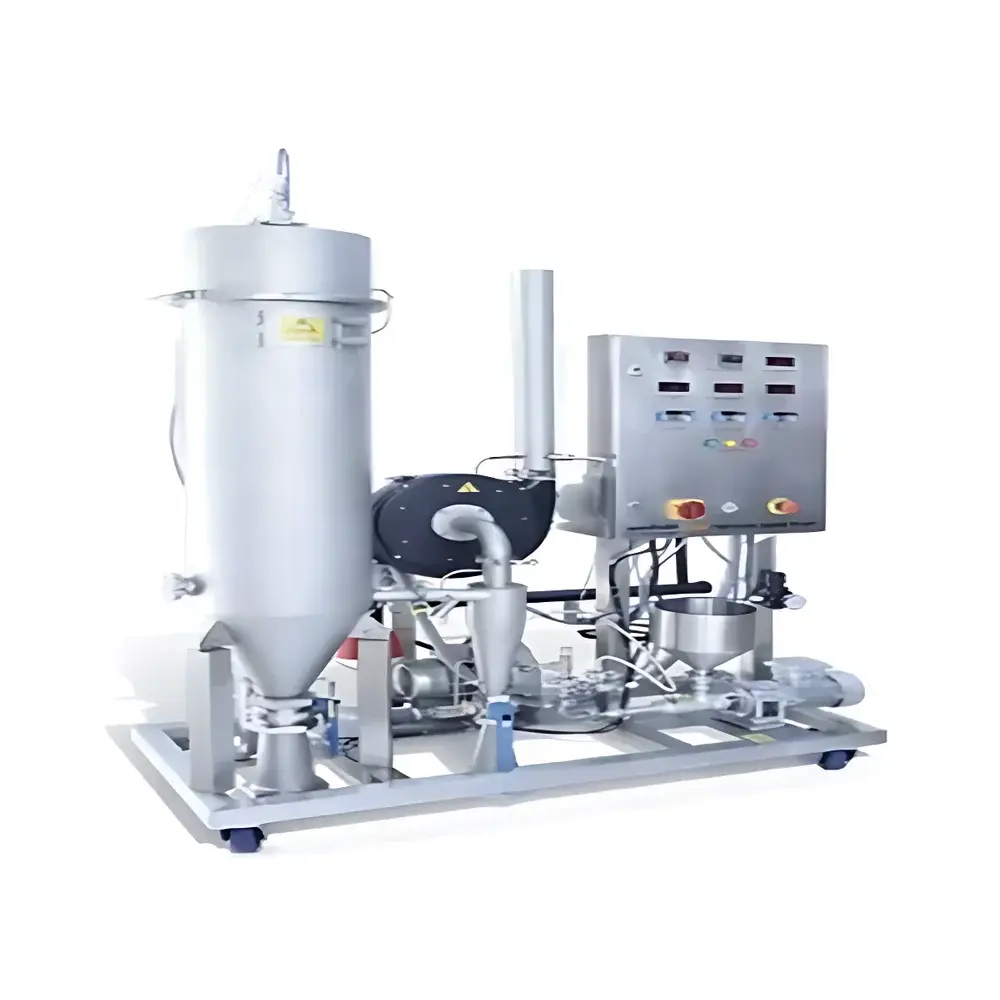
Armfield FT80/81 Tower-Type Spray Dryer and Spray Cooler
| Brand | Armfield |
|---|---|
| Origin | United Kingdom |
| Model | FT80/81 |
| Configuration | Dual-mode (Spray Drying or Spray Cooling) |
| Chamber Aspect Ratio (Height | Diameter): 3:1 |
| Discharge Section | Conical |
| Atomization | Twin-Fluid Nozzle System (Co-current & Counter-current Configurable) |
| Air Handling | Independently Variable-Speed Inlet & Exhaust Fans |
| Filtration Option | Bag Filter Kit Available |
| Monitoring | Integrated Relative Humidity Sensor at Inlet |
| Safety | Spark Arrestor on Inlet Fan |
| Enclosure Rating | IP65 Control Console |
| Data Logging | Full Parameter Recording with USB/PC Export Capability |
| Noise Level | Low-Noise Operation |
| Cleanability | Tool-Free Disassembly for Inspection & Cleaning |
| Mobility | Compact, Wheeled Base Design |
| Compliance Support | Designed for GLP-aligned lab environments |
Overview
The Armfield FT80 Tower-Type Spray Dryer and FT81 Tower-Type Spray Cooler represent a purpose-engineered dual-mode laboratory-scale platform for thermal processing of small-batch liquid feeds into free-flowing powders or solidified granules. Based on the fundamental principles of rapid evaporative drying (FT80) and controlled convective cooling solidification (FT81), this system leverages tower geometry—characterized by a 3:1 height-to-diameter ratio and conical discharge section—to optimize residence time distribution, particle trajectory control, and phase separation efficiency. Unlike conventional benchtop spray units constrained by fixed airflow orientation, the FT80/81 employs a configurable twin-fluid nozzle assembly that supports both co-current and counter-current gas–liquid contact modes. This enables precise manipulation of thermal history: co-current operation minimizes thermal stress on heat-sensitive biologics (e.g., enzymes, probiotics, monoclonal antibody formulations), while counter-current mode extends droplet dwell time in the hot zone for enhanced moisture removal in robust materials such as ceramic precursors or food-grade starches.
Key Features
- Dual-function architecture: One physical unit operates interchangeably as either a spray dryer (FT80) or spray cooler (FT81) via modular reconfiguration—no structural retrofitting required.
- Independent variable-speed inlet and exhaust fans enable fine-tuned control over air mass flow rate, pressure differential, and drying/cooling kinetics.
- Twin-fluid (gas–liquid) atomization system with interchangeable nozzle inserts for co-current or counter-current orientation—ensuring reproducible droplet size distribution (DSD) across operational modes.
- IP65-rated control console with full instrumentation: real-time display of inlet/outlet temperature, relative humidity (measured at inlet), airflow rate, chamber pressure differential, and fan RPM.
- Integrated spark arrestor on the inlet fan assembly mitigates ignition risk when processing solvent-based or combustible suspensions.
- Tool-free disassembly design facilitates rapid access to the drying/cooling tower, cyclone separator, and collection vessels for visual inspection, residue assessment, and cleaning validation per GMP Annex 1 or ISO 22000 hygiene protocols.
- Compact wheeled footprint (W × D × H ≈ 1.2 m × 0.8 m × 2.4 m) supports flexible placement in ISO Class 7/8 cleanrooms or general-purpose analytical laboratories.
Sample Compatibility & Compliance
The FT80/81 accommodates aqueous and organic solvent-based feeds with solids content ranging from 5% to 50% w/w, including protein solutions, polymer emulsions, pharmaceutical suspensions, and functional food concentrates. Its conical discharge geometry and low-residue cyclone separator minimize product hold-up and support quantitative recovery (>95% typical yield). The system is engineered to align with key regulatory expectations: its sealed air handling path and documented parameter logging capability support GLP-compliant experimental reporting; when paired with validated third-party data acquisition software, it satisfies audit-trail requirements under FDA 21 CFR Part 11. Optional bag filter kits meet EN 60335-1 dust containment standards for operator safety during powder handling.
Software & Data Management
All operational parameters—including inlet air temperature (±0.5 °C), outlet temperature (±0.8 °C), RH (±3% RH), fan speeds (±10 rpm), and pressure drop across the cyclone—are continuously recorded at user-defined intervals (1–60 s). Data export is supported via USB interface in CSV format, enabling direct import into MATLAB, Python (pandas), or statistical process control (SPC) platforms. Timestamped logs include operator ID fields and configuration metadata (e.g., “mode=FT80_co-current”, “nozzle_orifice=1.2 mm”), ensuring traceability for method development reports or technology transfer documentation.
Applications
- Rapid formulation screening of amorphous solid dispersions for enhanced bioavailability.
- Thermal stability mapping of labile biopharmaceuticals under varying residence time and ΔT profiles.
- Development of encapsulated flavors, probiotics, or vitamins with controlled release characteristics.
- Production of ceramic or catalyst precursor powders requiring narrow particle size distribution (PSD) and minimal agglomeration.
- Process simulation for scale-up studies—empirical correlation of lab-scale FT80/81 outputs with pilot-scale tower dryers using dimensionless numbers (e.g., Reynolds, Weber, and dimensionless residence time τ*).
FAQ
Can the FT80 and FT81 be operated simultaneously on the same unit?
No—FT80 and FT81 denote operational modes, not separate hardware. Reconfiguration between drying and cooling requires mechanical adjustment of the nozzle orientation, airflow direction logic, and temperature setpoints, performed manually in <5 minutes.
What is the maximum allowable inlet air temperature for FT80 operation?
The standard configuration supports inlet temperatures up to 200 °C; high-temperature variants (up to 250 °C) are available upon request with upgraded insulation and thermocouple calibration.
Is the system suitable for handling ethanol-based feeds?
Yes—when equipped with the optional explosion-proof fan package, intrinsically safe temperature sensors, and grounded stainless-steel wetted parts per ATEX Directive 2014/34/EU.
How is particle size distribution influenced by nozzle selection?
Nozzle orifice diameter (standard options: 0.8 mm, 1.2 mm, 1.6 mm) directly governs primary droplet Sauter mean diameter (SMD); smaller orifices yield finer powders but require higher atomizing gas pressure.
Does Armfield provide IQ/OQ documentation templates?
Yes—Armfield supplies vendor-specific qualification protocols aligned with ASTM E2500-13 and ISPE GAMP5, including test scripts for airflow verification, temperature uniformity mapping, and data integrity checks.
Related Products