
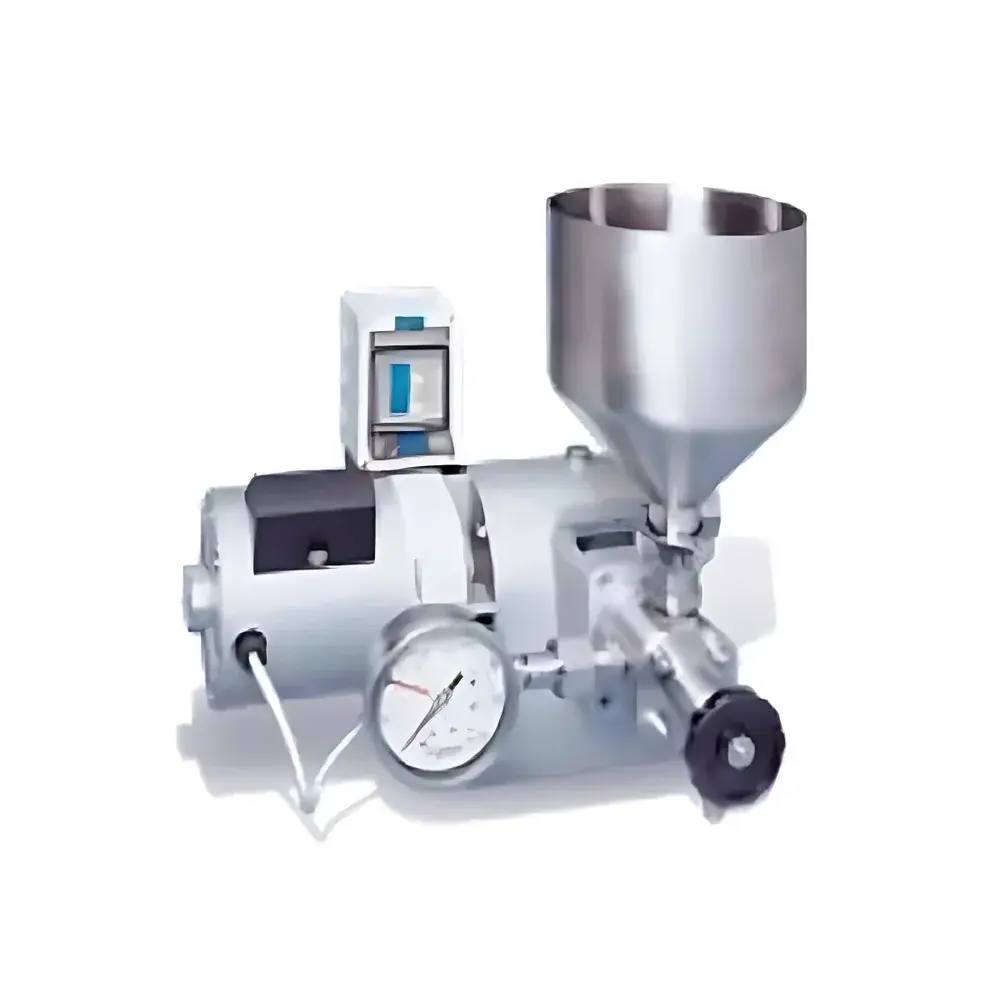
Armfield FT9 High-Pressure Homogenizer
| Brand | Armfield |
|---|---|
| Origin | United Kingdom |
| Model | FT9 |
| Production Capacity | 45 L/h |
| Maximum Operating Pressure | 70 bar (1015 psi) |
| Homogenization Index (whole milk) | ≤5.0% |
| Feed Tank Capacity | 4.5 L stainless steel (hygienic grade) |
| Pressure Gauge Range | 0–300 bar |
| Motor Power | 0.18 kW |
| Electrical Supply | FT9-A: 220–240 V / 1Φ / 50 Hz |
| FT9-B | 120 V / 1Φ / 60 Hz |
| Dimensions (H×W×L) | 0.56 × 0.56 × 0.41 m |
| Net Weight | 60 kg |
| Material | Hardened stainless steel cylinder, valve, and plunger |
| Homogenization Index compliance | Meets ISO 5530-1 for fat globule size distribution assessment in dairy emulsions |
Overview
The Armfield FT9 High-Pressure Homogenizer is an engineered laboratory-scale system designed to replicate industrial high-shear processing conditions in controlled R&D environments. It operates on the principle of high-pressure cavitation, turbulent flow, and microfluidic shear—where fluid is forced at elevated pressures through a precisely engineered dual-stage hardened alloy homogenizing valve. This generates intense hydrodynamic forces—including impact against valve surfaces, collision with chamber walls, and rapid pressure drop-induced cavitation—resulting in efficient droplet size reduction, emulsion stabilization, and particle dispersion. Unlike multi-valve or cascade systems, the FT9’s single integrated valve delivers consistent performance with minimal maintenance. Its primary application domain centers on dairy and semi-solid food systems: notably the controlled disruption of fat globules in raw milk, UHT-treated milk, ice cream mix, salad dressings, mayonnaise, and margarine formulations. The device meets functional requirements defined in ISO 5530-1 for evaluating fat globule size distribution stability post-homogenization, and supports method development aligned with Codex Alimentarius standards for emulsion-based food products.
Key Features
- Single-piece dual-stage hardened alloy homogenizing valve—eliminates need for interchangeable valve heads and ensures repeatable shear profiles across batches
- Hardened stainless steel cylinder, plunger, and valve assembly—engineered for abrasion resistance and long-term hygiene integrity under repeated CIP/SIP cycles
- Volumetric piston displacement mechanism—provides precise, pulse-free flow control and stable pressure delivery up to 70 bar
- Integrated motor-gearbox drive unit—direct-coupled architecture minimizes mechanical losses and vibration transfer
- Homogenization index ≤5.0% (measured on whole milk per ISO 5530-1)—demonstrating superior layer stability versus industry benchmark of ≤12%
- Hygienic-grade 4.5 L stainless steel feed tank—designed for easy cleaning, sample traceability, and compatibility with GMP-aligned workflows
- Calibrated 0–300 bar pressure gauge and integrated safety relief valve—ensuring operational compliance with PED 2014/68/EU and EN 850-1 pressure equipment directives
Sample Compatibility & Compliance
The FT9 accommodates viscous and particulate-laden food matrices including dairy emulsions (milk, cream, UHT blends), oil-in-water dressings, plant-based analogues, and structured spreads (e.g., margarine, butter blends). Its wetted components conform to FDA 21 CFR §177.1520 for food-contact polymers and EN 1935:2000 for stainless steel surface roughness (Ra ≤ 0.8 µm). All materials are certified non-leaching and corrosion-resistant per ASTM A276 Type 440C and AISI 420 specifications. The system supports GLP-compliant documentation when paired with external data loggers, and its pressure calibration traceability aligns with UKAS-accredited metrology protocols.
Software & Data Management
While the FT9 operates as a standalone electromechanical instrument without embedded firmware or touchscreen interface, it is fully compatible with third-party data acquisition systems via analog 4–20 mA pressure output and digital pulse counting for flow monitoring. Users routinely integrate it with LabVIEW, MATLAB, or Siemens SIMATIC S7 PLC platforms to capture real-time pressure transients, cycle duration, and cumulative throughput. Audit trails—including operator ID, batch number, pressure setpoint, and homogenization time—can be generated using compliant electronic lab notebook (ELN) solutions meeting FDA 21 CFR Part 11 requirements. Calibration certificates for the pressure gauge are issued annually per ISO/IEC 17025:2017.
Applications
- Dairy product development: Optimization of fat globule size distribution in pasteurized and UHT milk to improve shelf-life, heat stability, and mouthfeel
- Ice cream mix standardization: Pre-churning homogenization to reduce ice crystal nucleation and enhance meltdown resistance
- Plant-based beverage formulation: Stabilization of protein-oil dispersions in oat, soy, and almond milks
- Sauces and dressings: Achieving target viscosity and phase stability in low-oil mayonnaise and vinaigrette systems
- Functional ingredient incorporation: Uniform dispersion of encapsulated probiotics, vitamins, or botanical extracts into viscous carriers
- Scale-up validation: Generating representative process data for transfer to pilot-scale APV or GEA Panda homogenizers (100–500 L/h)
FAQ
What is the homogenization index, and how is it measured?
The homogenization index quantifies vertical fat separation in dairy emulsions after static storage (typically 24 h at 4 °C), calculated as the absolute difference between fat content in the top and bottom layers (per ISO 5530-1). An index ≤5.0% indicates excellent emulsion stability.
Can the FT9 process non-dairy or high-viscosity samples?
Yes—within limits. Viscosities up to 15,000 mPa·s (at 20 °C) are supported with pre-heating and reduced flow rates; however, particulates >200 µm require upstream filtration to prevent valve clogging.
Is CIP (Clean-in-Place) possible with the FT9?
The feed tank, piping, and valve body are fully disassemblable and compatible with standard alkaline-acid CIP protocols; however, full automated CIP requires external pump integration.
How does the FT9 support regulatory submissions?
Its reproducible pressure control, documented calibration history, and material compliance enable inclusion in FDA GRAS dossiers, EFSA novel food applications, and Health Canada submission packages for process-validated food ingredients.
What maintenance intervals are recommended?
Valve inspection every 200 operating hours; plunger seal replacement every 500 hours; annual pressure gauge recalibration and gearbox oil change per Armfield Maintenance Manual Rev. 4.2.






