
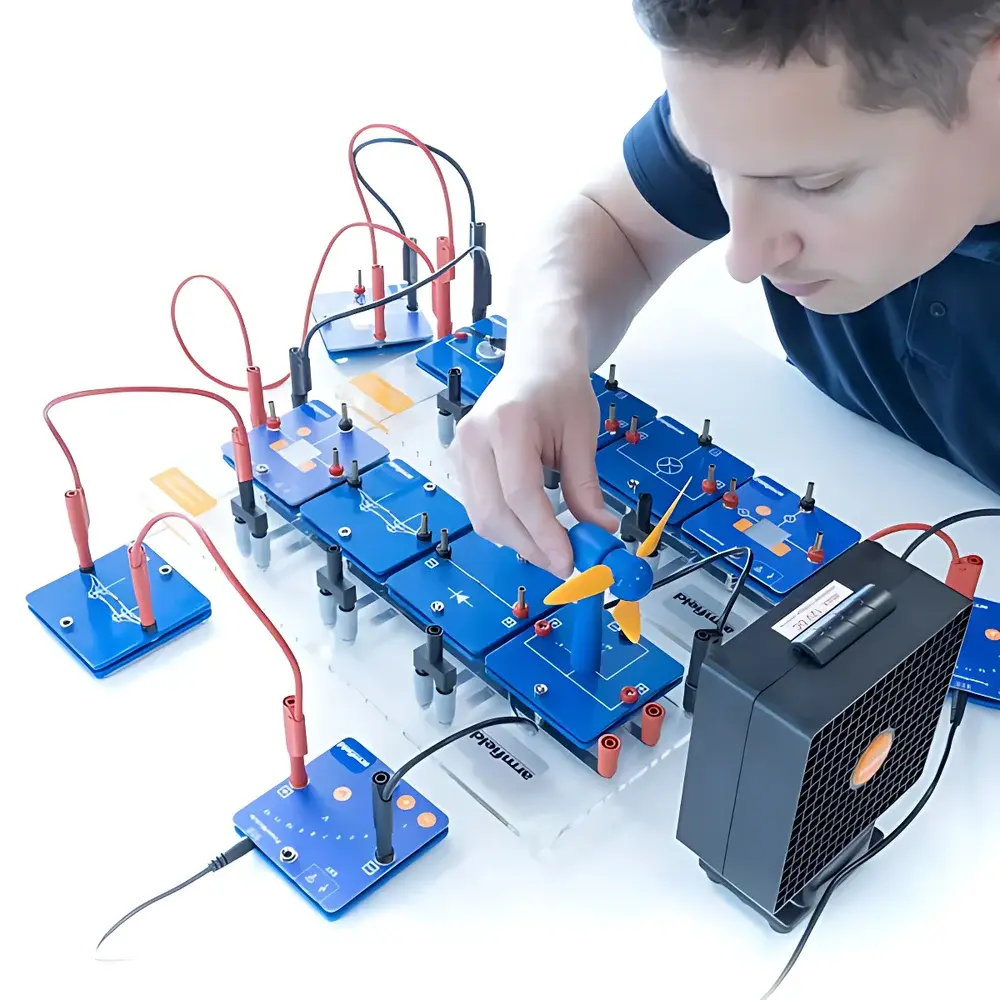
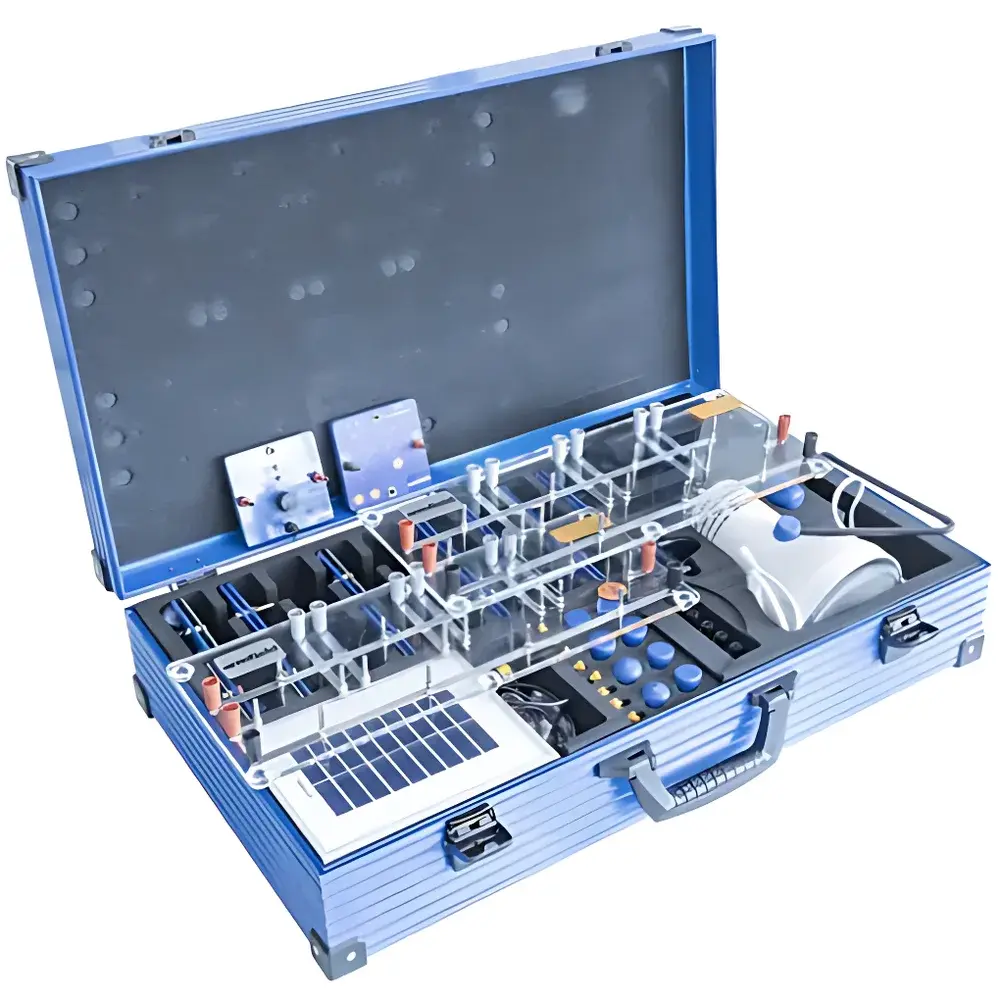
Armfield RE18 Smart Grid Training System
| Brand | Armfield |
|---|---|
| Origin | United Kingdom |
| Model | RE18 |
| Dimensions (L×W×H) | 0.640 m × 0.165 m × 0.370 m |
| Operating Temperature | +10 °C to +50 °C |
| Storage Temperature | −10 °C to +70 °C |
| Relative Humidity (non-condensing) | 0–95 % RH |
| Net Weight | 10 kg |
| Enclosure | Modular aluminum portable case with integrated storage |
Overview
The Armfield RE18 Smart Grid Training System is a comprehensive, laboratory-scale modular platform engineered for hands-on education and applied research in modern power systems engineering. Built upon fundamental principles of electrical energy conversion, distributed generation, bidirectional power flow, and real-time grid monitoring, the RE18 enables students and educators to construct, configure, and analyze functional smart grid topologies under controlled experimental conditions. Unlike abstract simulation environments, the RE18 delivers physical hardware-in-the-loop operation—integrating photovoltaic (PV) arrays, wind turbine emulators, reversible proton exchange membrane (PEM) fuel cells, lithium iron phosphate (LiFePO₄) battery modules, programmable load banks, and synchronized smart metering—all operating at safe, low-voltage DC/AC levels compatible with undergraduate and postgraduate laboratory infrastructure. Its architecture reflects industry-standard grid configurations—including radial distribution networks, islanded microgrids, and hybrid generation–storage–consumption nodes—allowing rigorous investigation into voltage regulation, frequency response, reactive power management, and transient stability under variable renewable input.
Key Features
- Modular, reconfigurable hardware platform supporting both instructor-led and student-designed smart grid architectures
- Integrated renewable energy sources: calibrated PV module (5.33 V, 370 mA), Pro-version wind turbine emulator with adjustable blade pitch and azimuth control, and reversible PEM electrolyser/fuel cell unit
- Dual-mode energy storage: LiFePO₄ AAA battery pack with charge/discharge profiling capability and high-capacity supercapacitor module for transient energy buffering
- Real-time instrumentation: two professional-grade smart meters with ±0.5% accuracy, capable of measuring active/reactive power, voltage, current, and harmonic content at node-level resolution
- Grid interface modules including Pro-version grid-synchronization inverters, diode-based rectification units, MPP trackers, and programmable resistive/inductive load banks
- Complete physical enclosure: rugged anodized aluminum portable case with labeled compartments, safety-rated test leads (25 cm and 50 cm, color-coded red/black), insulated shorting plugs, and mechanical alignment tools (e.g., azimuth scale, turbine base mount)
- Comprehensive pedagogical support: printed laboratory manual containing 13 structured smart grid experiments and 19 foundational component-level labs aligned with IEEE 1547, IEC 61850-7-420, and EN 50160 standards
Sample Compatibility & Compliance
The RE18 system is designed for use with standard academic laboratory power supplies (0–30 V DC, 0–5 A), function generators, and oscilloscopes. All electrical interfaces comply with IEC 61000-6-3 (EMI emission limits) and IEC 61000-6-2 (immunity requirements). Component-level safety adheres to IEC 61010-1:2010 for measurement/control laboratory equipment. The system supports GLP-aligned experimental documentation through timestamped data export and configurable measurement intervals. While not certified for utility-scale deployment, its topology modeling fidelity aligns with IEEE P2030.1 (Guide for Smart Grid Interoperability) and serves as a validated teaching platform for courses accredited under EUR-ACE® and ABET criteria.
Software & Data Management
The RE18 operates without proprietary software dependencies—data acquisition is performed via standard USB-connected multimeters and smart meters exporting CSV or Excel-compatible files. Optional integration with MATLAB® Simulink®, LabVIEW™, or Python-based control scripts (via Modbus RTU over RS-485) enables advanced co-simulation of grid dynamics, state estimation, and demand-response algorithms. All experiments include preconfigured data logging templates with column headers compliant with IEEE C37.118.2 synchrophasor metadata conventions. Audit trails—including operator ID, experiment ID, environmental conditions (recorded ambient temperature/humidity), and calibration timestamps—are manually documented per GLP guidelines; digital audit logs may be implemented using third-party LIMS platforms.
Applications
- Undergraduate power electronics and energy systems laboratories
- Graduate-level research on distributed energy resource (DER) integration challenges
- Validation of droop control, virtual inertia, and consensus-based microgrid stabilization algorithms
- Evaluation of MPPT algorithm performance under dynamic irradiance and thermal profiles
- Analysis of voltage sag/swell propagation in radial feeders with intermittent generation
- Load forecasting and demand-side management using real-time smart meter datasets
- Education on cybersecurity fundamentals in industrial control systems (ICS) via intentional fault injection and anomaly detection exercises
FAQ
Is the RE18 suitable for research beyond teaching?
Yes—the system’s open architecture, calibrated sensors, and hardware-in-the-loop compatibility support peer-reviewed experimental work in DER modeling, protection scheme testing, and grid-code compliance studies.
Does the system include firmware update capabilities?
Firmware updates for smart meters and MPP trackers are delivered via USB and require no external licensing; version history and release notes are provided in the technical documentation.
Can additional modules be added post-purchase?
All RE18 modules adhere to Armfield’s standardized mechanical and electrical interconnect specifications (2 mm banana jacks, 12 V auxiliary rail, Modbus RTU pinout), enabling seamless expansion with compatible RE-series accessories.
What safety certifications apply to the RE18?
The system complies with IEC 61010-1:2010 (Safety Requirements for Electrical Equipment for Measurement, Control, and Laboratory Use) and carries CE marking for the European Economic Area.
Is training provided with system delivery?
Armfield offers optional on-site or virtual instructor training covering setup, experiment execution, troubleshooting, and curriculum integration—delivered by certified application engineers with power systems backgrounds.






