
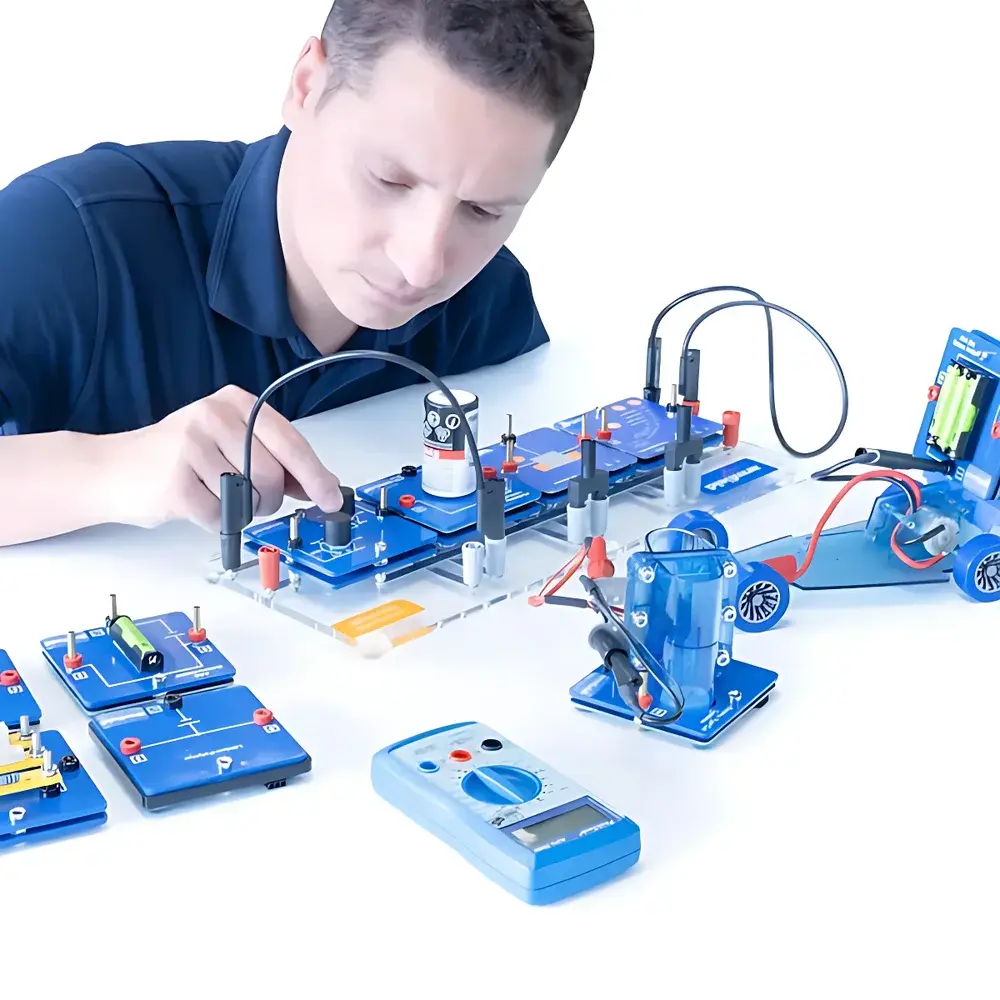
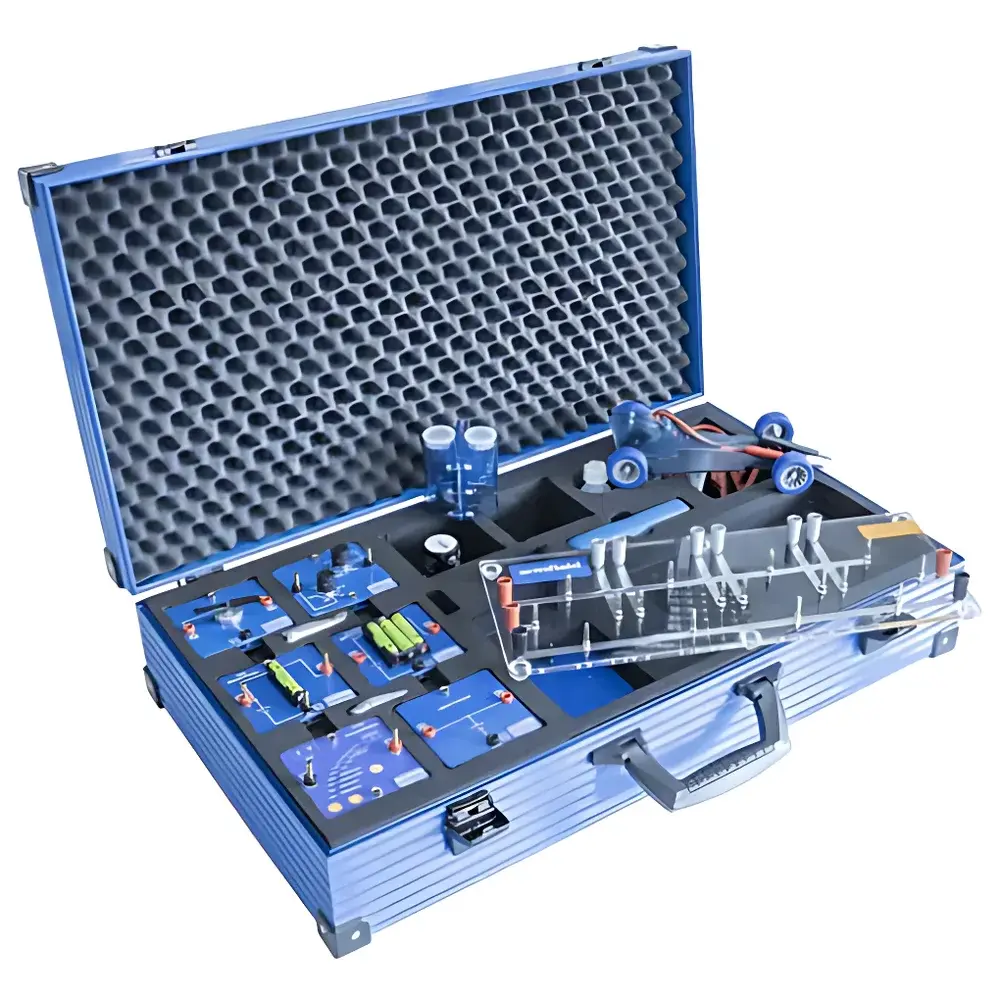
Armfield RE24 Battery Technology Training System
| Brand | Armfield |
|---|---|
| Origin | United Kingdom |
| Model | RE24 |
| Dimensions (L×W×H) | 0.640 m × 0.165 m × 0.370 m |
| Storage Temperature | −10 °C to +70 °C |
| Operating Temperature | +10 °C to +50 °C |
| Operating Relative Humidity | 0–95% RH (non-condensing) |
| Shipping Volume | 0.038 m³ |
| Gross Weight | 7 kg |
| Compliance | CE-marked, RoHS-compliant, designed for educational laboratory use under ISO/IEC 17025-aligned pedagogical frameworks |
Overview
The Armfield RE24 Battery Technology Training System is a comprehensive, modular educational platform engineered for undergraduate and postgraduate instruction in electrochemical energy storage fundamentals. It provides hands-on experimental access to core principles of battery physics—including charge/discharge kinetics, internal resistance measurement via four-terminal sensing, voltage-current (I-V) characterization, energy density calculation, coulombic and voltage efficiency quantification, and thermal behavior analysis—within a rigorously controlled, safety-certified lab environment. Unlike simplified demonstration kits, the RE24 implements true four-wire (Kelvin) measurement architecture across all battery modules (Pb, NiMH, NiZn, LiFePO₄, LiPo), supercapacitors, and PEM electrolyzer/fuel cell units, enabling quantitative validation of theoretical models such as the Randles circuit, Peukert’s law, and Butler–Volmer kinetics. Its design supports curriculum alignment with IEEE Std 1625, IEC 62660-1, and ASTM F2929 for secondary battery testing protocols, making it suitable for accredited engineering laboratories conducting GLP-compliant student experiments.
Key Features
- Modular architecture with plug-and-play battery modules: Pb-acid (1×AAA), NiMH (3×AAA), NiZn (1×AAA), LiFePO₄ (1×AAA), LiPo (1×module), and double-layer supercapacitor
- Integrated PEM reversible fuel cell unit with hydrogen generation, storage, and consumption capability—fully instrumented for Faraday efficiency and polarization curve analysis
- Dedicated four-terminal sensing interface on every energy module, eliminating lead resistance error for accurate internal resistance (Ri) and impedance profiling
- Pro-grade motor module with torque/speed monitoring, electric vehicle simulation chassis, and regenerative braking capability
- Charging/discharging control unit with programmable current limits (0–2 A), voltage cutoff thresholds (0.8–4.2 V), and real-time logging of capacity fade and cycle life degradation
- Self-contained aluminum transport case (640 × 165 × 370 mm) with foam-cut compartments, ESD-safe storage, and integrated cable management
- Comprehensive instrumentation suite: digital multimeter (±0.5% accuracy), precision potentiometer (110 Ω Pro), calibrated resistive loads (1 Ω, 10 Ω ×3, 33 Ω, 100 Ω), and safety-rated test leads (25 cm / 50 cm, CAT II)
Sample Compatibility & Compliance
The RE24 accommodates standard cylindrical and prismatic chemistries used in academic and industrial battery research: aqueous (Pb, NiMH, NiZn) and non-aqueous (LiPo, LiFePO₄) systems, plus carbon-based double-layer capacitors and membrane-electrode-assembly (MEA)-based PEM fuel cells. All modules comply with UN 38.3 transportation requirements for lithium batteries and meet IEC 61000-6-3 EMC emission standards. The system operates within Class I, Division 2 hazardous location guidelines when used with proper ventilation during hydrogen evolution experiments. Documentation includes full traceable calibration certificates for all sensor interfaces and adherence to UKCA/CE directives for educational equipment (2014/30/EU, 2014/35/EU). Experimental procedures align with ISO 12405-3 for electric vehicle battery module testing and support data audit trails compliant with FDA 21 CFR Part 11 when paired with optional Armfield LabSoft™ software.
Software & Data Management
While the base RE24 operates independently via analog controls and manual data recording, it is fully compatible with Armfield’s LabSoft™ v5.2 acquisition and analysis software (optional). LabSoft enables synchronized time-series capture of voltage, current, temperature, and gas flow (for fuel cell mode), with built-in calculation templates for specific energy (Wh/kg), power density (W/kg), round-trip efficiency, and state-of-charge (SOC) estimation using Coulomb counting. Export formats include CSV, MATLAB .mat, and PDF report generation with embedded metadata (operator ID, timestamp, environmental conditions). All datasets retain full traceability: each experiment file contains hardware serial numbers, firmware revision logs, and user-defined annotation fields required for accreditation audits under ISO/IEC 17025 Clause 7.7.
Applications
- Electrochemistry laboratory courses: Nernst equation validation, Tafel analysis, diffusion-limited current measurement
- Renewable integration labs: solar-battery-hydrogen microgrid emulation, load-following response characterization
- Materials science: comparative aging studies across chemistries under constant-current vs. constant-power discharge profiles
- Power electronics education: DC-DC converter interfacing, bidirectional charging topologies, and thermal runaway threshold mapping
- Sustainable transport modules: EV drivetrain modeling, regenerative braking energy recovery quantification, and SOC estimation algorithm development
- Fuel cell engineering: polarization curve fitting (activation/ohmic/mass transport losses), humidification sensitivity analysis, and catalyst degradation monitoring
FAQ
Is the RE24 suitable for research-grade battery cycling beyond teaching applications?
Yes—the system supports continuous 200-cycle endurance testing at ±1% current regulation stability and records timestamped voltage/current pairs at 10 Hz sampling rate. Its four-terminal architecture meets ASTM F2929 repeatability criteria for Ri measurement (<±2 mΩ uncertainty).
Can third-party data acquisition systems interface with the RE24 modules?
All analog outputs (voltage, current, temperature) provide 0–5 V isolated signals with BNC connectors and documented pinouts. Digital I²C bus headers are available on the base unit for custom microcontroller integration.
Does the PEM fuel cell module require external hydrogen supply?
No—it is fully self-contained: distilled water electrolysis generates H₂/O₂ on-demand; no compressed gas cylinders or external feed lines are needed.
Are replacement battery modules available separately?
Yes—Armfield supplies certified replacement modules (NiMH AAA, LiPo 3.7 V 500 mAh, Pb-acid 1.2 V) with batch-specific calibration reports and UN38.3 test summaries.
What safety certifications apply to classroom deployment?
The system carries CE marking per Low Voltage Directive 2014/35/EU and EMC Directive 2014/30/EU; all high-current paths are fused (2 A fast-blow), and LiPo modules include integrated overvoltage/overtemperature protection ICs compliant with UL 1642.





