
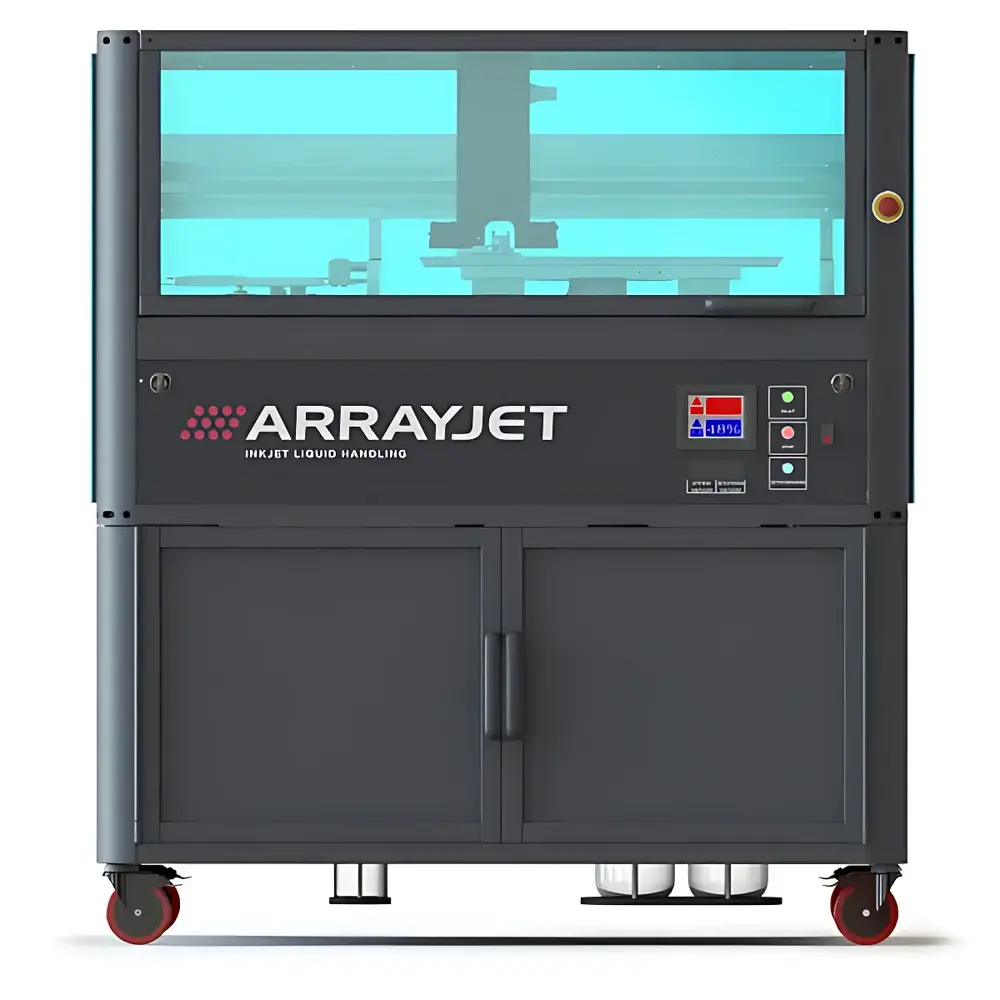
ArrayJet Mercury 100 High-Throughput Inkjet-Based Biochip and Microelectronic Array Spotter
| Brand | ArrayJet |
|---|---|
| Origin | United Kingdom |
| Model | Mercury 100 |
| Certification | ISO 13485:2016 (Manufacturing Site, Edinburgh, Scotland) |
| Technology | Non-contact Piezoelectric Inkjet Dispensing |
| Throughput | >10,000 Unique Spots per Second |
| Minimum Dispense Volume | Sub-nanoliter (typ. 0.1–2.0 nL) |
| Spot Precision | ≤ ±5 µm positional accuracy |
| Compatible Substrates | Glass slides, silicon wafers, membranes, polymer films, functionalized surfaces |
Overview
The ArrayJet Mercury 100 is a high-precision, non-contact inkjet-based arraying platform engineered for ultra-high-throughput deposition of biological and microelectronic materials onto solid substrates. Built upon patented piezoelectric drop-on-demand (DOD) inkjet technology, the Mercury 100 delivers sub-nanoliter liquid handling with exceptional reproducibility, minimal sample waste, and full preservation of biomolecular integrity. Unlike contact-based pin spotters or robotic dispensers, this system operates without physical substrate contact—eliminating cross-contamination, surface shear stress, and carryover risks. Its core architecture supports parallel deposition of >10,000 chemically distinct reagents per second across standard microscope slides, silicon wafers, nitrocellulose membranes, or custom functionalized surfaces. The instrument is manufactured at ArrayJet’s ISO 13485:2016-certified facility in Edinburgh, UK—ensuring compliance with quality management requirements for medical device-related manufacturing processes and supporting regulatory readiness for IVD assay development.
Key Features
- Non-contact piezoelectric inkjet dispensing enabling true zero-cross-contamination operation
- Sub-nanoliter dispensing precision (0.1–2.0 nL typical range) with <±5 µm spot placement accuracy
- Modular cartridge-based source plate design accommodating up to 384 independent sample reservoirs
- Real-time jet health monitoring and automated nozzle calibration for consistent droplet formation
- Integrated environmental control (temperature and humidity stabilization) to maintain biomolecule stability during spotting
- Robust mechanical architecture with vibration-damped optical stage and linear motor-driven precision motion control
- Compliance-ready firmware architecture supporting audit trails and user access logging
Sample Compatibility & Compliance
The Mercury 100 accommodates a broad spectrum of viscous and sensitive biological formulations—including DNA oligonucleotides, proteins, antibodies, peptides, glycans, cell lysates, and synthetic polymers—without denaturation or aggregation. Its low-shear, ambient-temperature dispensing mechanism preserves conformational integrity critical for functional assays. For regulated environments, the system supports GLP- and GMP-aligned workflows: raw data files are timestamped and immutable; all operator actions, parameter changes, and hardware diagnostics are logged with traceable user IDs. While not a medical device itself, its ISO 13485:2016 manufacturing certification provides documented evidence of process rigor applicable to IVD kit development and preclinical biomarker array production under FDA 21 CFR Part 11 and EU MDR Annex II requirements.
Software & Data Management
ArrayJet’s proprietary ArrayStudio software provides a validated, Windows-based interface for experimental design, pattern definition, and run execution. Users define spotting layouts via intuitive grid mapping or import custom coordinate files (CSV, GPR, GAL). The software enforces parameter validation (e.g., minimum inter-spot distance, maximum dwell time), performs pre-run nozzle diagnostics, and generates comprehensive run reports including jet performance metrics, volume consistency histograms, and environmental logs. All data—including raw image captures from onboard alignment cameras and thermal/humidity sensor outputs—are stored in vendor-neutral formats (HDF5, XML) with embedded metadata compliant with MIAME and MIAPE standards. Export options include TIFF, PNG, and tab-delimited quantification-ready outputs compatible with downstream analysis platforms such as GeneSpring, Partek Flow, or R/Bioconductor.
Applications
- High-density nucleic acid microarrays for genotyping, expression profiling, and methylation analysis
- Antibody and recombinant protein arrays for multiplexed immunoassay development
- Tissue microarray (TMA) construction using cell suspensions or fragmented biopsies
- Microelectronic test structures: deposition of conductive inks, quantum dot solutions, and polymer electrolytes on flexible substrates
- Drug discovery: miniaturized dose-response screening on functionalized surfaces
- Diagnostic assay prototyping: rapid iteration of capture probe layouts for lateral flow or electrochemical biosensors
FAQ
What types of biofluids or reagents are compatible with the Mercury 100?
The system supports aqueous buffers, glycerol-containing formulations (<30% v/v), and surfactant-stabilized suspensions with viscosities up to 20 cP—provided they are filtered to ≤0.22 µm and free of particulates.
Can the Mercury 100 be integrated into a larger automated lab workflow?
Yes. It features standard RS-232, Ethernet, and digital I/O interfaces for synchronization with third-party liquid handlers, incubators, or slide scanners via LabVIEW or Python-based orchestration frameworks.
Is method validation support available for regulated applications?
ArrayJet provides IQ/OQ documentation templates, installation qualification checklists, and on-site operational qualification assistance—aligned with ISO/IEC 17025 and ASTM E2500 guidance for analytical instrument qualification.
How does the system ensure consistent droplet ejection across extended runs?
Each print head undergoes factory-calibrated jet-to-jet voltage tuning; real-time acoustic sensing detects misfiring nozzles, triggering automatic recalibration or dynamic path rerouting without interrupting the run.
What substrate formats are supported out-of-the-box?
Standard 25 × 75 mm microscope slides, 3-inch and 4-inch silicon wafers, 96-well microplate footprints, and custom-sized rigid or semi-rigid carriers up to 120 × 80 mm.
Related Products




