
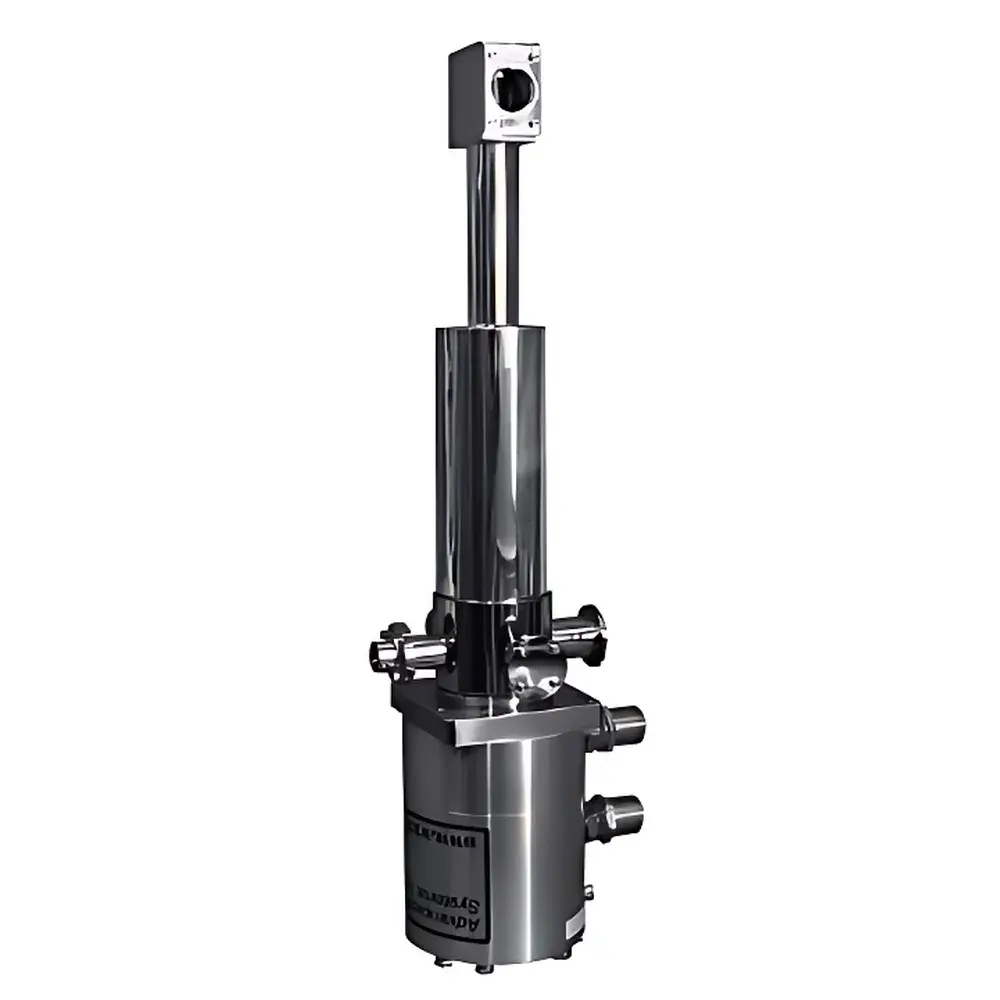
ARS X-12 Narrow-Aperture Closed-Cycle Cryogenic Thermostat
| Brand | ARS |
|---|---|
| Origin | USA |
| Model | X-12-1 |
| Type | Vertical |
| Cooling Source | Helium-Free Closed-Cycle Refrigeration |
| Base Temperature Options | 4 K, 5.5 K, or 10 K (dependent on cold head selection: DE-202 or DE-204) |
| Minimum Tail Diameter | 19 mm (standard: 25 mm) |
| Vacuum Jacket Material | Non-magnetic Aluminum |
| Radiation Shield | Polished Oxygen-Free Copper (replaces Ni-plated Cu) |
| Application-Specific Design | Optimized for in-situ magnetic field integration (e.g., electromagnets, superconducting magnets) |
| Compliance Context | Designed for GLP-compliant low-temperature characterization under static or swept magnetic fields |
Overview
The ARS X-12 Narrow-Aperture Closed-Cycle Cryogenic Thermostat is an engineered solution for high-field magneto-optical, magneto-electrical, and quantum transport measurements requiring simultaneous ultra-low temperature operation and physical access to the sample region within tight magnetic gaps. Unlike conventional cryostats relying on liquid helium dewars or bulky cold-finger extensions, the X-12 employs a compact, helium-free closed-cycle refrigeration architecture centered on ARS’s DE-202 or DE-204 series Gifford-McMahon cryocoolers. Its defining feature is a minimized radial footprint—achieved through a purpose-built narrow-aperture vacuum tail with a standard outer diameter of 25 mm (down to 19 mm upon request)—enabling direct insertion into the bore of high-field electromagnets or split-pair superconducting magnets without mechanical interference. This geometry preserves maximum available magnetic flux density at the sample position while eliminating thermal penalties associated with extended cold fingers. The system operates stably at base temperatures of 4 K, 5.5 K, or 10 K, depending on cold head configuration and thermal load, and maintains sub-Kelvin stability (< ±10 mK over 24 h) under continuous operation.
Key Features
- Helium-free operation eliminates dependency on liquid cryogens, reducing operational cost, logistical complexity, and safety hazards associated with cryogenic liquid handling.
- Narrow-aperture vacuum tail (19–25 mm OD) enables seamless integration into magnetic systems with gap widths as small as 30 mm, preserving >95% of nominal field strength at the sample plane.
- Non-magnetic construction: aluminum vacuum jacket replaces stainless steel; polished oxygen-free copper radiation shield replaces nickel-plated copper—minimizing magnetic susceptibility and eddy current generation during field ramping.
- Direct cold-head-to-sample thermal path: no intermediate cold finger extension required, minimizing conductive heat leak and maximizing cooling efficiency at low temperatures.
- Modular cold head compatibility: supports DE-202 (4 K base) and DE-204 (5.5 K or 10 K base) configurations, allowing users to select optimal trade-offs between base temperature, cooling power, and vibration performance.
- Integrated temperature sensing and control: calibrated Cernox™ or RuO₂ sensors mounted at multiple thermal stages (cold head, radiation shield, sample stage) with PID-controlled heater regulation and 0.1 K resolution readout.
Sample Compatibility & Compliance
The X-12 accommodates standard sample mounting configurations including chip carriers, probe cards, and fiber-coupled optical mounts. Its top-loading vertical design allows straightforward sample exchange without disassembly of the magnet interface. All internal materials are selected for ultra-high vacuum (UHV) compatibility (<1×10⁻⁸ mbar typical after bake-out), and surface finishes meet ASTM B731-16 specifications for non-magnetic aluminum anodization. The system complies with electromagnetic compatibility requirements per IEC 61326-1 for laboratory equipment and supports audit-ready documentation packages aligned with ISO/IEC 17025 and FDA 21 CFR Part 11 when integrated with compliant data acquisition software. Magnetic field tolerance is validated up to ±12 T static field exposure with no degradation in thermal performance or vacuum integrity.
Software & Data Management
The X-12 is fully compatible with LabVIEW™-based and Python-driven control frameworks via RS-232, Ethernet (TCP/IP), or USB interfaces. ARS-provided software includes real-time temperature logging, multi-stage PID tuning, alarm thresholds (e.g., vacuum loss, temperature excursion >0.5 K), and automated cooldown/warm-up sequences. Data streams support timestamped CSV export and HDF5 formatting for traceability in GLP/GMP environments. Optional integration with third-party platforms (Keysight PathWave, Quantum Design QDControl) enables synchronized acquisition across electrical, optical, and magnetic measurement channels—critical for Hall effect mapping, MOKE hysteresis loops, or time-resolved photoluminescence under field.
Applications
- Magneto-transport characterization: Hall effect, longitudinal resistivity, Shubnikov–de Haas oscillations, and quantum Hall regime studies at T ≤ 4 K and B ≥ 9 T.
- Magneto-optical spectroscopy: Faraday rotation, Voigt effect, and magneto-reflectance in semiconductor heterostructures and 2D materials (e.g., graphene, TMDCs).
- Quantum device testing: DC and RF characterization of superconducting qubits, Josephson junctions, and spintronic devices under combined cryogenic and magnetic conditions.
- Optoelectronic evaluation: Temperature-dependent electroluminescence (EL), photoluminescence (PL), and absorption spectroscopy from UV to mid-IR spectral ranges.
- Defect spectroscopy: Deep-level transient spectroscopy (DLTS) and capacitance-voltage (C-V) profiling of semiconductor interfaces at cryogenic bias conditions.
FAQ
What magnetic field strengths are supported without performance degradation?
The X-12 has been validated for uninterrupted operation in static fields up to ±12 T; field ramp rates up to 1 T/min induce no measurable thermal drift or vacuum compromise.
Can the X-12 be retrofitted with optical fibers or electrical feedthroughs?
Yes—customizable vacuum feedthrough options include SMA, K-type thermocouple, twisted-pair, and single-mode fiber (SMF-28) ports, all rated for UHV and cryogenic thermal cycling.
Is remote monitoring and control possible?
Fully supported via Ethernet interface using Modbus TCP or ARS’s native ASCII command protocol; integration with enterprise SCADA or LIMS systems is documented and tested.
How is vibration isolation managed at base temperature?
Mechanical decoupling is achieved through compliant bellows sections, low-vibration cold head mounting, and optional active damping modules—achieving <50 nm RMS displacement at 4 K under DE-202 operation.
What documentation is provided for regulatory compliance?
Includes full material declarations (RoHS/REACH), UHV outgassing test reports (per ASTM E595), magnetic susceptibility certificates, and IQ/OQ protocols aligned with ISO 9001 and ISO/IEC 17025 calibration traceability.



