
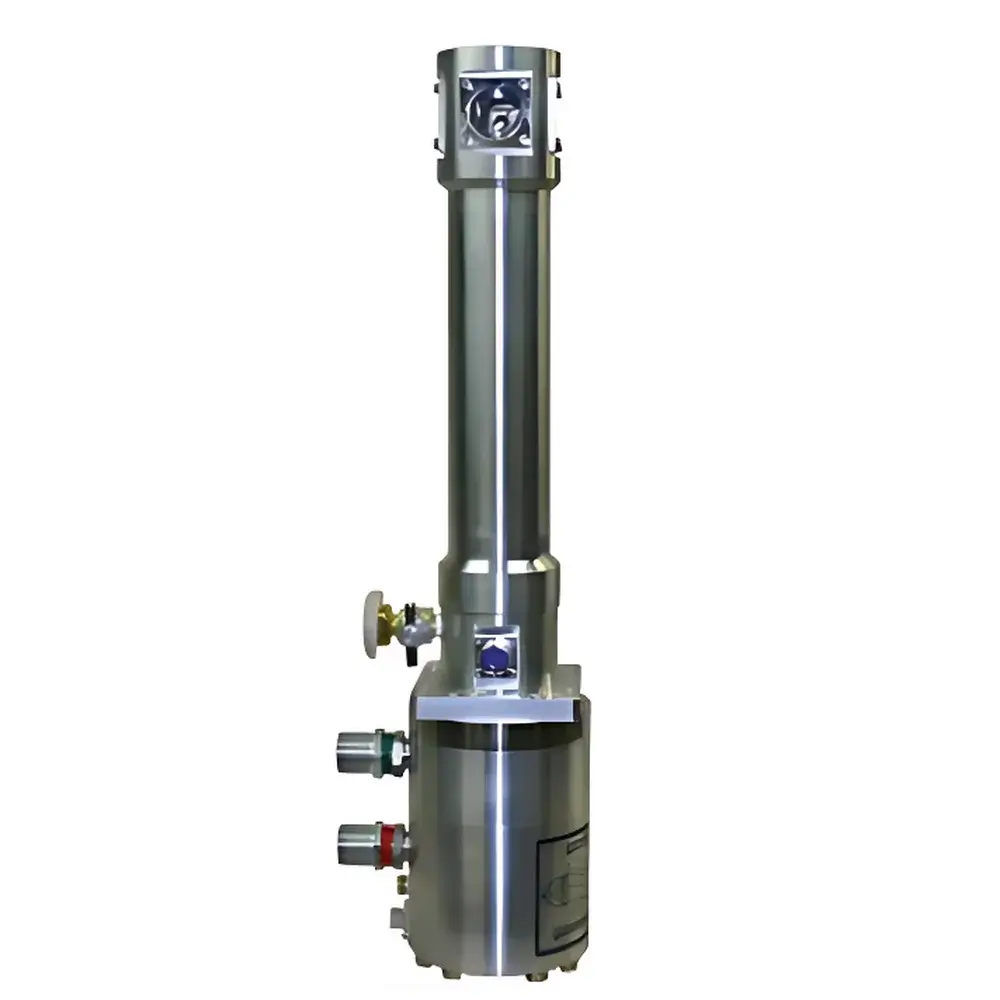
ARS X-1AL-2 Standard Optical Closed-Cycle Cryogenic Thermostat
| Brand | ARS |
|---|---|
| Origin | USA |
| Model | X-1AL-2 |
| Type | Vertical |
| Temperature Range | 4 K to 800 K |
| Base Temperature | ≤4 K (with optional 1.5 K insert) |
| Optical Access | Fully integrated optical path with coaxial alignment capability |
| Software Interface | Guided, modular GUI for automated temperature ramping, dwell, and synchronization with external spectrometers |
| Sample Compatibility | Solid (powder, thin film), liquid, and mounted substrates |
| Modularity | Supports cryogenic optical modules including confocal microscopy, time-resolved photoluminescence (TRPL), anisotropy, quantum yield, and variable-temperature spectroscopy |
| Compliance | Designed for GLP/GMP-aligned labs |
Overview
The ARS X-1AL-2 Standard Optical Closed-Cycle Cryogenic Thermostat is an engineered solution for precision temperature control in optical spectroscopy applications requiring stable, vibration-isolated, helium-free operation from 4 K to 800 K. Unlike traditional liquid-helium-dependent cryostats, the X-1AL-2 employs a two-stage pulse tube cryocooler coupled with high-efficiency thermal anchoring and low-vibration cold-head design to achieve base temperatures below 4 K without consumables. Its optical architecture features coaxial, multi-port vacuum feedthroughs optimized for collinear excitation and collection paths—enabling seamless integration with fluorescence lifetime spectrometers, confocal microscopes, and quantum efficiency measurement systems. The system is purpose-built for laboratories conducting temperature-dependent photophysics research, where reproducibility, thermal stability (< ±10 mK over 1 hr at 10 K), and long-term unattended operation are critical.
Key Features
- Helium-free operation: Eliminates dependency on liquid cryogens while maintaining <4 K base temperature performance—reducing operational cost and logistical complexity.
- Vertical optical configuration: Optimized for top-down illumination and bottom-up detection, supporting standard microscope objectives and fiber-coupled spectrometers.
- Modular cold stage design: Accepts interchangeable sample mounts—including resistive heater stages, magnetic field inserts (up to 9 T with optional superconducting magnet), and ultra-low-temperature inserts down to 1.5 K.
- Vibration-damped cold head: Integrated active/passive damping minimizes mechanical coupling to optical components, essential for time-resolved photoluminescence (TRPL) and single-photon counting applications.
- Intelligent thermal management: Dual-zone PID control with real-time thermometry (Cernox® and RuO₂ sensors) ensures precise ramp rates (0.1–10 K/min), dwell stability, and programmable thermal cycles.
Sample Compatibility & Compliance
The X-1AL-2 accommodates diverse sample geometries: planar solids (wafers, thin films, crystals), powdered specimens in quartz cups, sealed liquid cells (e.g., cryogenic solvents), and custom-mounted devices. Its vacuum-tight, radiation-shielded sample chamber maintains pressures below 1×10⁻⁶ Torr, minimizing condensation and background interference during UV–Vis–NIR spectral acquisition. The system complies with ISO/IEC 17025 requirements for calibration traceability and supports audit-ready documentation when interfaced with validated third-party acquisition software. It is routinely deployed in environments governed by GLP and GMP frameworks—particularly where temperature-programmed quantum yield or anisotropy measurements require full electronic record integrity per FDA 21 CFR Part 11.
Software & Data Management
The included CryoConsole™ software provides a guided, context-aware interface for non-specialist users while offering expert-level scripting (Python API) for advanced automation. All temperature setpoints, sensor readings, and hardware status logs are timestamped and exported in HDF5 or CSV format. Synchronization triggers (TTL, USB, Ethernet) enable deterministic coordination with TCSPC modules, lock-in amplifiers, or CCD/CMOS detectors. Audit trails include user authentication, parameter change history, and electronic signatures—fully configurable to meet institutional data governance policies.
Applications
- Time-resolved photoluminescence (TRPL) mapping across temperature gradients for defect-state analysis in perovskites and 2D materials.
- Variable-temperature fluorescence quantum yield quantification under controlled atmospheric conditions.
- Polarization-resolved anisotropy decay studies of molecular rotors and conjugated polymers.
- Cryogenic micro-photoluminescence (µ-PL) and cathodoluminescence (CL) with spatial resolution down to 500 nm.
- Thermally activated carrier capture/detrapping kinetics in semiconductor heterostructures.
FAQ
Does the X-1AL-2 support integration with third-party spectrometers and TCSPC systems?
Yes—it provides standardized TTL, analog, and Ethernet interfaces for hardware synchronization with commercial fluorescence lifetime systems (e.g., PicoQuant, Becker & Hickl, Horiba) and spectrometers.
Can the system operate continuously for extended periods without maintenance?
With proper vacuum integrity and routine compressor service intervals (every 12–18 months), the pulse tube cooler supports >10,000 hours of continuous operation.
Is remote monitoring and control supported?
Yes—via secure HTTPS web interface or Python SDK, enabling real-time temperature profiling, alarm notifications, and script-based experiment sequencing from off-site locations.
What vacuum pumping options are recommended?
A turbomolecular pump backed by a dry scroll pump is standard; optional ion pumps are available for ultra-high-vacuum configurations requiring <1×10⁻⁸ Torr base pressure.
How is temperature calibration verified?
Each unit ships with NIST-traceable Cernox® sensor calibration certificates; in-situ verification is possible using reference standards such as indium, tin, and zinc melting points per ASTM E77.
Related Products



