
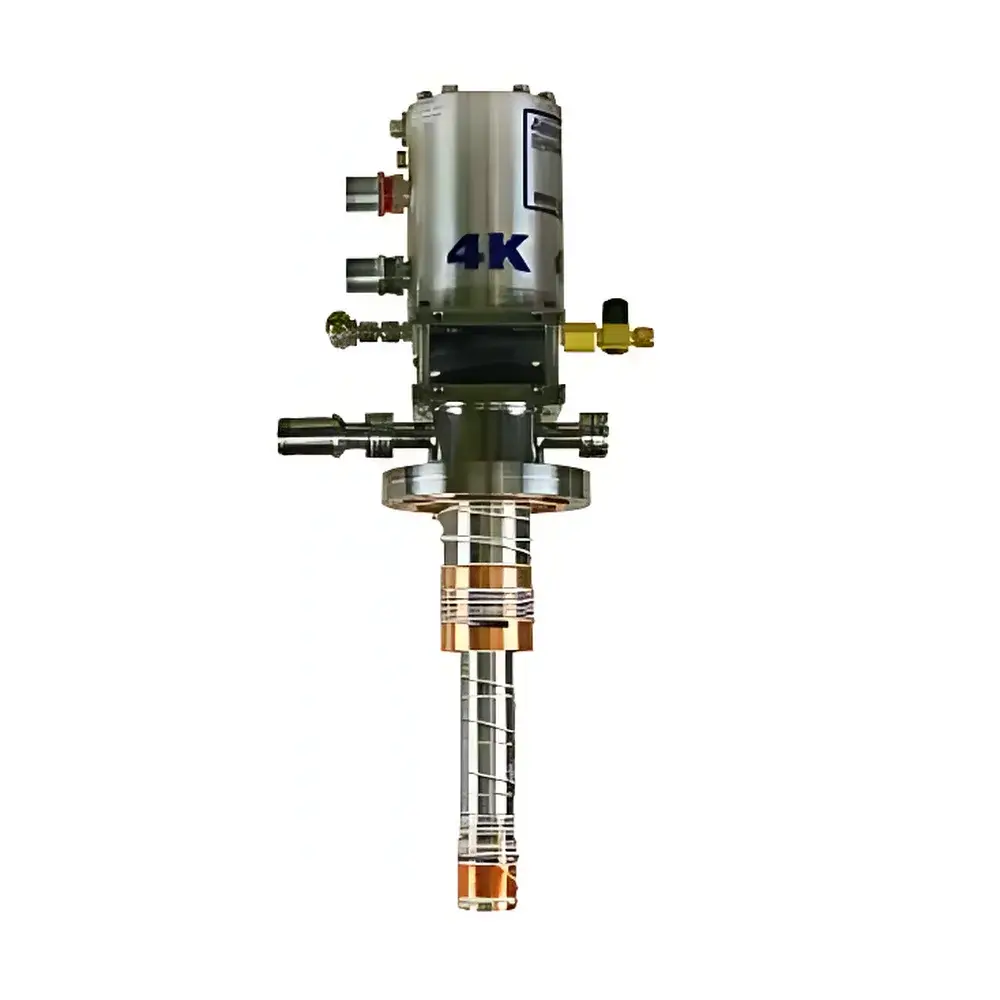
ARS X-20B UHV Ultra-Low-Vibration Cryogenic Closed-Cycle Thermostat
| Brand | ARS |
|---|---|
| Origin | USA |
| Model | X-20B |
| Vacuum Performance | ≤1×10⁻¹¹ Torr |
| Vibration Level | 3–5 nm RMS (typical) |
| Base Temperature | ~4 K (with DE-204/DE-210 cold head) |
| Cooling Method | Helium gas exchange |
| Cold Head Orientation | Vertical-down only |
| Bakeout Capability | Up to 200 °C without breaking vacuum |
| Compliance | UHV-compatible welded metal seals (CF flanges), all-elastomer-free construction |
Overview
The ARS X-20B is a purpose-engineered ultra-high vacuum (UHV) cryogenic closed-cycle thermostat designed for experiments where thermal stability, mechanical isolation, and vacuum integrity are non-negotiable. Unlike conventional cryostats relying on conductive or convective cooling paths that transmit compressor-induced vibrations, the X-20B employs helium gas exchange cooling—decoupling the sample thermally and mechanically from the cold head. This architecture enables sub-5 nm RMS vibration amplitudes at base temperature, verified under operational UHV conditions (≤1×10⁻¹¹ Torr). Its fully welded, all-metal UHV construction—featuring CF-flanged cold heads, nickel-plated oxygen-free copper radiation shields, and elastomer-free sealing—ensures long-term vacuum reliability and compatibility with rigorous bakeout protocols up to 200 °C. The system operates with standard ARS Displex® cold heads (e.g., DE-202/DE-204/DE-210) and is engineered for integration into surface science, quantum materials, and synchrotron-endstation environments where vibrational decoherence or outgassing compromises measurement fidelity.
Key Features
- True UHV compatibility: All-welded stainless steel body with metal-sealed CF interfaces; no elastomeric O-rings in vacuum path.
- Ultra-low vibration performance: 3–5 nm RMS measured at sample stage; validated via Mössbauer spectroscopy and cathodoluminescence imaging under active cooling.
- Vacuum-intact cold head removal: Cold head can be detached without venting the chamber—enabling in-situ bakeout and rapid hardware reconfiguration.
- Gas-exchange thermal coupling: Minimizes solid-conduction pathways; sample temperature typically 1–2 K above cold head setpoint, ensuring thermal uniformity without mechanical coupling.
- Vertical-down cold head orientation: Required to sustain stable helium convection within the exchange volume; ensures reproducible thermal gradients and minimal acoustic coupling.
- Modular instrumentation interface: Includes DMX-20 ultra-low-vibration feedthroughs, 10-pin UHV electrical connectors, calibrated silicon diode sensors (±12 mK accuracy), and integrated 50 Ω thin-film heaters for precision thermal control.
Sample Compatibility & Compliance
The X-20B accommodates diverse experimental geometries through its open-sample architecture and configurable mounting options—including 6-inch rotatable CF flanges, optional 4.5″ or 8″ variants, and custom-designed sample stages for optical, electrical, or magnetic characterization. Its compact tail section permits insertion into narrow-bore magnets (<25 mm bore), while anti-reflective-coated optical windows support high-NA microscopy and spectroscopy. The system complies with UHV material standards per ASTM E595 and ISO 10110-7 for outgassing control. All internal surfaces undergo electropolishing and high-temperature vacuum annealing to minimize hydrocarbon contamination. For regulated environments, the integrated temperature controller supports audit-trail logging and user-access-level authentication, aligning with GLP/GMP documentation requirements for materials qualification studies.
Software & Data Management
Temperature regulation is managed via ARS’s proprietary CryoCon 34i controller, supporting dual-sensor PID loops, ramp/soak profiles, and real-time derivative-based stability monitoring. Sensor data—including primary calibration-grade silicon diodes (4-ft lead length, NIST-traceable calibration certificate included) and secondary monitoring diodes—are logged at 10 Hz resolution with timestamped metadata. Export formats include CSV and HDF5, compatible with Python-based analysis pipelines (e.g., SciPy, Matplotlib) and LabVIEW VIs. Optional Ethernet/IP integration enables remote operation and synchronization with external DAQ systems (e.g., lock-in amplifiers, time-of-flight detectors) via IEEE-488 or TCP/IP protocols. Firmware updates are delivered via secure HTTPS, with SHA-256 signature verification to ensure traceability.
Applications
- Mössbauer Spectroscopy: Demonstrated linewidth stability <0.27 mm/s (FWHM) across thermal cycles; negligible broadening attributable to mechanical vibration.
- Cathodoluminescence (CL) Imaging: Sub-10 nm vibration enables diffraction-limited spatial resolution at 40–50 K on InGaN/GaN quantum wells; direct comparison of room-temperature vs. cryogenic CL contrast confirms vibrational suppression.
- Ellipsometry & FTIR: Integrated with SOPRA and BOMEM DA8 spectrometers; Z-axis translation stage maintains optical alignment during thermal drift <±50 nm over 24 h.
- MOKE & Magneto-Optic Studies: Sample positioning within 25 mm of pole faces; elliptical polarization retention verified via Stokes parameter analysis at 1.55 µm.
- Quantum Transport: 10-pin UHV feedthroughs support four-terminal DC and low-frequency AC measurements; shielded cabling minimizes pickup in sub-pA current regimes.
FAQ
Why must the cold head be oriented vertically downward?
Helium gas exchange relies on natural convection between the cold head and sample stage. Vertical-down orientation ensures consistent gas circulation, thermal homogeneity, and avoidance of stagnant zones that would degrade cooling efficiency and increase thermal noise.
Can the X-20B be used in magnetic fields?
Yes—the compact tail section and non-magnetic stainless steel construction allow insertion into solenoid and superconducting magnet bores down to 20 mm diameter. Optional mu-metal shielding is available for fields >1 T.
What is the typical thermal lag between cold head and sample?
Due to gas-phase thermal resistance, sample temperature stabilizes 1–2 K above the cold head setpoint. This offset is highly repeatable and compensated in closed-loop control using the calibrated sample-stage diode.
Is bakeout supported without disassembly?
Yes—full-system bakeout to 200 °C is possible with the cold head removed. The welded UHV envelope retains integrity; residual gas analysis confirms H₂O and CO partial pressures <1×10⁻¹² Torr after bakeout.
How is vibration isolation achieved beyond the cryostat itself?
ARS recommends pairing the X-20B with the optional granite-based low-vibration platform (4 pneumatic isolators + passive damping layers), decoupling floor-borne noise below 2 Hz. Compressor vibration is further attenuated via flexible helium lines and inertia-matched mounting brackets.
Related Products



