
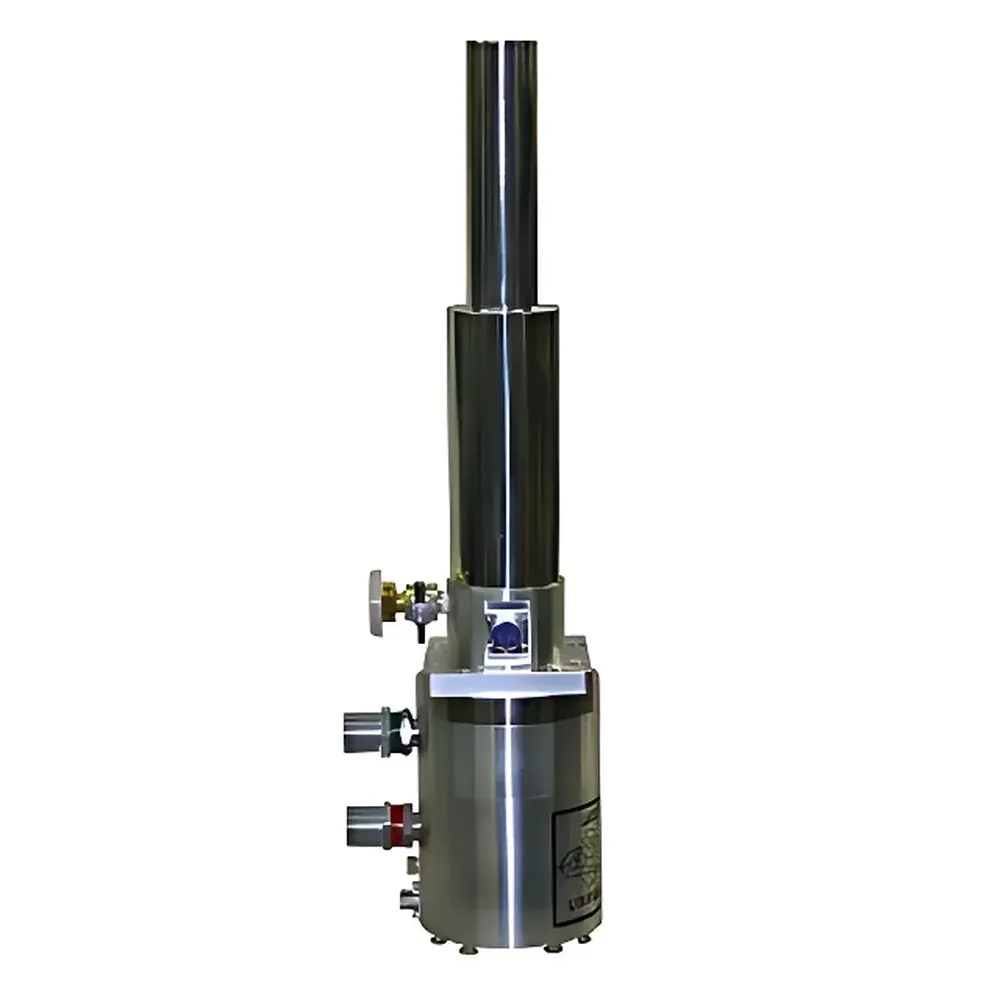
ARS X-3-2 Tubular Closed-Cycle Cryogenic Thermostat
| Brand | ARS |
|---|---|
| Origin | USA |
| Model | X-3-2 |
| Type | Vertical |
| Cooling Method | Helium-Free Closed-Cycle Refrigeration |
| Configuration | Integrated with Fluorescence Spectrometers (e.g., Edinburgh Instruments) |
| Sample Positioning | Motorized XYZ Translation Stage |
Overview
The ARS X-3-2 Tubular Closed-Cycle Cryogenic Thermostat is an engineered solution for high-stability, vibration-isolated low-temperature experimentation in optical and spectroscopic applications. Designed and manufactured in the United States by Advanced Research Systems (ARS), this vertical-format cryostat employs a two-stage pulse tube cryocooler to achieve base temperatures down to 3.2 K without liquid helium consumption. Its tubular geometry enables direct optical access along the central axis—ideal for integration with confocal microscopes, photoluminescence setups, and fluorescence spectrometers such as those from Edinburgh Instruments. Unlike bath-style cryostats, the X-3-2 utilizes a rigid, low-thermal-conductivity support structure that minimizes mechanical drift and thermal transients during temperature ramping or hold cycles. The system operates within a vacuum-jacketed stainless steel dewar, maintaining pressure below 1×10⁻⁵ Torr to suppress conductive and convective heat loads.
Key Features
- Helium-free operation: Eliminates dependency on liquid helium supply chains, reducing operational cost and logistical complexity while supporting long-term unattended runs.
- Vertical, tubular architecture: Optimized for top-down optical access; accommodates standard lens mounts, fiber couplers, and detector assemblies aligned coaxially with the sample.
- Integrated XYZ motorized translation stage: Precision positioning with ±0.5 µm repeatability over 25 mm × 25 mm × 15 mm travel range—enabling spatial mapping of luminescent or quantum emitters.
- Low-vibration cooling: Pulse tube refrigerator with active vibration cancellation; residual mechanical noise < 50 nm RMS at 1–100 Hz, critical for high-resolution spectroscopy and single-photon detection.
- Modular cold-finger interface: Standard CF-63 or CF-100 flange options allow flexible integration with existing vacuum chambers or custom optical tables.
- Temperature stability: ≤ ±5 mK over 24 h at 4.2 K; programmable ramp rates from 0.1 K/min to 5 K/min with overshoot suppression.
Sample Compatibility & Compliance
The X-3-2 supports a wide range of sample geometries—including bulk crystals, thin films on substrates, nanostructured wafers, and mounted quantum dots—via customizable sample holders compatible with standard cryogenic electrical feedthroughs (up to 32 channels). All internal materials comply with ultra-high vacuum (UHV) standards: oxygen-free copper cold stages, electropolished 304L stainless steel shields, and low-outgassing epoxies. The system meets ASTM E2879-21 requirements for cryogenic temperature measurement uncertainty and conforms to ISO/IEC 17025 calibration traceability when paired with NIST-traceable platinum resistance thermometers (PRTs). It is routinely deployed in GLP-compliant laboratories where audit-ready temperature logging and hardware interlocks are required.
Software & Data Management
Control is managed via ARS’s CryoCommand™ software suite (Windows-based), supporting both local touchscreen operation and remote Ethernet communication. The interface provides real-time monitoring of cold-head temperature, compressor status, vacuum level, and stage position. All parameters are logged with timestamps and stored in CSV-compatible format for post-acquisition analysis. For regulated environments, optional FDA 21 CFR Part 11 compliance packages include electronic signatures, role-based access control, and immutable audit trails. Integration with LabVIEW, Python (PyVISA), and MATLAB is supported through documented SCPI command sets and DLL libraries.
Applications
- Photoluminescence and time-resolved fluorescence spectroscopy of semiconductor nanostructures and 2D materials.
- Optical characterization of single-photon sources (e.g., NV centers, quantum dots) under stable sub-10 K conditions.
- Low-temperature Raman microscopy requiring minimal thermal drift and high positional fidelity.
- Electro-optical testing of superconducting devices and Josephson junctions.
- In situ magneto-optical studies using external field coils mounted externally to the cryostat body.
FAQ
Does the X-3-2 require liquid nitrogen precooling?
No—the system achieves full cooldown from ambient temperature using only electrical power; no cryogens are required at any stage.
Can the XYZ stage be upgraded with piezoelectric actuators?
Yes; ARS offers optional nanopositioning modules with closed-loop feedback for sub-10 nm resolution, subject to vacuum and thermal load constraints.
What vacuum pumping configuration is recommended?
A turbomolecular pump backed by a dry scroll pump is standard; base pressure < 1×10⁻⁶ Torr is achievable with proper bake-out and material selection.
Is the system compatible with magnetic fields?
The standard X-3-2 is non-magnetic; however, versions with superconducting magnet integration (up to 9 T) are available as custom configurations.
How is temperature calibration performed?
Factory calibration uses dual NIST-traceable PRTs; users may perform in-situ verification using a calibrated reference sensor installed in the same thermal anchor location.



