
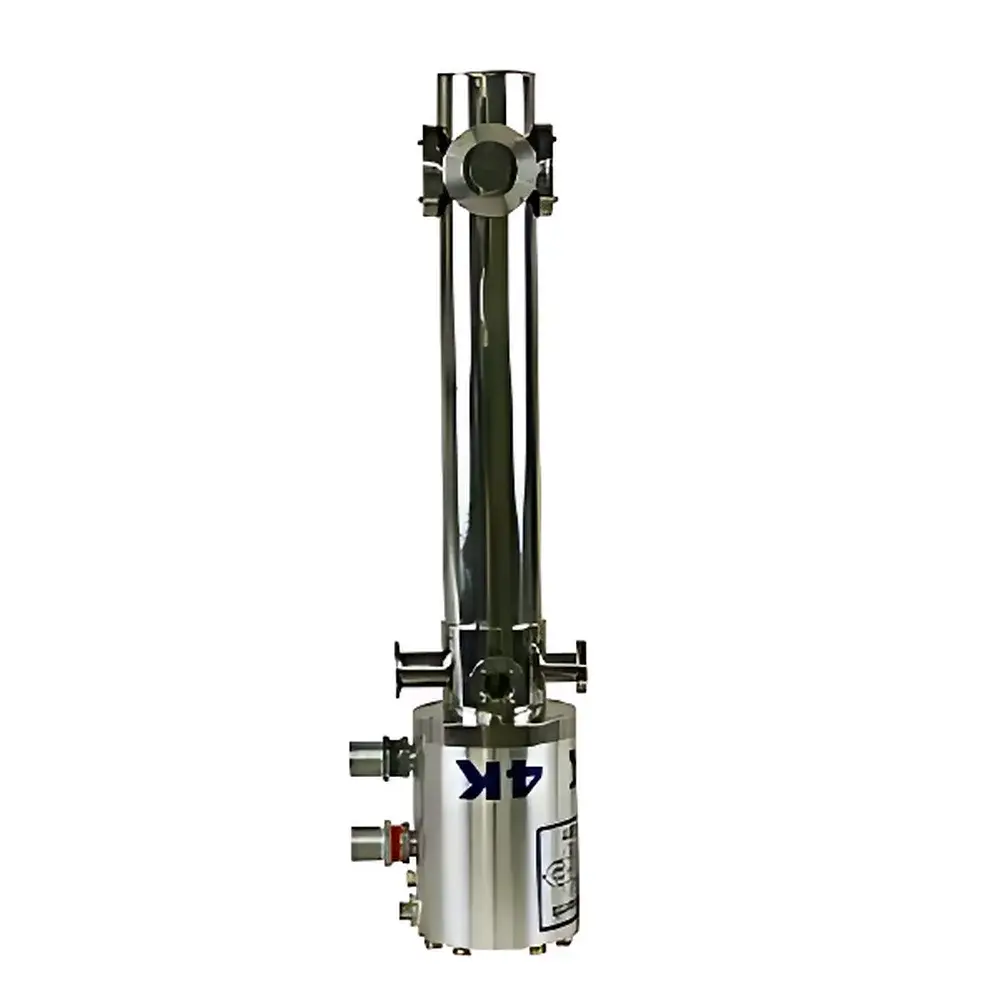
ARS X-4-1 Large-Bore Closed-Cycle Cryogenic Thermostat
| Brand | ARS |
|---|---|
| Origin | USA |
| Model | X-4-1 |
| Cooling Method | Gifford-McMahon (GM) Cryocooler |
| Temperature Range | 4 K to 350 K (optional: 2.7 K low-temp stage / 800 K high-temp upgrade) |
| Configuration | Vertical |
| Sample Chamber Diameter | 1.5 in (38 mm) optical access |
| Standard Viewports | 4 radial + 1 optional bottom |
| Structural Material | Welded Stainless Steel |
| Cryocooler Options | DE-202 or DE-204 series |
| Compliance | Designed for GLP/GMP-aligned lab environments, compatible with ASTM E2217 and ISO/IEC 17025 traceable calibration protocols |
Overview
The ARS X-4-1 Large-Bore Closed-Cycle Cryogenic Thermostat is an engineered solution for low-temperature experimental physics, materials science, and quantum device characterization requiring both wide thermal coverage and expansive sample accommodation. Unlike liquid-helium-dependent systems, the X-4-1 employs a Gifford-McMahon (GM) cryocooler—typically the DE-202 or DE-204 series—to achieve stable base temperatures from 4 K up to 350 K, with factory-upgradable configurations extending operational range to 2.7 K (via enhanced cold-head integration) or 800 K (with auxiliary resistive heating and thermal shielding). Its vertical, stainless-steel-welded architecture ensures mechanical rigidity and ultra-high vacuum (UHV)-compatible integrity (<1×10⁻⁸ mbar typical after bakeout), critical for long-duration experiments involving sensitive quantum transport or optical spectroscopy. The system’s defining feature is its large-bore sample chamber—designed specifically to accommodate diamond anvil cells (DACs), multi-probe electrical feedthroughs, and custom optical mounts—without compromising thermal stability or spatial accessibility.
Key Features
- Large internal bore: 38 mm (1.5-inch) clear aperture enables unobstructed optical path alignment for Raman, FTIR, photoluminescence, and magneto-optical Kerr effect (MOKE) measurements.
- F/1.1 optical collection geometry optimized for high-efficiency signal capture from low-light-emission samples under cryogenic conditions.
- Modular viewport configuration: four standard radial ports plus one optional bottom port for orthogonal optical access or integrated cryogenic wiring routing.
- Integrated instrumentation panel with calibrated PT-100 sensors, thermocouple inputs, and analog/digital I/O for synchronized temperature ramping and feedback control.
- No consumables required: fully closed-cycle operation eliminates dependency on liquid helium, reducing total cost of ownership and enabling continuous 24/7 operation in regulated laboratory environments.
- Structural robustness: all-welded 304 stainless-steel vacuum vessel meets ASME BPVC Section VIII standards and supports vibration-isolated mounting for interferometric or scanning probe applications.
Sample Compatibility & Compliance
The X-4-1 accommodates diverse sample geometries—including full-size diamond anvil cells with gasketed pressure media, multi-terminal mesoscopic devices, bulk single crystals, and thin-film heterostructures—within its 100 mm internal height and 38 mm diameter chamber. Electrical testing is supported via customizable hermetic feedthroughs (up to 64 channels, including low-noise coaxial and twisted-pair options). Optical compatibility extends across UV–Vis–NIR–MIR spectral bands (200 nm – 20 µm), validated per ISO 10110-7 surface quality specifications for installed windows. System design aligns with ISO/IEC 17025 requirements for measurement uncertainty quantification and supports audit-ready documentation for GLP and GMP workflows. All temperature controllers include NIST-traceable calibration certificates and comply with FDA 21 CFR Part 11 electronic record controls when paired with ARS’s optional LabVIEW-based acquisition software.
Software & Data Management
The X-4-1 integrates natively with ARS’s CryoCommand™ software suite, offering programmable temperature ramps (0.01 K/min to 10 K/min), real-time PID optimization, and synchronized data logging at up to 100 Hz sampling rate across multiple sensor inputs. Export formats include CSV, HDF5, and TDMS for direct ingestion into MATLAB, Python (NumPy/Pandas), or Igor Pro. Audit trails record user actions, parameter changes, and calibration events—enabling full compliance with 21 CFR Part 11 requirements for electronic signatures and data integrity. Optional API support allows integration into centralized lab automation platforms (e.g., LabArchives, Benchling) via RESTful endpoints and OPC UA protocol.
Applications
- High-pressure quantum phase studies using diamond anvil cells across 6 K–700 K temperature sweeps.
- Low-temperature transport characterization: Hall effect, van der Pauw resistivity, deep-level transient spectroscopy (DLTS), and gate-tunable 2D electron gas systems.
- Temperature-resolved optical spectroscopies: micro-Raman mapping, time-resolved photoluminescence (TRPL), electroluminescence under bias, and Fourier-transform infrared (FTIR) absorption.
- Magneto-optical investigations: Faraday rotation, polar Kerr effect, and magnetic circular dichroism (MCD) with field-cooling capability up to ±9 T when interfaced with superconducting magnets.
- Thermomagnetic property analysis: AC susceptibility, zero-field-cooled/field-cooled (ZFC/FC) magnetization, and specific heat measurements via relaxation calorimetry add-ons.
FAQ
What is the base temperature achievable with the standard DE-202 cold head?
The standard DE-202 configuration achieves a base temperature of ≤4.2 K under no-load conditions; with optional vibration-damping mounts and thermal anchoring upgrades, sub-4 K stability (≤3.8 K) is routinely maintained.
Can the X-4-1 be configured for UHV applications?
Yes—the chamber is constructed from vacuum-brazed 304 stainless steel, includes metal-sealed ConFlat flanges, and is bakeable to 150 °C, supporting pressures down to 1×10⁻⁹ mbar when paired with ion pumps and turbomolecular pumping stations.
Is remote operation supported?
All temperature setpoints, ramp rates, and sensor readouts can be controlled via Ethernet-connected PC or embedded web interface; secure SSH and TLS 1.2 encryption are enabled by default.
How is thermal uniformity ensured across the sample space?
A multi-zone thermal shunt network, combined with active heater-sensor feedback loops on the cold finger, sample stage, and radiation shield, maintains axial and radial gradients below ±15 mK over a 10 mm × 10 mm region at 4 K.
What electrical feedthrough options are available?
Standard configurations include 16-pin D-sub, SMA, and triaxial feedthroughs; custom solutions with filtered DC/RF lines, superconducting leads, or cryogenic CMOS-compatible interposers are available upon engineering review.



