
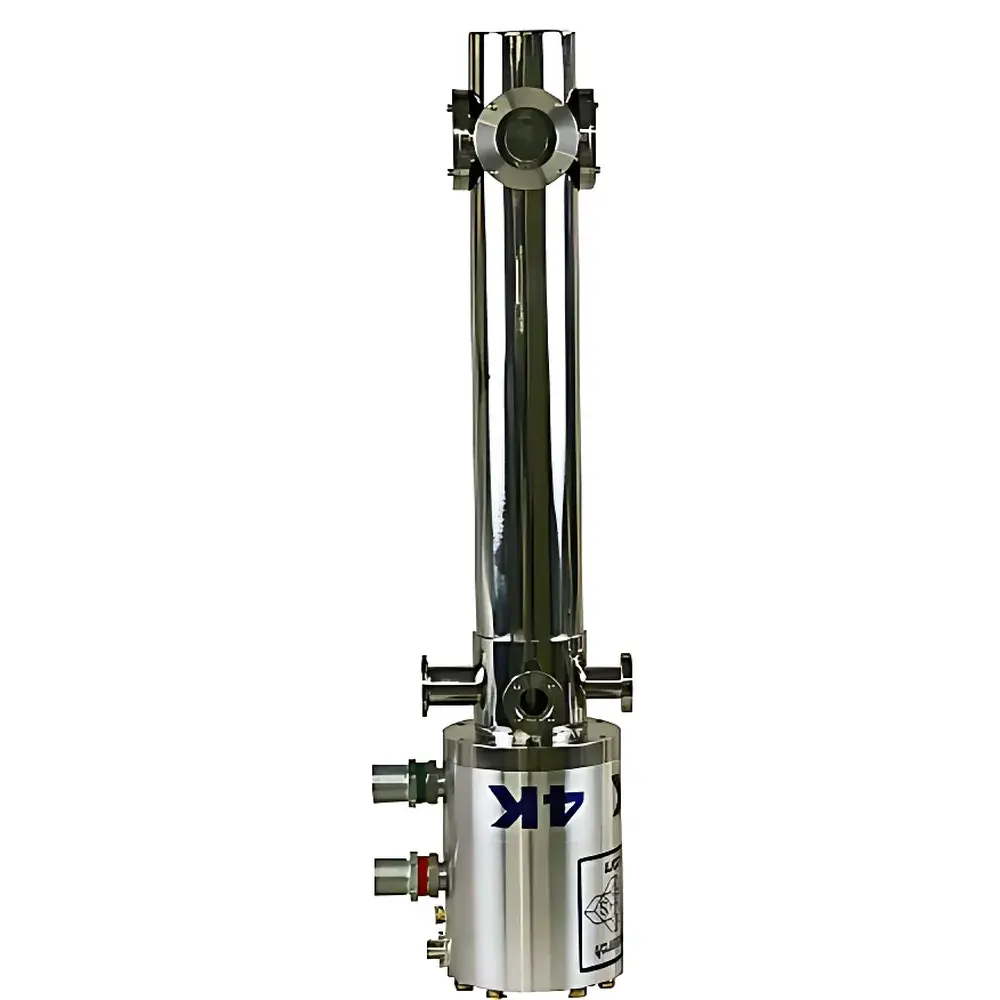
ARS X-4 Large-Bore Closed-Cycle Cryogenic Thermostat
| Brand | ARS |
|---|---|
| Origin | USA |
| Model | X-4 |
| Cooling Capacity Options | 4 K, 5.5 K, 10 K |
| Base Cooling System | DE-202 or DE-204 GM Cryocooler |
| Compressor | ARS-2HW |
| Vacuum Shroud | Stainless Steel with 4 Standard Optical Ports (5th Port Optional at Base) |
| Optical Windows | Two High-Purity Fused Silica, 1.5-inch Diameter |
| Sample Viewing Geometry | F/1.1 Aperture Ratio |
| Temperature Control Sensors | Calibrated Silicon Diode (±12 mK accuracy, 4-ft lead), Control-grade Silicon Diode (±0.5 K) |
| Electrical Feedthrough | 10-pin Hermetic Connector |
| Heating | 36 Ω Thin-Film Heater |
| Radiation Shield | Nickel-Plated Oxygen-Free Copper |
| Helium Transfer Lines | Two Flexible Cryogenic Lines |
| Operating Temperature Range (with Upgrade) | 6 K to 700 K Continuous Sweep |
Overview
The ARS X-4 Large-Bore Closed-Cycle Cryogenic Thermostat is an engineered solution for low-temperature experimentation requiring high optical access, mechanical stability, and thermal uniformity across extended temperature ranges. Designed around a GM-type cryocooler architecture—specifically compatible with DE-202 and DE-204 cold heads—the X-4 eliminates dependence on liquid cryogens while maintaining stable base temperatures of 4 K, 5.5 K, or 10 K. Its defining feature is the enlarged sample chamber, constructed from fully welded stainless steel, which accommodates bulky experimental configurations including diamond anvil cells (DACs), multi-probe electrical assemblies, and optomechanical stages used in synchrotron or laser-based spectroscopy. The integrated vacuum shroud includes four standard optical ports arranged orthogonally; a fifth port may be added at the base for vertical optical access—a critical capability for magnetooptical and ellipsometric measurements. Thermal management is enhanced by a nickel-plated oxygen-free copper radiation shield, actively cooled via conduction to the second stage of the cold head, ensuring minimal radiative loading on the sample stage.
Key Features
- Large-bore design with 1.5-inch fused silica optical windows and F/1.1 numerical aperture—optimized for high-throughput light collection in Raman, FTIR, photoluminescence, and electroluminescence experiments
- Hermetically sealed 10-pin electrical feedthrough enabling low-noise DC and low-frequency AC measurements without vacuum breach
- Dual-sensor temperature control architecture: one calibrated silicon diode (±12 mK uncertainty, 4-ft cable for direct sample mounting) and one control-grade diode (±0.5 K) for system-level regulation
- Integrated 36 Ω thin-film heater for precise resistive heating and continuous 6 K–700 K temperature sweeps when combined with optional high-temperature interface kits
- Modular vacuum shroud (DMX-4 configuration) with standardized flange geometry, facilitating integration with UHV chambers, superconducting magnets, and custom optical tables
- Flexible helium transfer lines and ARS-2HW compressor platform—designed for long-term unattended operation with <0.5% temperature drift over 24-hour intervals under steady-state conditions
Sample Compatibility & Compliance
The X-4 supports heterogeneous sample geometries—from sub-millimeter DAC gaskets to macroscopic single crystals and heterostructured thin-film devices. Its open-stage architecture allows direct mounting of commercial probe stations, piezoelectric positioners (e.g., Attocube systems), and fiber-coupled detectors. All wetted materials comply with ASTM F897 (standard specification for oxygen-free copper) and ASTM B152 (copper sheet/plate standards). The stainless steel vacuum envelope meets ISO 10100:2019 requirements for ultra-high vacuum compatibility (base pressure <1×10⁻⁸ mbar achievable with supplemental pumping). For regulated environments, the system’s analog temperature readout and digital control interface support audit-trail logging when integrated with third-party SCADA platforms compliant with FDA 21 CFR Part 11 and GLP/GMP documentation frameworks.
Software & Data Management
While the X-4 operates natively via analog front-panel controls and discrete instrumentation, it is fully compatible with industry-standard data acquisition ecosystems. Temperature sensors output standard 4-wire resistance signals (0–10 kΩ range), interoperable with Keysight B2900-series SMUs, Lake Shore 372 AC resistance bridges, and National Instruments DAQ modules. Optional RS-232 or Ethernet-enabled temperature controllers (e.g., Lake Shore 336 or CryoCon 26C) provide programmable ramping, setpoint sequencing, and real-time PID parameter adjustment. All sensor calibrations are traceable to NIST SRM 1750a (silicon diode reference standard), and raw resistance-to-temperature conversion follows the IEEE 1194-1991 polynomial standard for semiconductor thermometers.
Applications
- High-pressure quantum transport: diamond anvil cell integration for resistivity, Hall effect, and deep-level transient spectroscopy (DLTS) under cryogenic magnetic fields
- Low-temperature spectroscopy: polarization-resolved magneto-optical Kerr effect (MOKE), time-resolved photoluminescence, and synchrotron-based X-ray absorption near-edge structure (XANES) mapping
- Thermomagnetic characterization: temperature-dependent magnetic susceptibility measurements using SQUID-compatible sample holders mounted directly on the cold finger
- Optoelectronic device testing: cryogenic evaluation of perovskite solar cells, quantum dot LEDs, and 2D material heterojunctions across 6–300 K
- Calibration metrology: reference-stage deployment for validating secondary thermometer performance against primary standards in national metrology institutes
FAQ
What base temperature options are available for the X-4 system?
The X-4 is configured with either a DE-202 or DE-204 cold head, supporting base temperatures of 4 K, 5.5 K, or 10 K depending on cold head model and compressor operating parameters.
Can the X-4 be integrated into an existing UHV system?
Yes—the stainless steel vacuum shroud uses CF-63 or ISO-KF 50 flanges (configurable upon order) and maintains compatibility with turbomolecular pumping systems down to 1×10⁻⁹ mbar.
Is the 1.5-inch optical window suitable for UV transmission?
Standard fused silica windows transmit effectively from 185 nm to 2.5 µm; for enhanced deep-UV performance (<190 nm), synthetic fused silica or MgF₂ window upgrades are available as custom options.
How is temperature uniformity maintained across the sample stage?
Uniformity is achieved through symmetric thermal anchoring of the sample mount to the second-stage cold head, active radiation shielding, and low-thermal-conductance mounting hardware—typical spatial gradients are ≤ ±15 mK over a 10 mm diameter area at 4 K.
Does ARS provide calibration certificates for the included temperature sensors?
Each calibrated silicon diode is supplied with a NIST-traceable calibration certificate covering the 1.4–300 K range, generated using a dual-slope interpolation method per IEEE 1194-1991 Annex A.



