
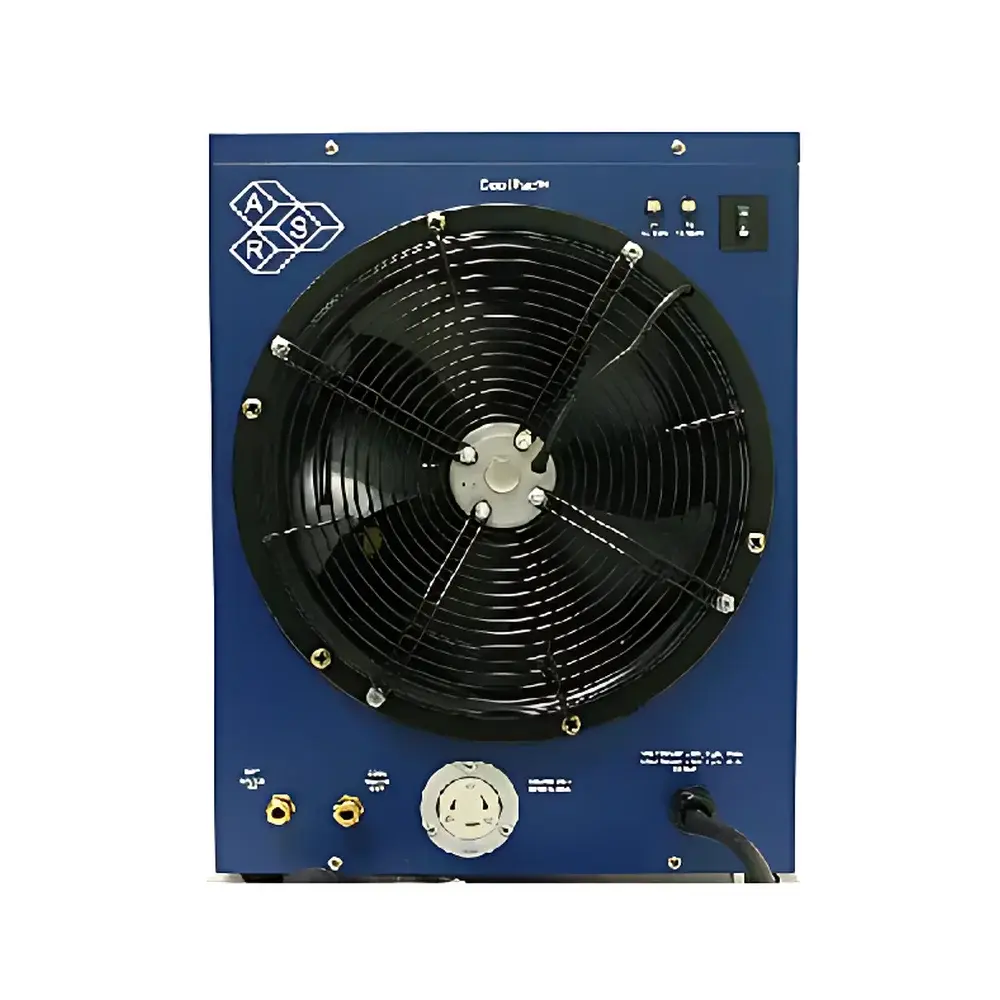
ARS CP-4 Circulating Chiller
| Brand | ARS |
|---|---|
| Origin | USA |
| Model | CP-4 |
| Instrument Type | Integrated Circulating Chiller |
| Cooling Method | Air-Cooled |
| Temperature Control Range | 12–32 °C |
| Temperature Stability | ±0.1 °C |
| Refrigeration Capacity | 3.9 kW |
| Circulation Pump Pressure | 2.0 bar |
| Circulation Flow Rate | 6.3 L/min |
| Reservoir Volume | 1 L |
| Operating Mode | Continuous |
| Power Supply | 200–230 V, 50/60 Hz |
| Ambient Operating Temperature | 12–32 °C |
| Storage Temperature | −20 to +60 °C |
| Water Flow Connection | 3/8″ compression fitting |
| Airflow Requirement | 19.8 m³/min (700 SCFM) |
| Dimensions (L×W×H) | 483 × 533 × 617 mm |
| Net Weight | 36 kg (compressor unit), 39 kg (fully assembled) |
| Water Quality | pH 6–8, total hardness < 85 ppm CaCO₃ |
Overview
The ARS CP-4 Circulating Chiller is an integrated, air-cooled refrigeration system engineered for precise thermal management of laboratory instruments requiring stable, continuous coolant delivery. Designed and manufactured in the United States, the CP-4 employs a hermetically sealed scroll compressor and optimized fin-and-tube condenser architecture to deliver consistent cooling performance across ambient temperatures from 12 °C to 32 °C. Its core function is to maintain a tightly regulated bath temperature—within ±0.1 °C stability—while supplying chilled water at a nominal flow rate of 6.3 L/min and up to 2.0 bar pressure. This enables reliable operation of high-heat-load analytical equipment including NMR spectrometers, X-ray diffractometers, laser systems, plasma sources, and vacuum pumps. Unlike immersion-based or open-bath chillers, the CP-4 utilizes a closed-loop circulation path with a 1-liter stainless-steel reservoir, minimizing evaporation loss and reducing maintenance frequency. Its compact footprint (483 × 533 × 617 mm) and front-access service panel support integration into space-constrained lab environments without compromising serviceability.
Key Features
- Stable temperature control within ±0.1 °C over the full 12–32 °C operating range, achieved via PID-controlled electronic expansion valve and dual-sensor feedback loop
- Air-cooled design eliminates dependency on facility chilled water infrastructure—ideal for labs lacking centralized cooling systems
- High-efficiency scroll compressor with low-vibration mounting and acoustic insulation for reduced operational noise (<65 dB(A) at 1 m)
- Integrated circulation pump rated for continuous duty at 6.3 L/min and 2.0 bar maximum head pressure
- Corrosion-resistant 304 stainless-steel reservoir with level sensor, leak detection circuit, and over-temperature cutoff
- Dual-voltage compatibility (200–230 V, 50/60 Hz) supports global deployment without external transformers
- Front-panel digital interface with real-time display of setpoint, actual bath temperature, flow status, and fault codes
Sample Compatibility & Compliance
The CP-4 is compatible with standard laboratory-grade deionized or municipal tap water meeting ASTM D1193 Type IV specifications (pH 6–8, total hardness < 85 ppm CaCO₃). It interfaces seamlessly with instruments requiring 3/8″ compression fittings and tolerates inlet water temperatures up to 35 °C. The unit complies with UL 61010-1 (Safety Requirements for Electrical Equipment for Measurement, Control, and Laboratory Use) and meets CE marking requirements under the EU Low Voltage Directive (2014/35/EU) and EMC Directive (2014/30/EU). While not certified for cleanroom use, its sealed refrigerant circuit and non-oil-lubricated pump reduce particulate generation—making it suitable for ISO Class 7 (10,000) or less stringent controlled environments. For GLP/GMP-regulated applications, optional analog output (0–10 V) and RS-485 Modbus RTU enable integration into validated environmental monitoring systems.
Software & Data Management
The CP-4 operates as a standalone instrument with no proprietary software dependency. All configuration and monitoring occur via its embedded LCD interface. For remote oversight, optional RS-485 connectivity supports integration with LabVIEW, Python-based SCADA platforms, or building management systems (BMS) using standard Modbus RTU protocol. Logged parameters—including runtime hours, compressor cycles, temperature deviation history, and alarm events—are retained in non-volatile memory for up to 30 days. Audit trails are exportable via serial dump; however, native 21 CFR Part 11 compliance (e.g., electronic signatures, user role management) requires third-party middleware. Firmware updates are performed locally via USB port using signed binary files provided by ARS Technical Support.
Applications
- Thermal stabilization of superconducting magnet cryocoolers in NMR and MRI preclinical systems
- Coolant supply for high-power CO₂ and fiber lasers used in materials processing and spectroscopy
- Heat extraction from XRD goniometers, electron beam welders, and RF plasma generators
- Temperature regulation of photomultiplier tube housings and CCD detector assemblies in low-light imaging
- Support of long-duration chromatography runs where column oven heat dissipation must be actively managed
- Backup cooling for recirculating water baths in failure-contingency protocols
FAQ
What is the minimum ambient temperature required for safe operation?
The CP-4 is rated for continuous operation between 12 °C and 32 °C ambient. Below 12 °C, compressor oil viscosity increases and refrigerant return may be impaired; extended use below this threshold voids warranty.
Can the CP-4 be used with ethylene glycol/water mixtures?
No. The CP-4 is designed exclusively for aqueous solutions meeting specified pH and hardness limits. Glycol-based coolants degrade seals, impair heat transfer, and invalidate safety certifications.
Is the reservoir accessible for cleaning or descaling?
Yes. The stainless-steel reservoir features a removable top cover and drain valve. ARS recommends quarterly inspection and citric acid descaling if water hardness exceeds 50 ppm CaCO₃.
Does the unit include dry-run protection for the circulation pump?
Yes. A flow sensor and reservoir level switch trigger automatic shutdown if flow drops below 2.5 L/min for >15 seconds or if liquid level falls below 30% capacity.
What maintenance intervals does ARS recommend?
Compressor oil and filter replacement every 12 months or 4,000 operating hours; condenser coil cleaning every 3 months in dusty environments; annual calibration verification of temperature sensors per ISO/IEC 17025 guidelines.



