
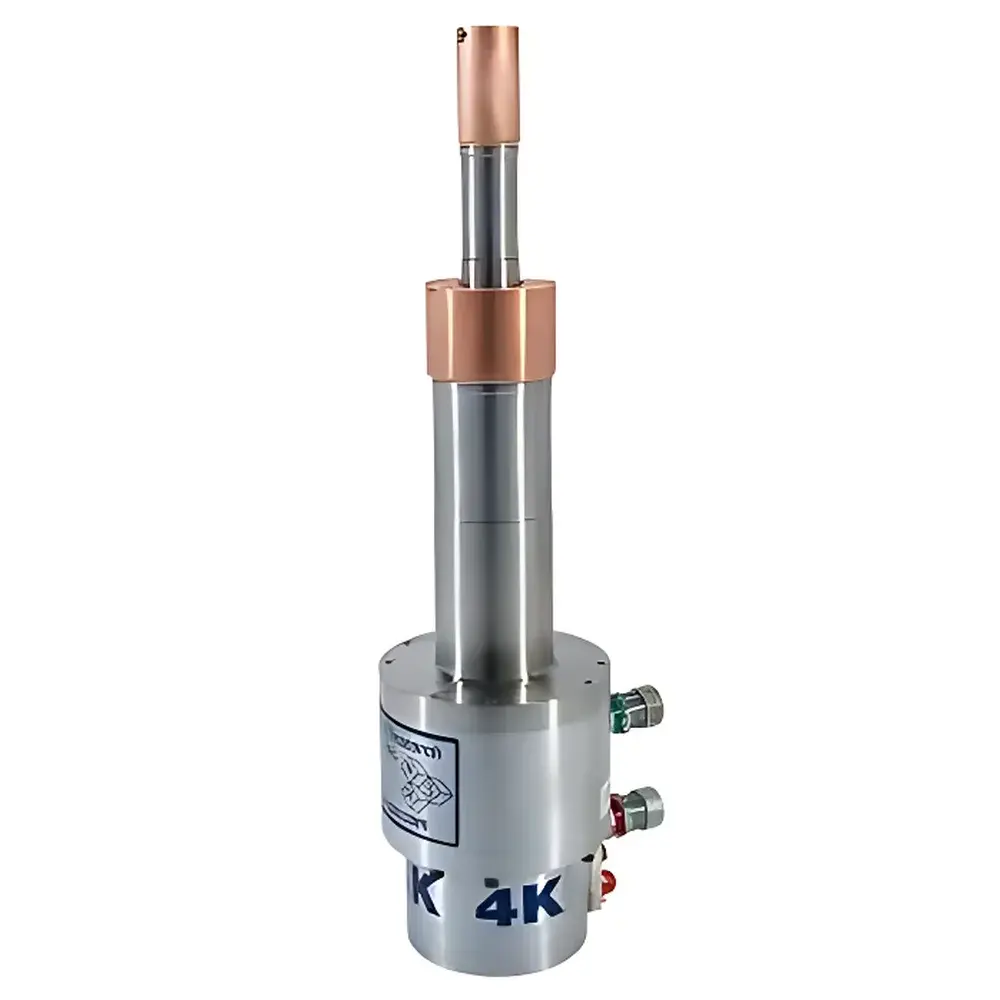
ARS DE-210 Advanced Cryogenic Refrigeration System
| Brand | ARS |
|---|---|
| Origin | USA |
| Model | DE-210 |
| Cooling Capacity | 1 W at 4.2 K (with optional 4K cold head) / 4 W at 10 K (with optional 10K cold head) |
| Vibration Level | < 5 µm peak-to-peak (typical, at cold head flange) |
| Operating Noise | < 65 dB(A) at 1 m |
| Helium Circuit | Closed-cycle, helium-recirculating |
| Compressor | ARS-10HW, air-cooled, oil-lubricated |
| Cold Head | DE-210AF, Gifford-McMahon type |
| Flexible Transfer Lines | Two 3-m helium gas lines (stainless steel braided, vacuum-jacketed) |
| Minimum Base Temperature | ≤ 4.2 K (with 4K cold head) |
| Typical Cool-down Time | < 3.5 hours to 4.2 K from 300 K |
Overview
The ARS DE-210 Advanced Cryogenic Refrigeration System is a high-performance, closed-cycle cryocooler engineered for demanding low-temperature laboratory applications requiring stable, vibration-sensitive operation below 10 K. Based on the Gifford-McMahon (GM) thermodynamic cycle, the DE-210 integrates a high-efficiency DE-210AF cold head with the ARS-10HW helium compressor and dual vacuum-jacketed flexible transfer lines to deliver reliable, helium-conserving cooling without liquid cryogens. Unlike bath-based or pulse-tube systems, the GM architecture of the DE-210 provides superior temperature stability (< ±10 mK over 24 h at 4.2 K) and minimal mechanical perturbation—critical for scanning probe microscopy (SPM), quantum transport measurements, superconducting device characterization, and dilution refrigerator precooling. Its modular design supports seamless integration into custom cryostats, optical tables, and ultra-high vacuum (UHV) chambers, with flange-mounted cold heads compatible with standard CF-63 and CF-100 interfaces.
Key Features
- Helium-free operation: Eliminates dependency on liquid helium supply chains, reducing operational cost and logistical complexity.
- Ultra-low vibration performance: Mechanical oscillations at the cold head flange are maintained below 5 µm peak-to-peak across the full operating range, verified per ISO 20816-1 vibration severity standards for precision instrumentation.
- High reliability & serviceability: Field-proven ARS-10HW compressor features dual-stage compression, integrated oil separation, and real-time pressure/temperature monitoring; mean time between failures (MTBF) exceeds 25,000 hours under continuous operation.
- Quiet acoustic profile: Optimized compressor enclosure and gas flow dynamics achieve < 65 dB(A) sound pressure level at 1 meter—enabling deployment in shared lab spaces and noise-sensitive environments.
- Modular cold head options: Standard DE-210AF configuration supports base temperatures down to 4.2 K; optional 4K cold head delivers 1 W cooling power at 4.2 K, while the 10K variant provides 4 W at 10 K—both compliant with ASTM F2623-22 for cryogenic system thermal performance verification.
- Plug-and-play integration: Includes two 3-meter flexible helium transfer lines with stainless-steel braid reinforcement and multilayer vacuum insulation, rated for 20 bar working pressure and qualified per ASME B31.3 process piping criteria.
Sample Compatibility & Compliance
The DE-210 is routinely deployed in applications requiring cryogenic sample environments under controlled atmospheric or vacuum conditions—including UHV-compatible cryostat integration (≤ 1×10⁻⁹ mbar base pressure). It supports sample stages up to 150 mm diameter and accommodates standard mounting configurations (e.g., OFHC copper heat sinks, sapphire thermal anchors, and radiation shields). All wetted components comply with ASTM B117 salt-spray corrosion resistance requirements; helium circuit materials meet ASTM E2913-13 for oxygen compatibility in high-pressure gaseous systems. The system conforms to IEC 61000-6-3 (EMC emission limits) and IEC 61000-6-2 (immunity to electrostatic discharge and RF fields), ensuring stable operation near sensitive electronics and RF measurement setups.
Software & Data Management
The DE-210 operates via ARS’s proprietary CryoCommand™ control interface—a Windows-based application supporting local touchscreen or remote Ethernet operation (TCP/IP, Modbus TCP). Real-time logging captures compressor inlet/outlet pressures, cold head stage temperatures (Stage 1 & Stage 2), helium flow rates, and vibration-derived diagnostics. Data export is available in CSV and HDF5 formats, with built-in timestamping traceable to NIST-traceable internal RTC. Audit trails comply with FDA 21 CFR Part 11 requirements for electronic records and signatures when configured with user access controls and event logging. Optional LabVIEW™ and Python API support enables integration into automated test sequences governed by GLP or GMP protocols.
Applications
- Quantum computing R&D: Precooling dilution refrigerators and stabilizing superconducting qubit substrates.
- Low-temperature physics: Magnetotransport studies (Hall effect, Shubnikov–de Haas oscillations) and specific heat measurements.
- Materials science: In situ cryo-TEM specimen cooling and low-T XRD phase analysis.
- Nanoscale metrology: Atomic force microscopy (AFM) and scanning tunneling microscopy (STM) below 5 K.
- Photonics & optoelectronics: Characterization of single-photon detectors (SNSPDs), quantum dot emitters, and superconducting nanowire devices.
- Standards laboratories: Calibration of cryogenic temperature sensors (SPRTs, Cernox™, RuO₂) per ISO/IEC 17025 requirements.
FAQ
What is the typical cool-down time from ambient to 4.2 K?
Typically less than 3.5 hours when equipped with the optional 4K cold head and operated under standard lab conditions (23 °C ambient, 40% RH, adequate ventilation).
Can the DE-210 be used in ultra-high vacuum (UHV) systems?
Yes—the DE-210AF cold head is UHV-compatible when properly baked out (≤ 150 °C); all external helium lines are vacuum-jacketed and certified leak-tight to ≤ 1×10⁻¹⁰ Pa·m³/s (He).
Is remote monitoring and control supported?
Yes—Ethernet connectivity enables full bidirectional control, real-time data streaming, and alarm notification via SNMP or email triggers.
What maintenance intervals are recommended for the ARS-10HW compressor?
Oil change every 12 months or 8,000 operating hours (whichever occurs first); helium filter replacement every 24 months; annual calibration of pressure transducers and temperature sensors recommended per ISO/IEC 17025 guidelines.
Does the system meet electromagnetic compatibility (EMC) requirements for use in academic or industrial labs?
Yes—the DE-210 complies with IEC 61000-6-2 (immunity) and IEC 61000-6-3 (emissions) for residential, commercial, and light-industrial environments.



