
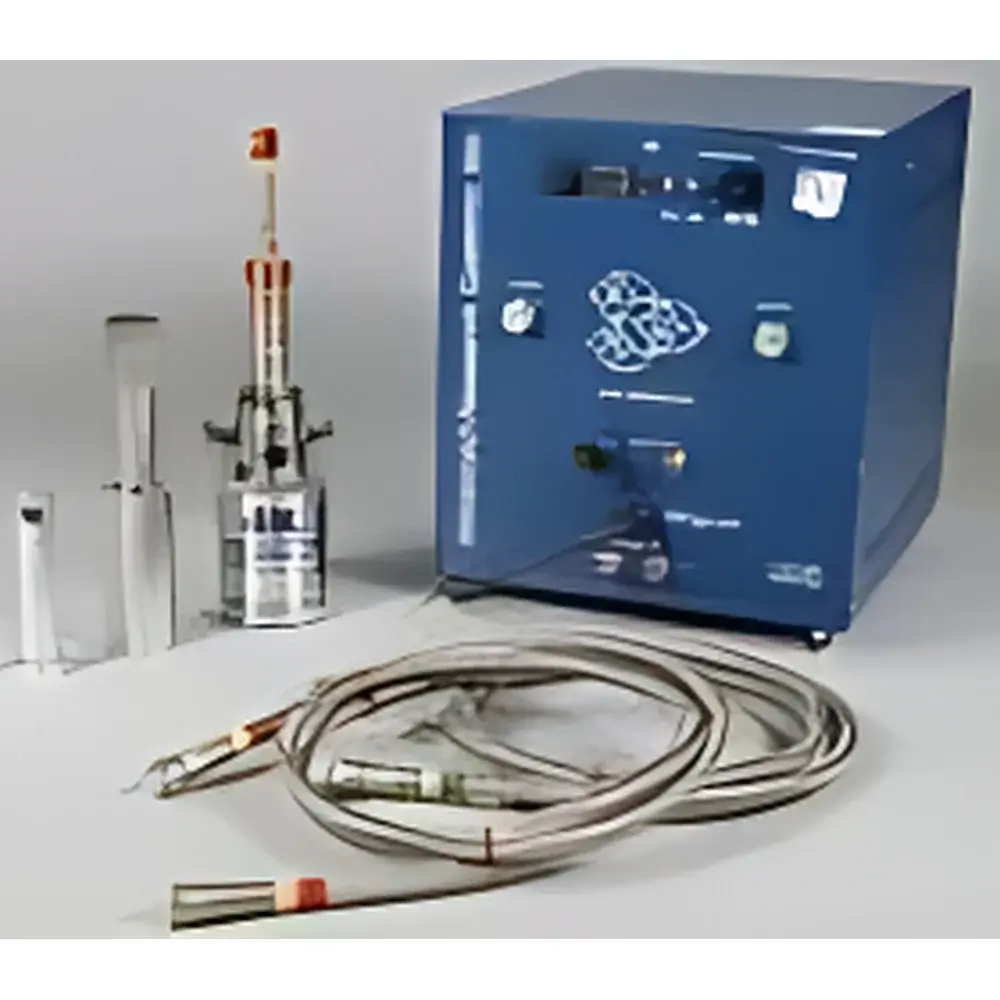
ARS Displex Series Closed-Cycle Cryogenic Refrigeration System
| Brand | ARS |
|---|---|
| Origin | USA |
| Model | Displex Series |
| Type | Two-Stage & Single-Stage Cryocoolers |
| Cooling Principle | Gifford-McMahon (GM) Cycle |
| Operating Voltage | 110 V / 60 Hz (performance reduced ~20% at 220 V / 50 Hz) |
| Compliance | Designed for integration with spectroscopic, magneto-optical, and quantum transport measurement systems |
| Key | Two-stage models reach ≤4.2 K |
| Key | Refrigeration power ranges from 40 mW @ 2 K (DE-202-1.7) to 210 W @ 150 K (DE-110) |
| Key | Typical base temperature stability: ±10 mK over 24 h (with optional PID-controlled heater & calibrated RuO₂ sensor) |
| Key | Vacuum-compatible stainless-steel cold head, all-metal seals, ISO-KF 63 vacuum flange standard |
| Key | Integrated temperature controller with 4-wire RTD/RuO₂ input, programmable ramp rates, and setpoint hold function |
Overview
The ARS Displex Series Closed-Cycle Cryogenic Refrigeration System is an engineered solution for high-stability, vibration-minimized low-temperature environments in advanced spectroscopy, quantum materials characterization, and condensed matter physics laboratories. Based on the Gifford-McMahon (GM) cryocooling cycle, the system achieves continuous, oil-free cooling without liquid cryogens by compressing and expanding helium gas through regenerative heat exchangers. This thermodynamic process enables precise thermal management across a broad operational range—from 355 K down to 1.7 K—making it ideal for experiments requiring long-duration thermal equilibration, repeated thermal cycling, or integration with optical access (e.g., FTIR, Raman, photoluminescence, and magneto-optical Kerr effect setups). Unlike bath-based cryostats, the Displex architecture eliminates boil-off losses, reduces operational overhead, and supports automated, unattended operation under vacuum or controlled-atmosphere conditions.
Key Features
- Two-stage and single-stage configurations optimized for distinct experimental requirements: two-stage units deliver sub-4.2 K base temperatures with milliwatt-level cooling power at ultra-low temperatures; single-stage units prioritize high cooling capacity above 77 K for rapid cooldown and high-heat-load applications.
- Modular cold head design featuring all-metal vacuum seals, ISO-KF 63 flange interface, and integrated radiation shielding—compatible with standard optical cryostat mounts and custom sample probes.
- Dual-sensor temperature control architecture: primary RuO₂ or Cernox® sensor for high-accuracy (<±5 mK) low-T measurement; secondary platinum RTD for mid-to-high temperature monitoring and redundancy.
- Dedicated ARS temperature controller with 4-channel I/O, programmable ramp profiles (0.01–10 K/min), auto-tuning PID, and real-time data logging via USB or Ethernet (TCP/IP).
- Low-vibration compressor platforms (ARS-2, ARS-4, ARS-10 series) acoustically decoupled from the cold head, minimizing mechanical perturbation critical for interferometric, scanning probe, and quantum coherence measurements.
- Comprehensive safety interlocks including overtemperature cutoff, compressor phase-loss detection, vacuum loss alarm, and helium pressure monitoring.
Sample Compatibility & Compliance
The Displex system is routinely deployed in ISO/IEC 17025-accredited analytical labs and university cleanroom facilities where reproducibility and traceable thermal control are mandatory. Its vacuum-jacketed cold finger accommodates standard sample holders (e.g., OFHC copper stages, sapphire windows, magnetic field inserts up to 9 T), and supports electrical feedthroughs (coaxial, twisted-pair, superconducting leads) for simultaneous transport, magnetotransport, or THz spectroscopy. All models meet CE marking requirements for electromagnetic compatibility (EMC Directive 2014/30/EU) and low-voltage safety (LVD Directive 2014/35/EU). The temperature controller firmware supports audit-trail logging compliant with GLP and FDA 21 CFR Part 11 when configured with user authentication and electronic signature modules.
Software & Data Management
ARS provides the proprietary CryoCommander™ software suite for Windows-based instrument control, enabling remote monitoring of cold head temperature, compressor status, helium pressure, and cooling power estimation in real time. Data export is supported in CSV and HDF5 formats for post-processing in MATLAB, Python (NumPy/Pandas), or Igor Pro. The system’s embedded controller includes non-volatile memory for storing up to 100 user-defined temperature programs and maintains full calibration history—including sensor coefficients, heater resistance drift compensation, and thermal lag corrections—accessible via secure web interface or local terminal.
Applications
- Low-temperature photoluminescence and cathodoluminescence spectroscopy of 2D materials (e.g., TMDCs, hBN) and quantum dots.
- In situ Raman and FTIR studies of phase transitions in correlated electron systems (e.g., VO₂, FeSe, cuprates).
- Quantum transport measurements (Hall effect, Shubnikov–de Haas oscillations) in epitaxial thin films and heterostructures.
- Magneto-optical characterization including Faraday rotation, Voigt effect, and polar Kerr microscopy.
- Calibration reference sources for IR detector arrays and bolometric radiometers per ASTM E1256-22.
- Stabilized cryogenic platforms for superconducting nanowire single-photon detectors (SNSPDs) and transition-edge sensors (TES).
FAQ
What is the typical base temperature stability achievable with the DE-204S model?
With active PID control and a calibrated RuO₂ sensor, the DE-204S maintains ±10 mK stability over 24 hours at 4.2 K under static load conditions. Stability degrades to ±25 mK when introducing 100 µW of AC excitation power.
Can the Displex system be operated under high vacuum or inert gas atmosphere?
Yes—the cold head is rated for operation at ≤1×10⁻⁶ Torr (high vacuum) or in purified N₂/He purge environments. Optional gas-tight sample chambers with quartz viewports are available for atmospheric spectroscopy applications.
Is remote monitoring and control supported over LAN or internet?
Yes—CryoCommander™ supports TCP/IP communication and HTTPS-enabled web dashboard access. Integration with LabVIEW, Python (pyvisa), and EPICS IOC is documented in the ARS Developer Toolkit.
How does performance change when using 220 V / 50 Hz mains supply?
All cooling capacities and cooldown speeds decrease by approximately 20% relative to 110 V / 60 Hz specifications due to reduced compressor volumetric efficiency and lower GM cycle frequency. ARS recommends voltage conversion or dedicated 110 V / 60 Hz UPS for mission-critical applications.
Are OEM integration kits available for custom cryostat designs?
Yes—ARS offers engineering support packages including mechanical drawings (STEP/IGES), thermal interface specifications, electrical pinouts, and API documentation for seamless integration into third-party optical or magnetic systems.
Related Products




