
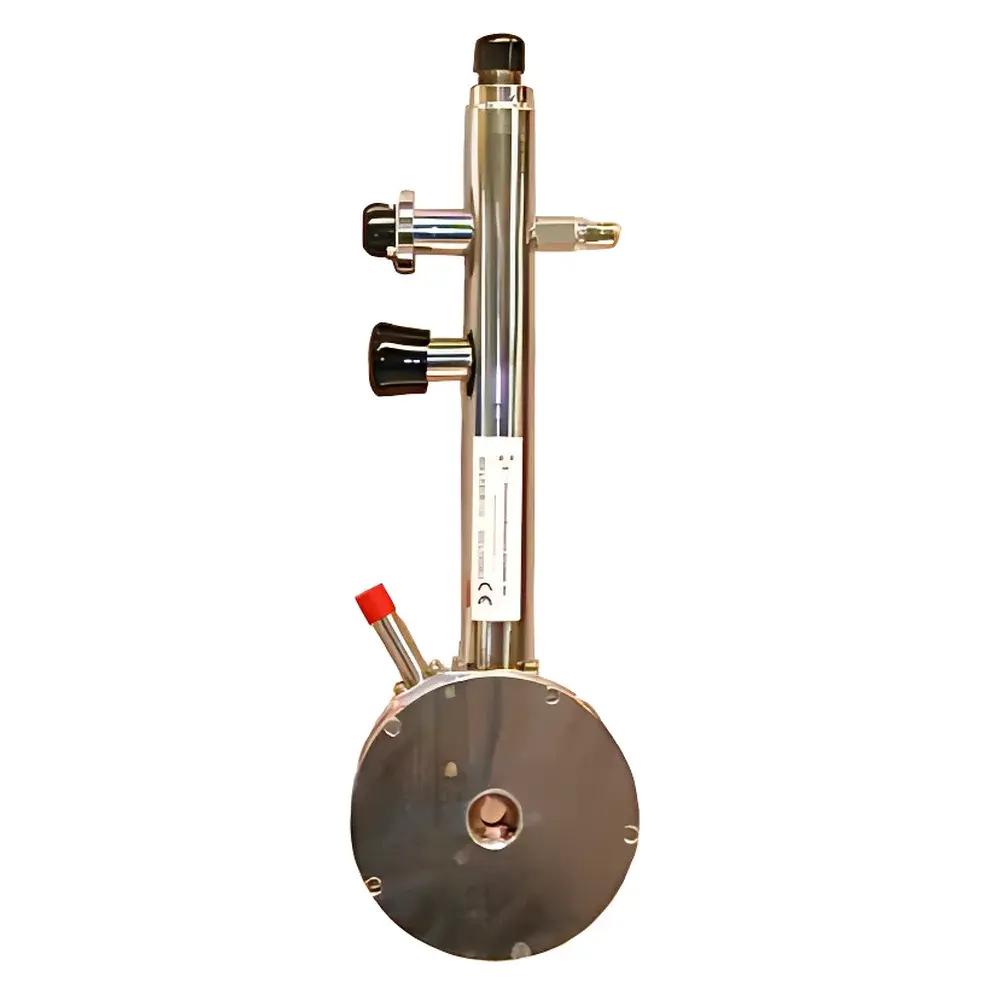
ARS LT3-OM Microscope-Compatible Cryogenic Thermostat
| Brand | ARS |
|---|---|
| Origin | USA |
| Model | LT3-OM-1 |
| Cooling Medium | Liquid Helium / Liquid Nitrogen |
| Temperature Range | 2 K (under pumping) to 350 K |
| Base Temperature | ≤4.2 K |
| Liquid Helium Consumption | 0.7 L/hr @ 4.2 K |
| Cool-down Time | ~20 min |
| Configuration | Vertical |
| Sample Chamber Diameter | 1.52 in (38.6 mm) |
| Vibration Performance | Ultra-low |
| Optical Access | Coaxial, Microscope-integrated |
| Vacuum Housing | Electropolished Welded Stainless Steel |
| Compliance | Designed for UHV-compatible optical microscopy environments |
Overview
The ARS LT3-OM Microscope-Compatible Cryogenic Thermostat is an engineered solution for high-stability, low-vibration cryogenic temperature control in optical microscopy applications—particularly confocal Raman spectroscopy. Based on a coaxial liquid helium transfer line architecture, the LT3-OM delivers precise, reproducible thermal regulation across a continuous range from <2 K (achievable under vacuum-pumped conditions) to 350 K. Its design prioritizes thermal homogeneity, mechanical isolation, and optical accessibility—enabling integration with commercial upright and inverted microscopes, including Renishaw inVia™ Raman systems. Unlike conventional cryostats with radial cold-finger configurations, the LT3-OM’s coaxial cooling path minimizes thermal gradients along the optical axis while suppressing conductive and convective perturbations that compromise spectral resolution and spatial fidelity.
Key Features
- Ultra-low helium consumption of 0.7 L/hr at 4.2 K—among the most efficient in its class—reducing operational cost and logistical burden associated with cryogen supply.
- Rapid cool-down to base temperature in approximately 20 minutes, enabling high-throughput experimental cycles without extended thermal stabilization delays.
- 1.52-inch (38.6 mm) internal sample chamber diameter—compatible with standard microscope stages and objective working distances, supporting both transmission and reflection-mode optical configurations.
- Continuously adjustable sample stage with micrometer-driven vertical translation, allowing fine-tuned optimization of focus position relative to objective focal planes.
- Electropolished, hermetically welded stainless steel vacuum housing—engineered to minimize outgassing rates and suppress water vapor partial pressure, thereby eliminating ice formation and spurious OH⁻ Raman peaks during long-duration measurements.
- Integrated vibration-damping mount interface compliant with ISO 10816-1 Class A specifications for sensitive optical instrumentation, ensuring sub-micron positional stability under dynamic thermal cycling.
Sample Compatibility & Compliance
The LT3-OM supports a broad spectrum of solid-state samples—including single crystals, thin films, 2D materials (e.g., graphene, TMDCs), quantum dots, and superconducting heterostructures—without requiring custom sample holders. Its clean-vacuum environment meets ASTM E1557-22 requirements for residual gas analysis in ultra-high vacuum (UHV)-adjacent systems. The stainless steel construction complies with ASME BPVC Section VIII Div. 1 for pressure boundary integrity, and all internal surfaces are passivated per ASTM A967 to ensure low-metallic contamination. While not certified as a medical or industrial process device, the LT3-OM is routinely deployed in GLP-aligned academic and national laboratory settings where traceable calibration, audit-ready log files, and environmental consistency are required per ISO/IEC 17025 Annex A.2.
Software & Data Management
Temperature setpoint control and real-time monitoring are managed via ARS’s proprietary CryoConsole™ software (v4.2+), which supports IEEE-488 (GPIB), USB, and Ethernet interfaces. The software provides programmable ramp-and-soak profiles, dual-channel PID tuning, and synchronized logging of sensor readings (Cernox® CX-1050, calibrated to NIST-traceable ITS-90 standards). All temperature data streams include timestamped metadata (UTC), sensor ID, and hardware revision—facilitating compliance with FDA 21 CFR Part 11 when used in regulated research environments. Export formats include CSV, HDF5, and MATLAB .mat; raw logs retain full audit trail history with user login attribution and modification timestamps.
Applications
- Low-temperature Raman spectroscopy of phonon anomalies, magnon modes, and strain-induced symmetry breaking in van der Waals heterostructures.
- In situ optical characterization of superconducting phase transitions (e.g., critical temperature mapping in FeSe monolayers).
- Photoluminescence excitation (PLE) spectroscopy of quantum emitters under cryogenic suppression of non-radiative decay channels.
- Combined AFM-Raman experiments requiring nanometer-scale thermal drift compensation over multi-hour acquisitions.
- Fundamental studies of electron–phonon coupling in topological insulators and correlated oxides using polarization-resolved micro-Raman.
FAQ
What vacuum level is required for optimal performance?
A base pressure of ≤5×10⁻⁷ Torr is recommended prior to cooldown; the system achieves stable operation down to 1×10⁻⁸ Torr with optional ion pump integration.
Can the LT3-OM be retrofitted onto existing Renishaw inVia systems?
Yes—the LT3-OM includes standardized flange interfaces (CF-63 and CF-100) and optical alignment fiducials compatible with Renishaw’s OEM microscope coupling kits.
Is liquid nitrogen precooling mandatory?
No; the system operates directly from ambient using liquid helium only. However, LN₂ precooling reduces cooldown time by ~35% and extends He hold time during extended 4.2 K experiments.
Does the system support electrical feedthroughs for transport measurements?
Standard configurations include four 10-pin D-sub vacuum feedthroughs; custom multi-channel (up to 48-wire) variants are available under ARS’s OEM engineering services program.
How is temperature uniformity verified across the sample area?
Each unit undergoes factory validation using a 5-point Cernox® array mapped across the sample plane; typical ΔT ≤ ±12 mK over 10 mm² at 4.2 K (as documented in included Certificate of Conformance).



