
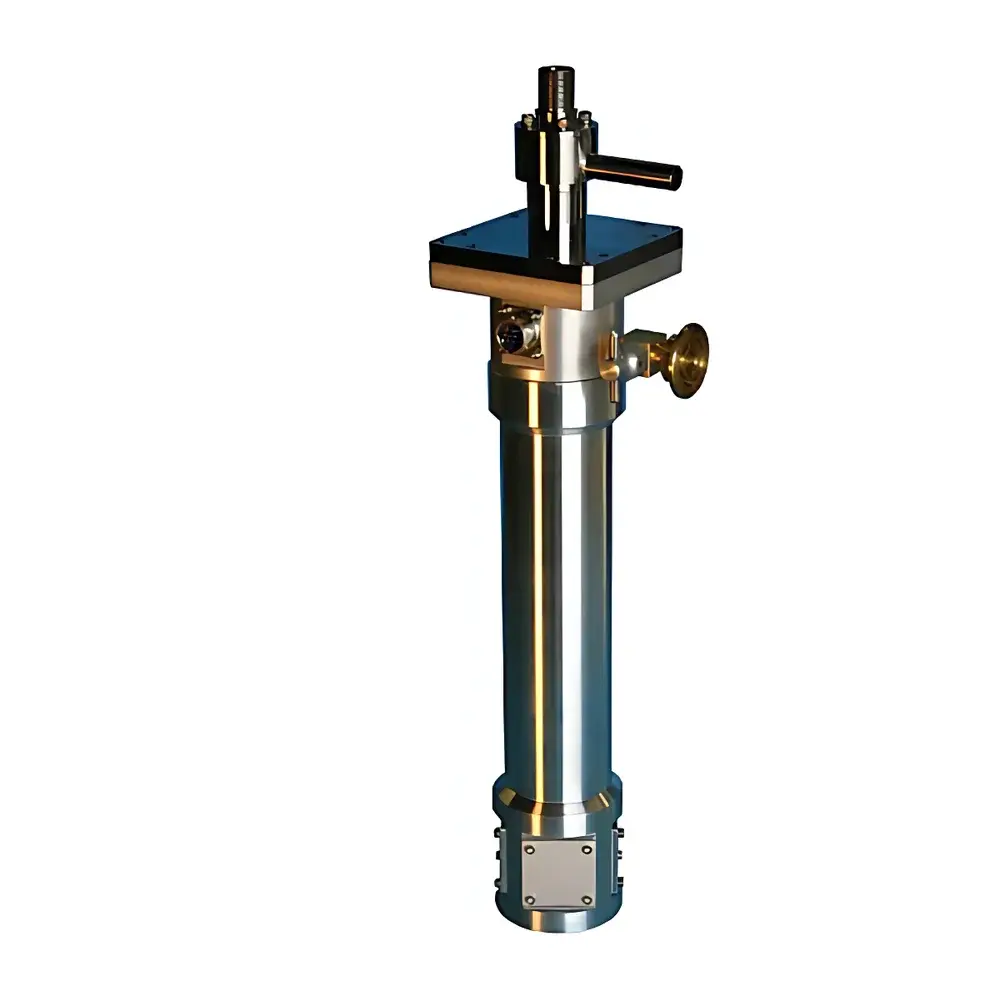
ARS LT4 Liquid Helium Continuous Flow Cryogenic Thermostat
| Brand | ARS |
|---|---|
| Origin | USA |
| Model | LT4 |
| Operating Temperature Range | 4.2 K (liquid helium) to 77 K (liquid nitrogen) |
| Optical Window Diameter | 1.25 in (31.75 mm) |
| Window Material | High-purity fused silica |
| Base Temperature Stability | ±0.5 K |
| Helium Consumption Rate | 0.75 L/hr at 4.2 K |
| Structural Material | Aluminum alloy |
| Sample Viewing Angle | F/1 (broad field-of-view for optical collection) |
| Electrical Interface | 10-pin hermetic feedthrough + 4 dedicated test leads |
| Temperature Sensing | Calibrated silicon diode sensors (±0.5 K accuracy), dual-sensor configuration (cold stage + sample mount) |
| Standard Accessories | DMX-1AL aluminum radiation shield & vacuum shroud, helium transfer line, aluminum instrument panel, Dewar adapter, two quartz windows, 36 Ω foil heater, temperature controller |
Overview
The ARS LT4 Liquid Helium Continuous Flow Cryogenic Thermostat is a precision-engineered, modular low-temperature platform designed for high-reproducibility experiments requiring stable thermal environments between 4.2 K and 77 K. Based on the continuous-flow cryostat principle, the LT4 utilizes regulated liquid helium (or liquid nitrogen) delivered through a flexible, vacuum-jacketed transfer line to cool a thermally anchored cold finger—enabling rapid cooldown, fine temperature control, and minimal thermal drift during extended operation. Its aluminum-alloy construction ensures mechanical rigidity, low thermal mass, and compatibility with ultra-high vacuum (UHV) and high-vacuum experimental chambers. The system is not a closed-cycle refrigerator; instead, it relies on externally supplied cryogens, offering superior base temperature stability and lower vibration compared to pulse-tube or Gifford-McMahon systems—critical for sensitive optical, magneto-optical, and quantum transport measurements.
Key Features
- Continuous-flow cooling architecture supporting both liquid helium (4.2 K base) and liquid nitrogen (77 K) operation
- 1.25-inch (31.75 mm) diameter high-transmission fused silica optical window optimized for UV–Vis–NIR–MIR spectral ranges (e.g., FTIR, Raman, photoluminescence)
- F/1 optical geometry enabling wide-angle light collection and efficient coupling into spectrometers or detector systems
- Dual calibrated silicon diode temperature sensors: one mounted on the cold stage, another directly on the sample holder (with 4-ft low-thermal-conductance lead), both traceable to NIST standards and rated for ±0.5 K absolute accuracy
- Integrated 36 Ω thin-film resistive heater for active temperature regulation and ramp control
- Hermetically sealed 10-pin electrical feedthrough plus four independent low-noise test leads for simultaneous DC/AC/RF electrical characterization
- Modular aluminum vacuum shroud (DMX-1AL) with integrated radiation shielding, compatible with standard optical tables and UHV flanges (CF, KF, or ISO-K)
- Standard configuration includes helium transfer line, Dewar adapter, instrument panel, and dual quartz viewport assembly
Sample Compatibility & Compliance
The LT4 accommodates diverse sample geometries—including bulk crystals, thin films, nanostructures, diamond anvil cells (DAC), and matrix-isolated species—within its open-access cold finger cavity. Its flat, thermally anchored sample stage supports custom mounting fixtures and electrical interconnects. The system meets standard laboratory safety and materials handling requirements for cryogenic operation under ASTM F1551 (Standard Guide for Cryogenic Systems Safety) and complies with ISO 21870 (Cryogenic Vessels — Design and Construction) for pressure-rated components. While not inherently GLP/GMP-certified, its temperature logging, heater control, and sensor traceability support audit-ready data acquisition when paired with validated third-party controllers (e.g., Lakeshore 336, BlueFors TCU). All electrical interfaces are grounded and shielded to minimize EMI in low-signal applications such as Hall effect or DLTS measurements.
Software & Data Management
The LT4 operates without proprietary firmware; temperature control is implemented via external commercial controllers (e.g., Lakeshore, Janis, or custom LabVIEW-based PID systems) interfacing through analog voltage inputs and resistance readouts. Sensor outputs are compatible with IEEE 488 (GPIB), RS-232, or Ethernet-enabled DAQ systems. Full audit trail capability—including timestamped temperature setpoints, heater power, and sensor resistance values—is achievable when integrated with 21 CFR Part 11-compliant software platforms. Data synchronization with spectrometers (e.g., Bruker VERTEX 80V) or probe stations is supported via TTL triggers and analog synchronization ports. Calibration files for silicon diodes are provided in standard .csv format for import into common analysis environments (Python, MATLAB, Igor Pro).
Applications
- FTIR and far-infrared spectroscopy of molecular vibrations and phonon modes under cryogenic conditions
- Micro-Raman and photoluminescence mapping of quantum emitters (e.g., NV centers, WSe₂ monolayers) with diffraction-limited spatial resolution
- DC and AC resistivity, Hall effect, and low-frequency impedance spectroscopy in correlated electron systems
- Magneto-optical Kerr effect (MOKE) and Faraday rotation studies of magnetic thin films and heterostructures
- High-resolution Mössbauer spectroscopy requiring sub-millikelvin thermal stability over hours
- Matrix isolation spectroscopy of reactive intermediates trapped in inert gas solids at 4–20 K
- Thermal magnetization and ac susceptibility measurements using SQUID-compatible wiring configurations
- Electroluminescence and carrier lifetime analysis in optoelectronic devices under controlled thermal bias
FAQ
What cryogens does the LT4 support?
The LT4 is fully compatible with both liquid helium (for 4.2 K operation) and liquid nitrogen (for 77 K operation); no hardware modification is required to switch between them.
Can the LT4 be integrated into an existing UHV chamber?
Yes—the standard DMX-1AL vacuum shroud features CF-63 or ISO-K160 flange options and is designed for direct integration into UHV systems with bake-out capability up to 150 °C.
Is the temperature controller included?
No—the LT4 is supplied as a cryomechanical platform only; users select and integrate their preferred temperature controller and software environment.
What is the typical helium consumption rate at base temperature?
At 4.2 K under steady-state conditions with no external heat load, helium consumption is specified at 0.75 L/hr; actual usage varies with thermal anchoring, radiation shielding efficiency, and measurement duty cycle.
Are custom window materials available?
Yes—alternative window substrates including CaF₂ (for deep-UV), ZnSe (for mid-IR), or sapphire (for high-strength applications) can be supplied upon request, with appropriate anti-reflection coatings.
Related Products



