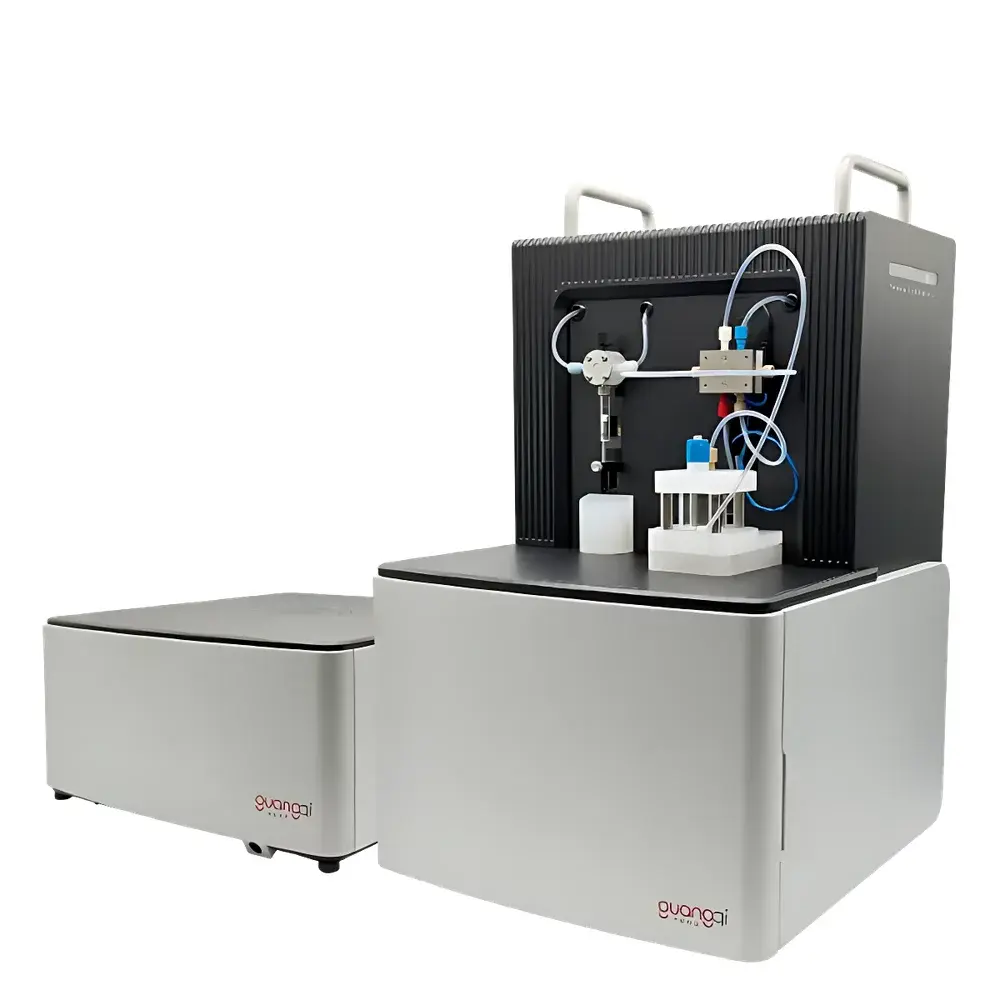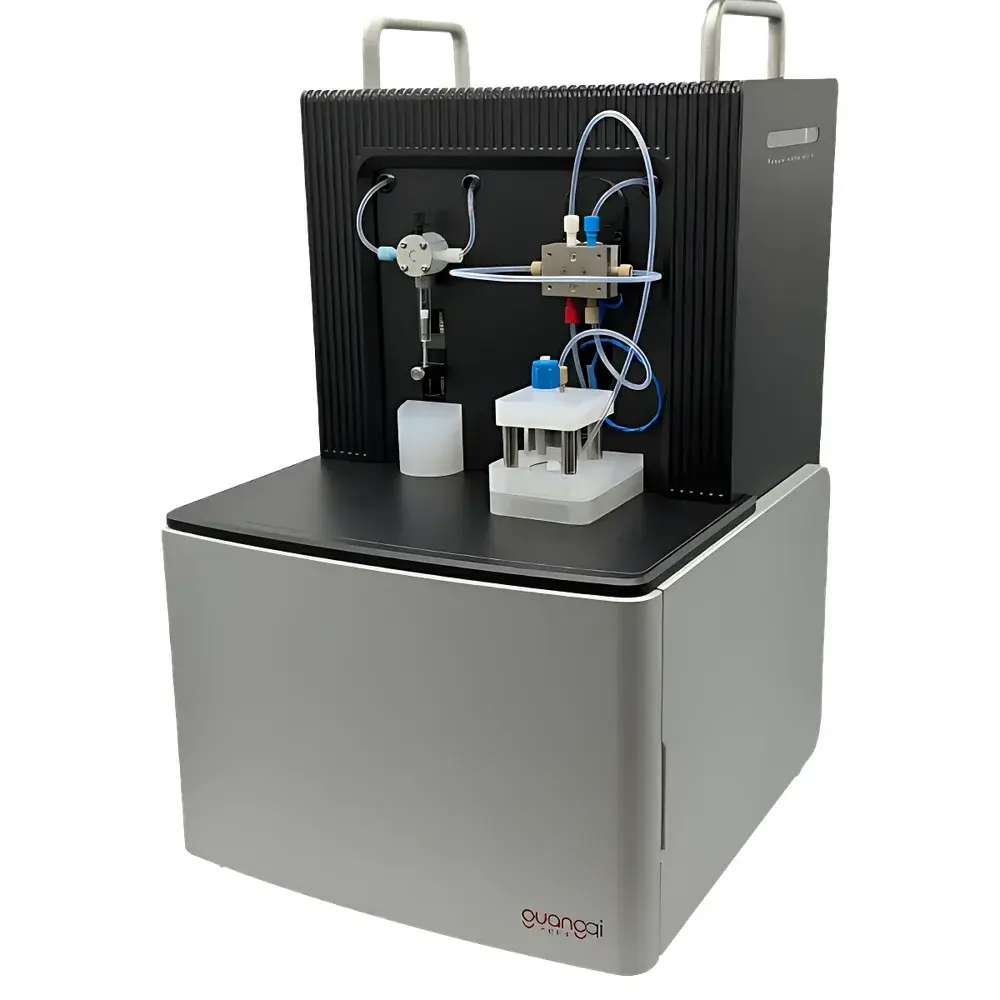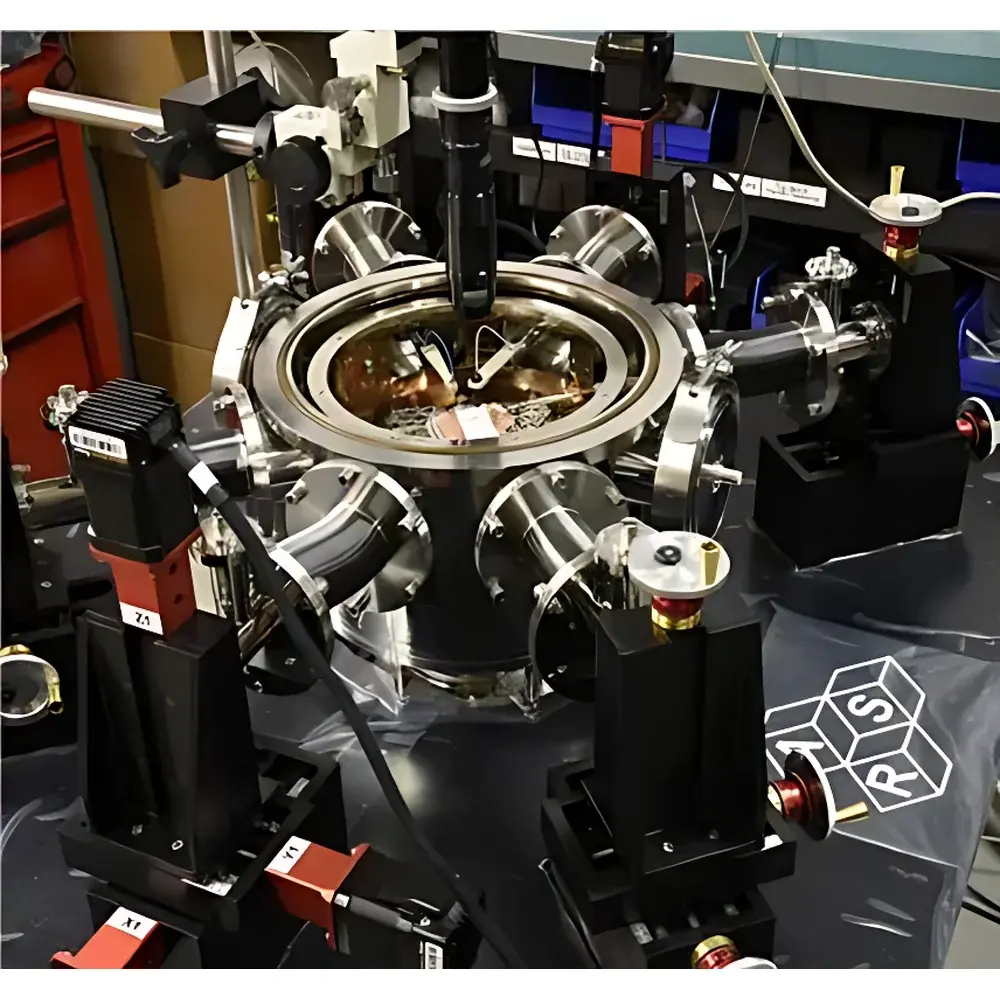
ARS PS-L Liquid Helium/Liquid Nitrogen Cryogenic Probe Station
| Brand | ARS |
|---|---|
| Origin | USA |
| Model | PS-L |
| Product Category | Temperature-Controlled Probe Station |
| Operation Type | Semi-Automatic |
| Cooling Method | Open-Cycle Cryostat (Liquid He / Liquid N₂) |
| Base Temperature | ~4 K (with LHe) or ~77 K (with LN₂) |
| Temperature Range | 4–400 K (extendable to 500 K or 800 K) |
| Temperature Stability | < ±50 mK |
| Vacuum Chamber | 10-inch welded stainless steel |
| Radiation Shield | 8-inch nickel-plated oxygen-free copper (OFHC) |
| Sample Stage | 2.25-inch gold-plated OFHC, grounded (optional insulated or biased) |
| Microscope | 7:1 zoom, ≤3 µm resolution, coaxial/ring illumination, 24″ HD monitor |
| Vibration Isolation | Triple-stage, sample stage vibration < 100 nm |
| Probe Arms | Up to 8 manually driven 3D micropositioners (X: 2″, Y: 1–2″, Z: 0.5″, 5 µm sensitivity) |
| Temperature Monitoring | Four calibrated DT-670 sensors (including DT-670-CU-4M at sample proximity) and two heaters (50 W on stage, 100 W on shield) |
| Controller | Lake Shore LS336 4-channel temperature controller with cryostat interface cables |
| Optional Upgrades | 16:1 microscope, 4″ sample stage, RF/microwave probes (up to 67 GHz), fiber-optic probe arms, motorized positioning |
Overview
The ARS PS-L Liquid Helium/Liquid Nitrogen Cryogenic Probe Station is an open-cycle, high-stability cryogenic measurement platform engineered for low-temperature electrical, microwave, and optoelectronic characterization of semiconductor devices, quantum materials, and nanoscale structures. It operates on the principle of conductive and radiative thermal anchoring within a high-vacuum environment, utilizing either liquid helium (LHe) or liquid nitrogen (LN₂) as the primary cryogen to achieve base temperatures of approximately 4 K or 77 K, respectively. The system integrates ARS’s proprietary open-cycle cryostat—designed for rapid cooldown, precise thermal management, and minimal thermal drift—with a modular stainless-steel vacuum chamber, multi-port feedthrough architecture, and vibration-isolated optical-mechanical staging. Its architecture supports both DC and high-frequency measurements while maintaining ultra-low noise floors and sub-100 nm mechanical stability—critical for quantum transport, superconducting qubit testing, and single-electron device analysis.
Key Features
- Open-cycle cryogenic platform compatible with liquid helium (4 K) and liquid nitrogen (77 K), with extended temperature range up to 400 K (optionally 500 K or 800 K) via integrated resistive heating
- Welded 10-inch stainless-steel vacuum chamber with high-purity quartz viewport and sapphire cold window for broadband optical access (UV–IR)
- 8-inch nickel-plated oxygen-free copper (OFHC) radiation shield—optimized for low emissivity and high thermal conductivity—to maximize net cooling power and minimize radiative loading on the sample stage
- 2.25-inch gold-plated OFHC sample stage, electrically grounded as standard (insulated or bias-capable variants available), thermally anchored to the 2nd stage of the cryostat
- Triple-stage passive vibration isolation system ensuring total sample-stage motion < 1 µm RMS and localized vibration < 100 nm—essential for nanoprobing and scanning probe compatibility
- Four independently monitored and controlled temperature zones: cold head, radiation shield, sample stage, and sample vicinity—enabled by four calibrated DT-670 sensors (including traceable DT-670-CU-4M at sample proximity) and dual-zone heating (50 W stage heater, 100 W shield heater)
- Standard 7:1 zoom stereomicroscope (≤3 µm resolution) with ring illumination and manual XYZ positioning; optional 16:1 high-magnification configuration available
- Up to eight fully independent 3D micropositioner arms—each with 2″ axial (X), 1–2″ lateral (Y), and 0.5″ vertical (Z) travel and 5 µm mechanical sensitivity—compatible with DC, RF, microwave (up to 67 GHz), and fiber-optic probing
Sample Compatibility & Compliance
The PS-L accommodates wafers up to 4″ diameter (upgradeable to 4″ stage), discrete dies, MEMS packages, and custom substrates mounted on standard or user-fabricated holders. Its clean, bakeable vacuum environment—achieving ≤1×10⁻⁷ Torr with turbomolecular pumping—ensures minimal surface contamination and stable electrical contact during long-duration low-current (<1 pA) or high-impedance measurements. The system complies with standard laboratory safety protocols for cryogenic fluid handling (ANSI/ASHRAE 15, CGA P-1) and meets electromagnetic compatibility requirements per FCC Part 15 Class B. All temperature control, data logging, and alarm functions are traceable and configurable to support GLP/GMP-aligned workflows. While not inherently 21 CFR Part 11 compliant, the LS336 controller supports audit-trail-ready configurations when integrated with validated third-party SCADA or LIMS environments.
Software & Data Management
The PS-L operates without proprietary software lock-in: temperature setpoints, ramp rates, and sensor readings are managed via the Lake Shore LS336 front panel or through industry-standard IEEE-488 (GPIB), RS-232, or Ethernet (LXI) interfaces. Full SCPI command support enables seamless integration into Python-, LabVIEW-, or MATLAB-based automated test sequences. All temperature logs—including time-stamped readings from all four DT-670 sensors—are exportable in CSV format with millisecond resolution. The system supports external trigger synchronization for time-correlated electrical/optical measurements (e.g., pulsed IV + photoluminescence). No embedded OS or cloud dependency is required; local data persistence is ensured via non-volatile memory within the LS336 unit.
Applications
- DC and low-frequency transport measurements: resistivity mapping, Hall effect, carrier mobility, and variable-temperature I–V/FET characterization
- High-frequency and microwave device testing: S-parameter extraction, impedance spectroscopy, and on-wafer RF calibration (SOLT, TRL) at cryogenic temperatures
- Quantum device characterization: superconducting transition edge sensors (TES), Josephson junctions, topological insulator surface states, and Majorana zero-mode detection
- Nanoelectronics and 2D materials: graphene, TMDCs, and heterostructure FETs under gate-bias and magnetic field (when interfaced with split-coil magnets)
- Optoelectronic and photonic integration: cryogenic PL/EL spectroscopy, single-photon detector validation, and quantum dot emission linewidth analysis
- MEMS/NEMS resonance and dissipation studies: quality factor (Q) mapping vs. temperature and pressure
- Non-destructive failure analysis: leakage path localization, time-dependent dielectric breakdown (TDDB), and soft error rate (SER) screening
FAQ
Can the PS-L be upgraded to a closed-cycle system later?
Yes—the mechanical interface, vacuum chamber, optical table, and probe arm mounting architecture are fully compatible with ARS’s closed-cycle cryocooler retrofits. No structural modification is required; only the cryostat head and associated wiring/cabling need replacement.
What vacuum level can the system achieve?
With standard turbo-molecular pumping, the PS-L reaches ≤1×10⁻⁷ Torr within ~10 minutes after rough pumping (~45 min with mechanical pump alone). Bake-out capability supports UHV-compatible configurations.
Is the sample stage electrically isolated by default?
No—the standard configuration provides direct grounding via the OFHC stage. Electrically floating (insulated) or bias-capable (coaxial/BNC/triaxial feedthrough) variants are available as factory options.
Are RF probes included, or must they be sourced separately?
RF and microwave probe arms are optional accessories. ARS offers GSG-type probes rated for 0–40 GHz (K-connectors), 0–50 GHz (2.4 mm), and 0–67 GHz (1.85 mm), all with semi-rigid coaxial cabling and tungsten or beryllium-copper tips.
Does the system support automated probe alignment?
The base PS-L is semi-automatic with manual micropositioners. Motorized XYZ stages and vision-guided auto-alignment modules are available as configurable upgrades—not standard equipment.