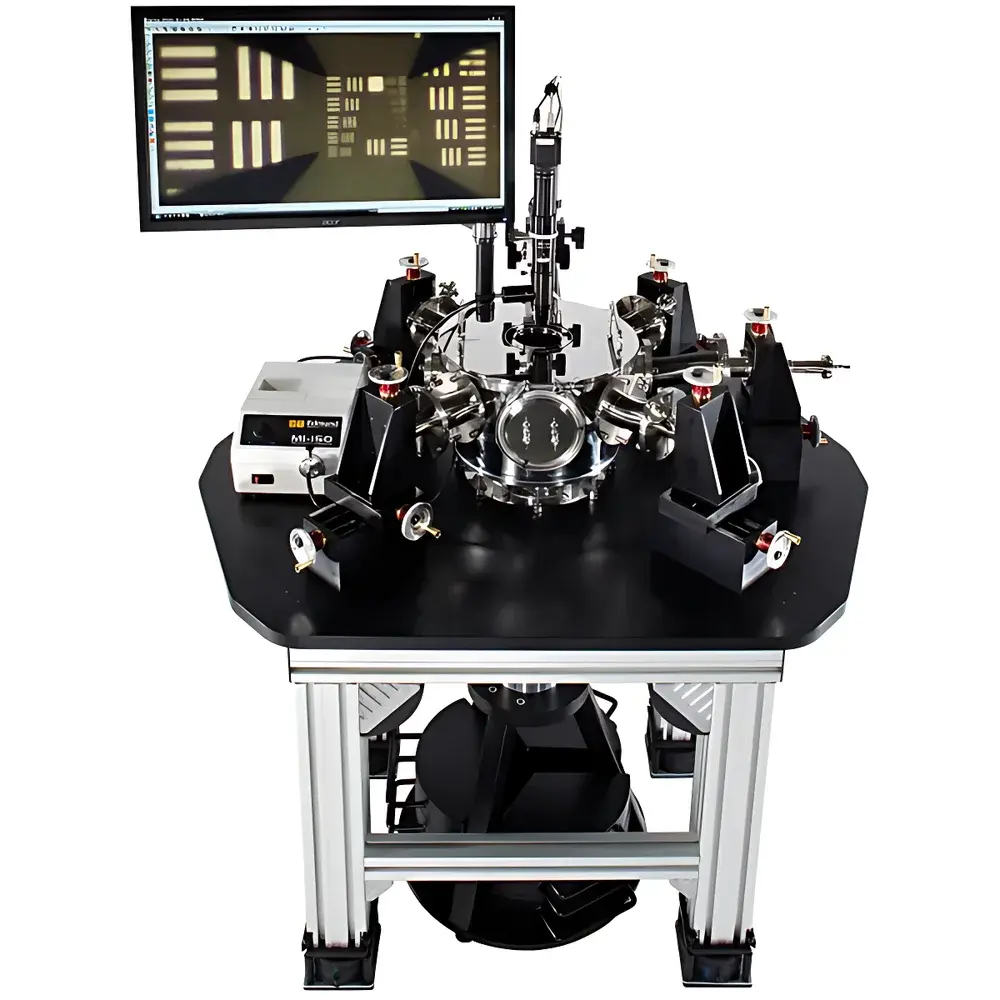
ARS PSF-10-4 Cryogenic Closed-Cycle Vacuum Probe Station
| Brand | ARS |
|---|---|
| Origin | USA |
| Manufacturer Type | Authorized Distributor |
| Origin Category | Imported |
| Model | PSF-10-4 |
| Price Range | USD $65,000 – $130,000 |
| Product Category | Temperature-Controlled Probe Station |
| Operation Mode | Semi-Automatic |
| Temperature Range | 7 K – 400 K (configurable down to <4 K with DE215 cold head) |
| Vacuum Chamber | 10-inch welded stainless steel |
| Radiation Shield | 8-inch nickel-plated OFHC copper |
| Sample Stage | 2.25-inch gold-plated OFHC copper, thermally anchored to cold head |
| Optical Viewports | High-purity quartz window + sapphire cold shield window |
| Microscope | Standard 7:1 zoom optics (3 µm resolution, 89 mm working distance) |
| Probe Arms | Up to six 3-axis micromanipulators (manual drive, 2″ X / 1″ Y / 0.5″ Z travel, 5 µm sensitivity) |
| Cooling Method | Closed-cycle helium refrigeration (no liquid cryogens) |
| Vibration Performance | <1 µm total stage motion |
| Temperature Control | Four-channel precision controller with calibrated DT-670 series sensors (±12 mK accuracy), dual heating zones (50 W stage heater + 100 W radiation shield heater) |
| Compliance | Designed for ASTM F1788, ISO/IEC 17025-compliant lab environments |
Overview
The ARS PSF-10-4 is a high-stability, closed-cycle cryogenic vacuum probe station engineered for low-noise, non-destructive electrical and optoelectronic characterization of semiconductor devices, quantum materials, and nanoscale structures. It operates on the principle of conductive cooling via a Gifford-McMahon (GM) cryocooler—eliminating dependence on consumable liquid cryogens while delivering stable base temperatures from <4 K to 400 K. The system integrates a hermetically sealed 10-inch stainless steel vacuum chamber with multi-layer thermal management: a nickel-plated oxygen-free high-conductivity (OFHC) copper radiation shield actively cooled to ~40 K, and a gold-plated OFHC copper sample stage directly mounted to the second-stage cold head. This architecture ensures minimal thermal gradient, high thermal stability (<50 mK drift over 24 h), and ultra-low mechanical vibration—critical for DC transport, RF impedance, and quantum coherence measurements. Its modular design accommodates variable cold head configurations (DE204P, DE210, or DE215), enabling users to select optimal cooling power and base temperature for specific applications such as superconducting qubit testing or 2D material transport.
Key Features
- True cryogenic operation without liquid helium or nitrogen—enabled by integrated GM cryocooler with high first-stage cooling capacity and inherently low mechanical vibration
- Ultra-low vibration platform: triple-stage passive isolation system achieves <100 nm RMS sample-stage displacement, validated per ISO 20816-1 for precision metrology-grade instrumentation
- Thermally optimized vacuum architecture: welded stainless steel chamber, nickel-plated OFHC radiation shield (low emissivity + high thermal conductivity), and sapphire cold window for IR-transparent optical access
- Four-point temperature monitoring and dual-zone active control: calibrated DT-670-CU-4M sensor at sample position (±12 mK uncertainty), plus independent sensors on cold head, stage, and radiation shield
- Expandable probe interface: supports up to six independently positioned 3-axis manual probe arms with sub-5 µm positioning resolution; compatible with DC, RF (up to 67 GHz), microwave, and single-mode fiber probes
- High-fidelity optical observation: standard 7:1 zoom microscope (3 µm resolution, 89 mm working distance) with ring illumination; upgradeable to 16:1 system (2 µm resolution) with motorized focus and 24″ high-resolution display
Sample Compatibility & Compliance
The PSF-10-4 accommodates wafers up to 100 mm diameter and custom substrates with thicknesses ranging from 100 µm to 5 mm. Its electrically isolated or grounded sample stage (user-selectable), BNC- or triaxial-fed biasing options, and guard-driven measurement topology support four-terminal (Kelvin) and low-current (<1 fA) measurements in compliance with IEEE Std 1116 and ASTM F1788-20 for semiconductor device probing. Vacuum performance—<5×10⁻⁷ Torr base pressure achieved within 55 minutes (mechanical + turbomolecular pumping)—ensures surface cleanliness critical for oxide-sensitive interfaces and in-situ surface science. The system’s construction and thermal management meet requirements for ISO/IEC 17025-accredited laboratories, and its temperature logging architecture supports traceable calibration records aligned with NIST-traceable standards.
Software & Data Management
While the PSF-10-4 operates as a hardware platform with analog signal routing, it is fully compatible with industry-standard data acquisition ecosystems including Keysight PathWave, Lake Shore Cryotronics Crosslink, and National Instruments LabVIEW. Optional integration with ARS’s proprietary temperature control software enables automated thermal ramping, hold-and-soak protocols, and synchronized timestamped logging of all four temperature channels with audit-trail metadata. All temperature sensors are pre-calibrated to NIST-traceable curves, and the system supports 21 CFR Part 11-compliant electronic signatures when deployed with validated third-party LIMS or ELN platforms.
Applications
- DC and low-frequency transport characterization of 2D materials (graphene, TMDs), topological insulators, and correlated oxides
- RF and microwave S-parameter extraction of GaN HEMTs, SiGe HBTs, and superconducting resonators (4–20 GHz)
- Quantum device testing: transmon qubit spectroscopy, Andreev bound state mapping, and Josephson junction I–V analysis
- Optoelectronic coupling: fiber-coupled photoluminescence and electroluminescence of quantum dots, nanowires, and perovskite microstructures
- Failure analysis and process development for advanced packaging, through-silicon vias (TSVs), and heterogeneous integration stacks
- In-situ cryo-SEM and cryo-AFM correlation studies using interchangeable sample holders
FAQ
Does the PSF-10-4 require liquid cryogens to operate?
No. It uses a closed-cycle GM cryocooler (DE204P, DE210, or DE215) and requires only electrical power and compressed dry nitrogen for cold head purge.
Can the system be upgraded to operate below 4 K?
Yes. Equipped with the DE215 cold head and optional high-efficiency thermal anchoring, base temperatures of ≤3.5 K are achievable under nominal vacuum conditions.
Is the probe station compatible with ultra-high vacuum (UHV) systems?
The standard configuration achieves high vacuum (10⁻⁷ Torr). UHV compatibility (≤10⁻¹⁰ Torr) is available with bakeable CF flanges, all-metal seals, and ion pump integration.
What level of temperature uniformity can be expected across the 2.25-inch sample stage?
At 10 K, radial temperature variation is ≤±150 mK over the central 50 mm; at 300 K, uniformity improves to ≤±50 mK with active radiation shield control.
Are OEM integration services available for custom automation or robotics?
Yes. ARS provides mechanical, electrical, and software interface documentation (including CAD models and API specifications) for seamless integration with wafer handlers, auto-probers, and industrial control systems.