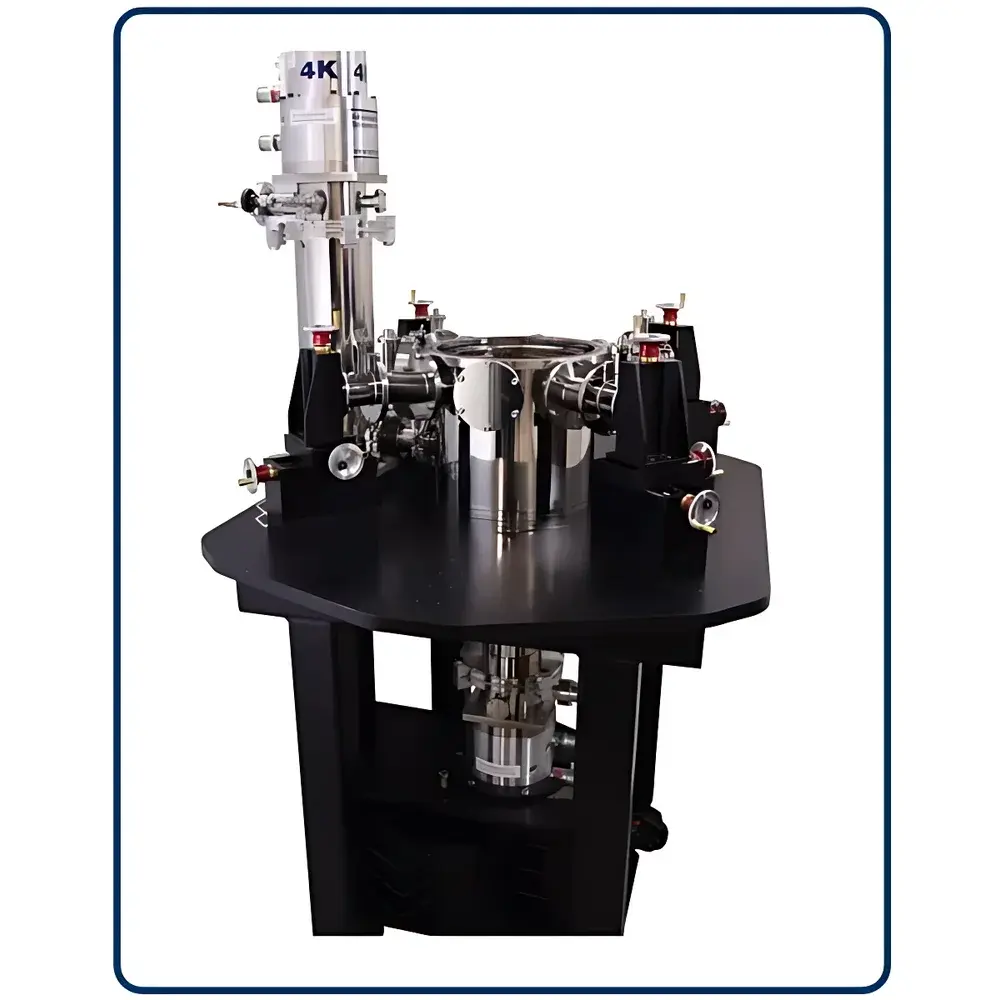
ARS PSG-SM Closed-Cycle Superconducting Magnet Probe Station
| Brand | ARS |
|---|---|
| Origin | USA |
| Model | PSG-SM |
| Product Category | Cryogenic Temperature-Controlled Probe Station |
| Operation Mode | Semi-Automatic |
| Cooling Method | Dual-Cryocooler Closed-Cycle Refrigeration (DE210/DE215) |
| Base Temperature | <4 K |
| Temperature Range | 5 K–350 K (optional high-temp stage up to 800 K) |
| Magnetic Field | ±3 T vertical (optional ±6 T or vector magnet) |
| Vacuum Chamber | 11″ stainless steel |
| Sample Stage Diameter | 1.75″ (supports 2″ wafers) |
| Vibration Level | <1 µm RMS |
| Microscopy | Standard 7:1 zoom lens (3 µm resolution), optional 16:1 (2 µm resolution) |
| Probe Arm Configurations | DC/LF, RF (up to 67 GHz), optical fiber (UV–Vis–IR) |
| Temperature Stability | <50 mK |
| Pump-Down Time | ~120 min |
| Cool-Down Time to 10 K | ~5 h (DE210S) |
Overview
The ARS PSG-SM Closed-Cycle Superconducting Magnet Probe Station is an engineered platform for low-temperature, high-field electrical and magneto-optical characterization of semiconductor devices, quantum materials, and nanoscale electronic structures. Built upon ARS’s proprietary closed-cycle cryocooler architecture—specifically the DE210 and DE215 series—the system achieves base temperatures below 4 K without liquid helium dependency. Its integrated superconducting magnet delivers a stable, homogeneous vertical field up to ±3 T (extendable to ±6 T or configurable as a dual-axis vector magnet), enabling precise control of spin-polarized transport, quantum Hall regimes, and Zeeman-split spectroscopy. The probe station operates under ultra-high vacuum (UHV)-compatible conditions, with a polished non-magnetic stainless steel vacuum chamber and nickel-plated oxygen-free copper (OFC) radiation shields ensuring thermal stability, minimal magnetic interference, and long-term experimental repeatability. Designed for integration into cleanroom-compatible research workflows, the PSG-SM supports in situ electrical probing, optical access, and synchronized thermometry across multiple thermal zones.
Key Features
- Two-stage closed-cycle refrigeration with DE210 or DE215 cryocoolers: <4 K base temperature, high cooling power, low mechanical vibration (<1 µm RMS), and long-term operational stability.
- UHV-grade 11-inch-diameter stainless steel vacuum chamber with high-purity quartz viewport and sapphire cold window for broadband optical transmission (UV to IR).
- Thermally optimized sample stage: 1.75-inch-diameter gold-plated OFC platform, accommodating standard 2-inch wafers or custom substrates; integrated with calibrated silicon diode sensors (DT-670B-SD, CX-1070-CU-4L) traceable to NIST standards.
- Multi-zone temperature control: Four-channel precision temperature controller with six dedicated sensor inputs and two independent heater circuits (50 W on sample stage, 100 W on shield) for gradient management and rapid thermal equilibration.
- Six degrees-of-freedom probe positioning: Manual XYZ translation stages with hardened steel ball bearings and theta rotation for planarization; 2″ axial, 1″ lateral, and 0.5″ vertical travel; 10 µm刻度, 5 µm sensitivity.
- Modular probe arm compatibility: DC/low-frequency (SMA/BNC/triaxial, 0–100 MHz), RF/microwave (K-type, 2.4 mm, 1.85 mm connectors, up to 67 GHz), and fiber-optic (SMA905, 100–400 µm core, single- or multimode) configurations.
Sample Compatibility & Compliance
The PSG-SM accommodates diverse semiconductor and quantum material platforms—including Si/SiGe heterostructures, GaAs/AlGaAs quantum wells, transition metal dichalcogenides (TMDs), topological insulators, and superconducting qubit test chips. Its non-magnetic construction complies with ASTM F2627 (Standard Practice for Magnetic Shielding of Semiconductor Equipment) and supports GLP/GMP-aligned experimental documentation when paired with validated temperature logging software. All internal surfaces are electropolished stainless steel or oxygen-free copper, minimizing outgassing and particulate generation—critical for maintaining <1×10⁻⁷ Torr base pressure over extended operation. The system conforms to IEC 61000-6-3 (EMC emissions) and IEC 61000-6-2 (immunity), and its vacuum integrity meets ISO 10110-7 surface quality specifications for optical viewports.
Software & Data Management
While the PSG-SM operates as a hardware-integrated platform without embedded firmware, it is fully compatible with third-party data acquisition systems (e.g., Keysight B2900A, Zurich Instruments HF2LI, LabVIEW-based DAQ) via standard analog/digital I/O and GPIB/Ethernet interfaces. Temperature telemetry from all six calibrated sensors is accessible through industry-standard 4–20 mA or IEEE-488 outputs, supporting time-synchronized logging with audit-trail capabilities. When deployed in regulated environments, the system can be configured to comply with FDA 21 CFR Part 11 requirements via external validated software—enabling electronic signatures, user access controls, and immutable measurement records. ARS provides detailed calibration certificates for all included DT-670B and CX-1070 temperature sensors, including uncertainty budgets referenced to ITS-90.
Applications
- Quantum transport measurements: Shubnikov–de Haas oscillations, quantum Hall effect mapping, and Landau level spectroscopy under tunable magnetic fields.
- Spintronics device characterization: Anisotropic magnetoresistance (AMR), giant magnetoresistance (GMR), and tunneling magnetoresistance (TMR) in magnetic tunnel junctions.
- Nanoscale device testing: IV/CV profiling of nanowire FETs, graphene transistors, and 2D material heterostructures at cryogenic temperatures and high fields.
- Magneto-optical studies: Faraday/Kerr rotation, photoluminescence under magnetic bias, and polariton condensation in microcavities.
- Qubit validation: DC and RF probing of superconducting flux/ion trap test structures, including coherence time correlation with thermal and magnetic noise spectra.
FAQ
Does the PSG-SM require liquid helium or liquid nitrogen?
No. The system uses ARS’s closed-cycle DE210 or DE215 cryocoolers and operates without consumable cryogens.
Can the probe station be upgraded to higher magnetic fields after purchase?
Yes. Field upgrades—from ±3 T to ±6 T or to a vector magnet configuration—are supported through factory service and mechanical retrofitting.
What vacuum level can be achieved, and what pump configuration is recommended?
The chamber reaches ≤1×10⁻⁷ Torr with a standard turbomolecular pump backed by a dry scroll pump; ARS provides full vacuum schematics and flange specifications (CF-63/CF-100) for integration.
Is remote operation or automation possible?
While the standard system is semi-automatic, XYZ stages and temperature controllers support motorized actuation kits and LabVIEW/Python API integration for script-driven experiment sequences.
How is thermal crosstalk between the magnet and sample stage mitigated?
Thermal isolation is achieved via multi-layer OFC radiation shielding, sapphire cold windows thermally anchored only to the first-stage cold head, and physical separation between magnet cryostat and sample stage heat sinks.