
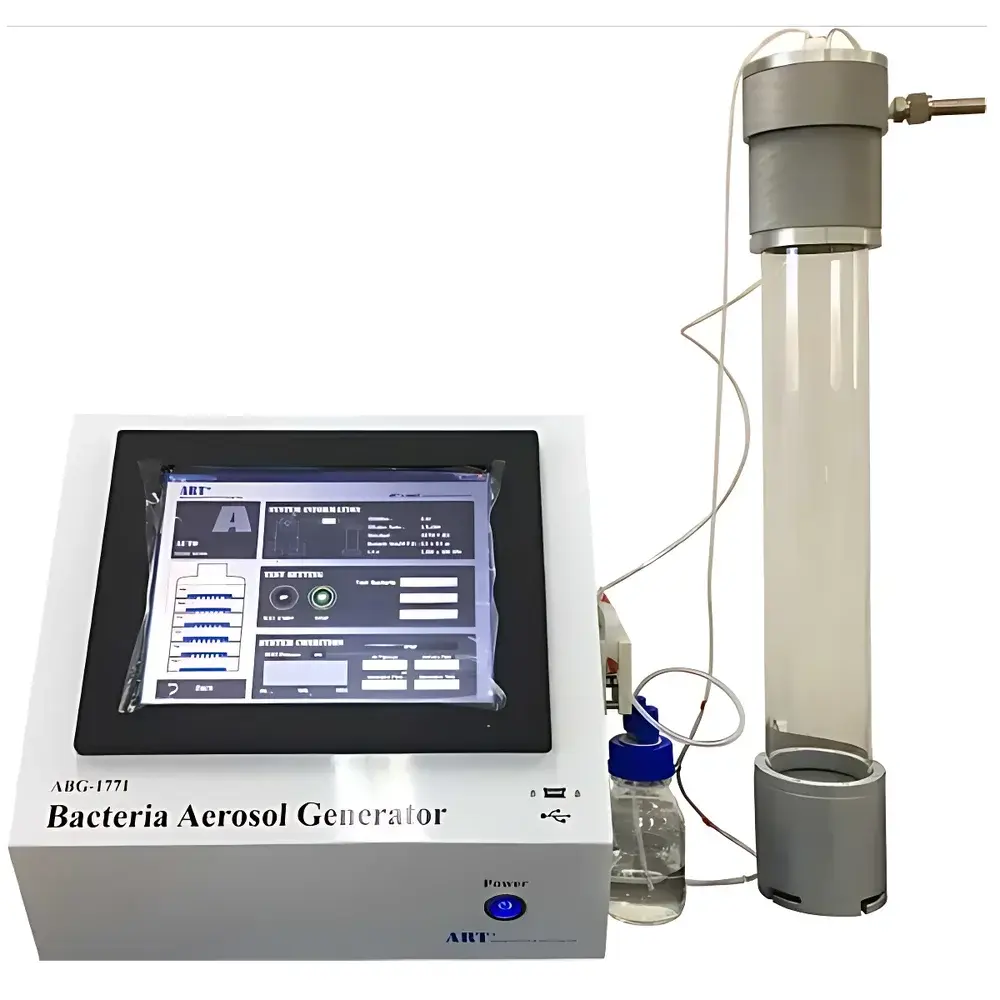
ART+ ABG-1771A Biological Aerosol Generator
| Brand | ART+ |
|---|---|
| Origin | South Korea |
| Model | ABG-1771A |
| Operating Principle | Two-phase nozzle-based nebulization of viable bacterial suspensions |
| Bacterial Output Concentration | > 5 × 10⁴ CFU/m³ |
| Aerosol Flow Rate | 30–50 L/min |
| Nebulization Fluid Delivery | Peristaltic pump, 2 mL/min |
| Pressure Control Range | 0–2 atm |
| Controller Dimensions (W×D×H) | 400 × 475 × 600 mm |
| Column Dimensions | ∅160 × 800 mm |
| Total Weight | 20 kg |
| Compliance | SPS-MACA02-16A (Korean Air Cleaning Association), GB 21551.3–2010 (PRC) |
Overview
The ART+ ABG-1771A Biological Aerosol Generator is a precision-engineered instrument designed for the controlled generation of viable bacterial aerosols in laboratory and testing environments. It operates on a two-phase pneumatic nebulization principle, where compressed gas interacts with a liquid suspension of live microorganisms (e.g., Staphylococcus epidermidis, Bacillus atrophaeus, or other ISO 14644-1/GB 21551.3–2010–qualified test strains) to produce monodisperse or polydisperse bioaerosols with reproducible particle size distributions (typically peaking in the 0.5–3.0 µm aerodynamic diameter range). This capability enables standardized challenge testing of air purification systems—including HEPA filters, UV-C reactors, photocatalytic oxidizers, and electrostatic precipitators—under defined environmental conditions. The ABG-1771A is not a sterilizer or disinfectant device; rather, it serves as a metrological reference source for quantitative microbial removal efficiency evaluation in accordance with internationally recognized test protocols.
Key Features
- Two-phase nozzle architecture ensures stable, pulse-free aerosol output with high viability retention (>90% post-nebulization for common Gram-positive test organisms under optimized flow and pressure settings)
- Integrated peristaltic pump delivers precise, contamination-free bacterial suspension at a calibrated rate of 2 mL/min, minimizing carryover and enabling repeatable dosing across sequential test cycles
- Adjustable pressure control (0–2 atm) and volumetric flow regulation (30–50 L/min) allow fine-tuning of aerosol concentration and particle dispersion characteristics to match chamber volume, residence time, and target challenge density
- Modular design separates the control unit (400 × 475 × 600 mm) from the vertical aerosol generation column (∅160 × 800 mm), facilitating integration into walk-in test chambers, glove boxes, or ISO-classified cleanrooms
- Rugged stainless-steel and anodized aluminum construction ensures long-term stability in humid or mildly corrosive test atmospheres, with IP54-rated electronics for dust and splash resistance
Sample Compatibility & Compliance
The ABG-1771A is validated for use with aqueous suspensions of non-pathogenic, biosafety level 1 (BSL-1) bacterial strains commonly employed in air cleaner efficacy testing, including but not limited to S. epidermidis ATCC 12228 and B. atrophaeus ATCC 9372. It conforms to the operational and performance requirements specified in SPS-MACA02-16A (Korean Air Cleaning Association) and GB 21551.3–2010 (General Requirements for Antibacterial Functions of Household Appliances – Part 3: Air Cleaners). While the generator itself does not carry CE, UKCA, or FDA clearance, its output profile supports test methods aligned with ISO 16000-28 (Indoor air — Part 28: Determination of the performance of air cleaners for removal of airborne microorganisms), ASTM F3150-18 (Standard Test Method for Measuring the Microbial Removal Efficiency of Air Cleaning Devices), and relevant sections of IEC 60335-2-65 (Safety of household air cleaners). Users must implement appropriate biosafety containment (e.g., Class II BSC pre-charging, negative-pressure test chambers, HEPA-filtered exhaust) in accordance with local institutional biosafety protocols.
Software & Data Management
The ABG-1771A operates via a dedicated front-panel interface with tactile push buttons and LED status indicators—no external PC or proprietary software is required for basic operation. All critical parameters (pressure setpoint, flow rate, run duration, pump activation state) are digitally displayed and manually adjustable. For traceability in GLP-compliant validation studies, users may integrate the device into larger test automation frameworks using its 0–10 V analog output signals (pressure feedback, flow monitor) and dry-contact relay outputs (start/stop, fault alarm). Audit trail functionality is maintained externally through chamber data loggers or LIMS platforms that record timestamped parameter values alongside microbiological assay results. The system supports 21 CFR Part 11–compatible electronic signatures when paired with validated third-party acquisition software and role-based access control.
Applications
- Quantitative assessment of microbial removal efficiency (MRE) of residential and commercial air purifiers under standardized challenge conditions
- Performance verification of HVAC filtration media against bioaerosol penetration (e.g., ASHRAE Standard 52.2 extended testing)
- Validation of decontamination cycle efficacy in pharmaceutical isolators and aseptic processing suites
- Calibration and inter-laboratory comparison of real-time bioaerosol monitors (e.g., fluorescence-based particle counters)
- Development and benchmarking of novel antimicrobial surface coatings exposed to dynamic airborne pathogen surrogates
FAQ
Can the ABG-1771A generate aerosols from fungal spores or viral surrogates?
The device is mechanically compatible with low-viscosity suspensions of BSL-1 fungal spores (e.g., Aspergillus niger) and non-enveloped virus surrogates (e.g., MS2 bacteriophage), provided suspension stability, particle size distribution, and viability endpoints are independently verified per test protocol.
Is routine calibration required, and what standards apply?
While no factory-certified calibration certificate is supplied, users should perform quarterly verification of flow rate (using a calibrated mass flow meter) and pressure transducer accuracy (traceable to NIST or KRISS standards); deviation thresholds should not exceed ±3% of full scale.
What biosafety level (BSL) infrastructure is necessary for safe operation?
Operation requires a minimum BSL-2 containment environment when handling live cultures; aerosol generation must occur inside a certified Class II Type A2 or B2 biological safety cabinet or within a negatively pressured, HEPA-filtered test chamber with monitored exhaust.
Does the system support automated start/stop synchronization with chamber environmental controllers?
Yes—via TTL-level trigger inputs and relay-coupled status outputs, enabling seamless coordination with temperature/humidity controllers, sampling pumps, and colony-counting workflows.
Are replacement nozzles and peristaltic pump tubing available as consumables?
Original-equipment manufacturer (OEM) spare parts—including stainless-steel two-phase nozzles, silicone peristaltic tubing (Pharmed BPT, 1.6 mm ID), and sterile sample reservoirs—are stocked and supplied with documented lot traceability and bioburden specifications.







