
ART Photonics CIR-Series Chalcogenide Infrared Fibers
| Brand | ART Photonics |
|---|---|
| Origin | Germany |
| Manufacturer Type | Authorized Distributor |
| Origin Category | Imported |
| Model Series | CIR-8, CIR-250, CIR-340, CIR-500 |
| Component Category | Optical Element |
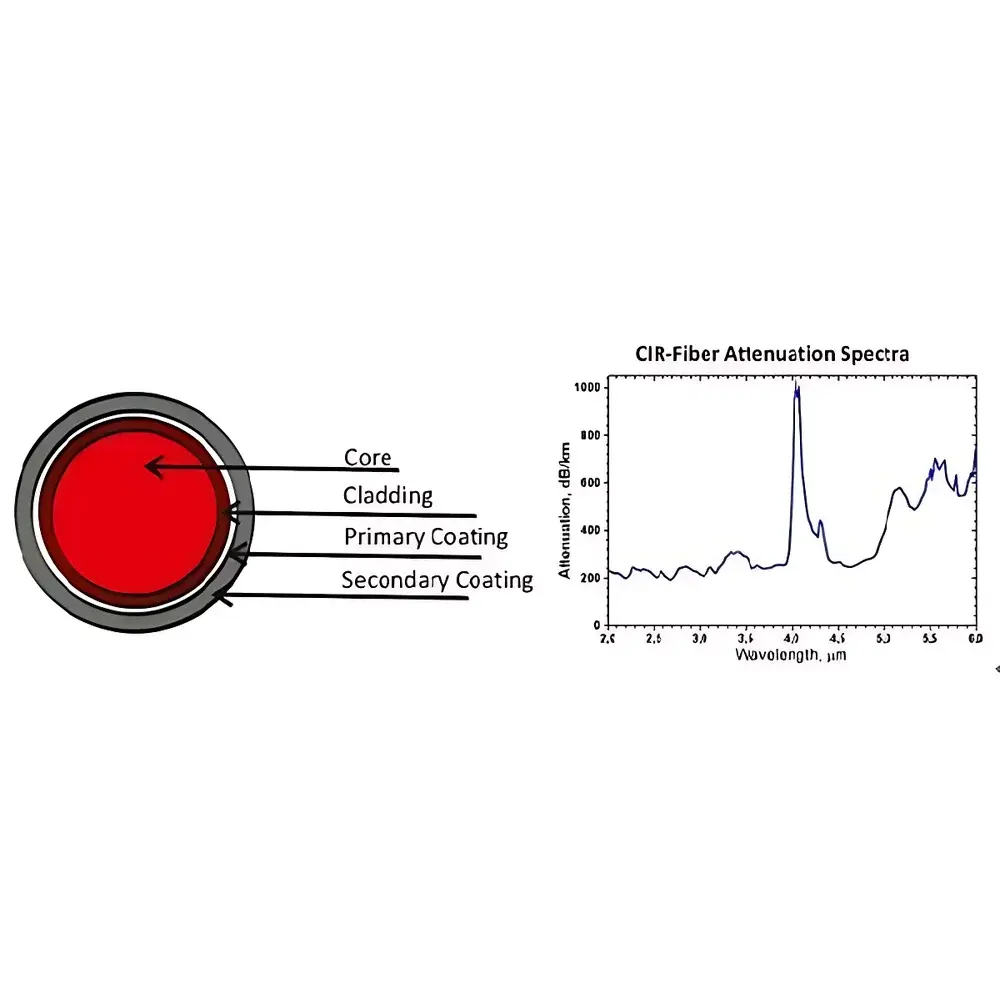
| Core Material | As₂S₃ |
| Cladding Material | As–S |
| Wavelength Range | 1.5–6 µm |
| Core Diameter | 8–500 µm |
| Cladding Diameter | 200–550 µm |
| Coating Diameter | 300–700 µm |
| Primary Coating | PTFE |
| Secondary Coating | PVC |
| Core Refractive Index | 2.4 |
| Numerical Aperture | 0.25–0.28 |
| Max CW Power Handling | 1 W |
| Fiber Structure | Step-Index, Dual-Layer Polymer-Coated |
| Termination | SMA Connector |
| Jacket | PEEK Polymer Sheath |
Overview
ART Photonics CIR-Series chalcogenide infrared fibers are engineered for high-fidelity optical transmission in the mid-infrared (MIR) spectral region—specifically from 1.5 to 6 µm. Constructed from arsenic trisulfide (As₂S₃) glass, these step-index fibers bridge a critical gap between fused silica fibers (0.2–2.4 µm) and polycrystalline infrared fibers (4–18 µm). The CIR-Series is optimized for applications requiring low-loss, flexible, and chemically stable waveguiding where conventional silica-based solutions fail due to strong multiphonon absorption beyond 2.4 µm. A proprietary glass purification process significantly suppresses hydroxyl (OH⁻) impurity absorption at ~3 µm, enabling reliable delivery of Er:YAG laser radiation (2.94 µm) and other MIR sources under continuous-wave (CW) operation up to 1 W.
Key Features
- Ultra-low intrinsic attenuation across 1.5–6 µm, with minimized OH⁻-related loss peaks at 2.9–3.0 µm
- Dual-layer polymer coating system: inner PTFE layer for thermal and chemical resistance; outer PVC layer for mechanical robustness and bend tolerance
- PEEK polymer overjacket provides crush resistance, dimensional stability, and compatibility with standard fiber handling tools
- Precision-cleaved and polished SMA-905 terminations ensure repeatable coupling efficiency and alignment reproducibility
- Controlled numerical aperture (0.25–0.28) enables efficient coupling with common MIR lasers and detectors while maintaining modal stability
- Core refractive index of 2.4 supports high confinement and low dispersion in the MIR band
Sample Compatibility & Compliance
The CIR-Series fibers are compatible with standard laboratory-grade MIR optical components—including quantum cascade lasers (QCLs), lead salt diode lasers, globar sources, FTIR spectrometers, and MCT or InSb detectors. All fibers comply with ISO 10110-7 (optical element surface quality) and IEC 61300-2-4 (mechanical durability testing for fiber optic devices). The PEEK jacket and polymer coatings meet UL 94 V-0 flammability rating requirements. While not classified as medical devices per FDA 21 CFR Part 820, the fibers support GLP-compliant analytical workflows when integrated into validated IR spectroscopy or imaging platforms.
Software & Data Management
As passive optical waveguides, CIR-Series fibers require no embedded firmware or driver software. However, they are fully interoperable with industry-standard optical design and simulation tools—including Zemax OpticStudio (via custom material definition files for As₂S₃), COMSOL Multiphysics (for mode field and thermal load modeling), and MATLAB-based beam propagation analysis scripts. Traceable calibration reports—including spectral attenuation curves (dB/m vs. wavelength), NA verification data, and power-handling validation logs—are supplied with each batch and archived per ISO/IEC 17025 documentation protocols.
Applications
- Remote sensing in industrial process control (e.g., real-time monitoring of hydrocarbon C–H stretch vibrations at 3.4 µm)
- Fiber-coupled FTIR spectroscopy for pharmaceutical solid-state analysis (polymorph identification, hydrate detection)
- MIR endoscopic probes for biomedical diagnostics, including ex vivo tissue spectroscopy and breath analysis
- Delivery of Er:YAG (2.94 µm) and CO₂ (5.3–5.6 µm) laser pulses in minimally invasive surgical systems
- Gas-phase absorption spectroscopy targeting fundamental rovibrational bands of NH₃, CH₄, CO₂, and NO
- Integration into quantum optics setups requiring low-noise MIR photon transport (e.g., entangled photon pair generation via SPDC in nonlinear chalcogenide waveguides)
FAQ
What is the maximum recommended bending radius for CIR-Series fibers?
For CIR-250 and larger core diameters, a minimum bend radius of ≥30 mm is advised during installation; for CIR-8, ≥15 mm ensures negligible macrobending loss.
Can these fibers be spliced to silica fibers?
Direct fusion splicing is not feasible due to thermal expansion and softening temperature mismatch; butt-coupling with index-matching gel and precision kinematic mounts is the standard integration method.
Is the PTFE/PVC coating resistant to common organic solvents?
The PTFE layer exhibits excellent resistance to alcohols, ketones, and chlorinated solvents; prolonged exposure to aromatic hydrocarbons (e.g., toluene) may degrade the PVC outer layer.
Do you provide custom lengths or connectorization options?
Yes—standard lengths range from 0.5 m to 5 m; custom SMA, FC/PC, or bare-fiber termination with AR-coated windows is available upon request and subject to NDA-compliant manufacturing protocols.
How is batch-to-batch consistency ensured?
Each production lot undergoes spectral attenuation mapping (1.5–6 µm), core concentricity measurement (<±0.5 µm), and tensile strength validation (≥5 N), with full traceability to raw material melt batches and annealing profiles.




