
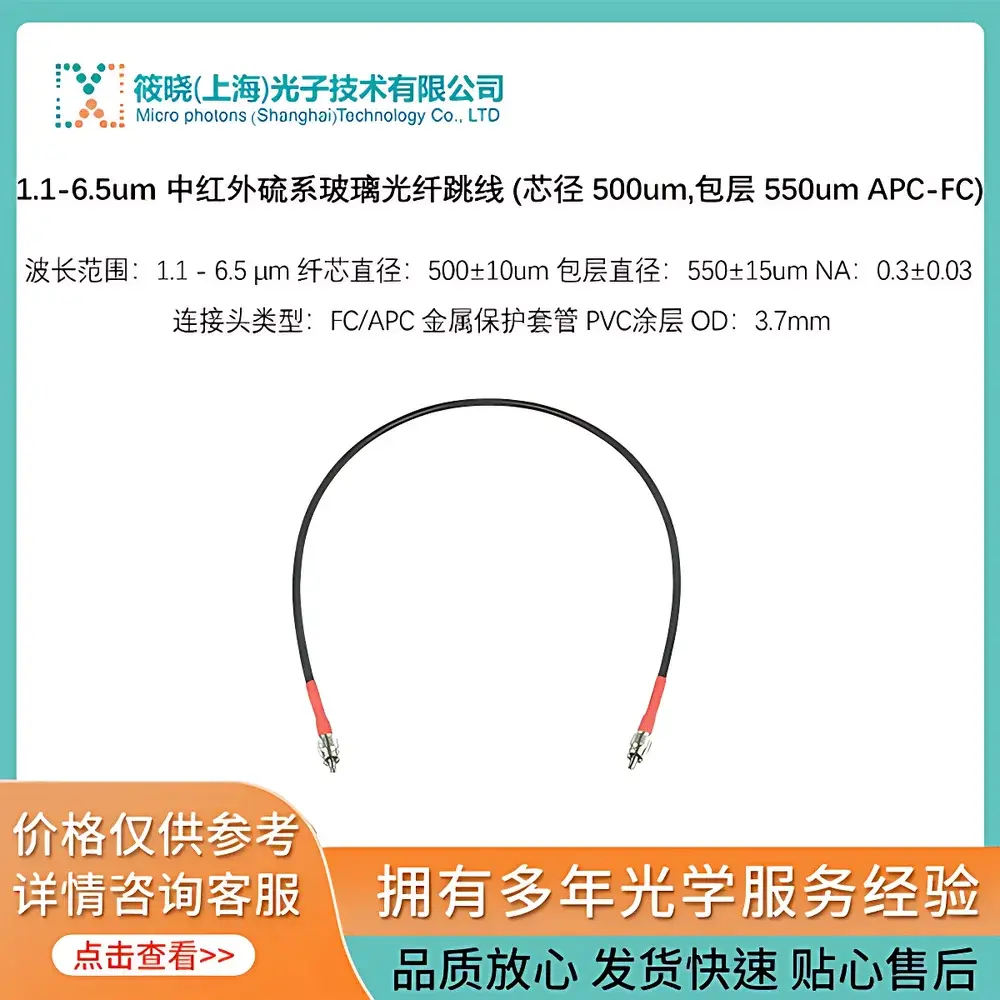
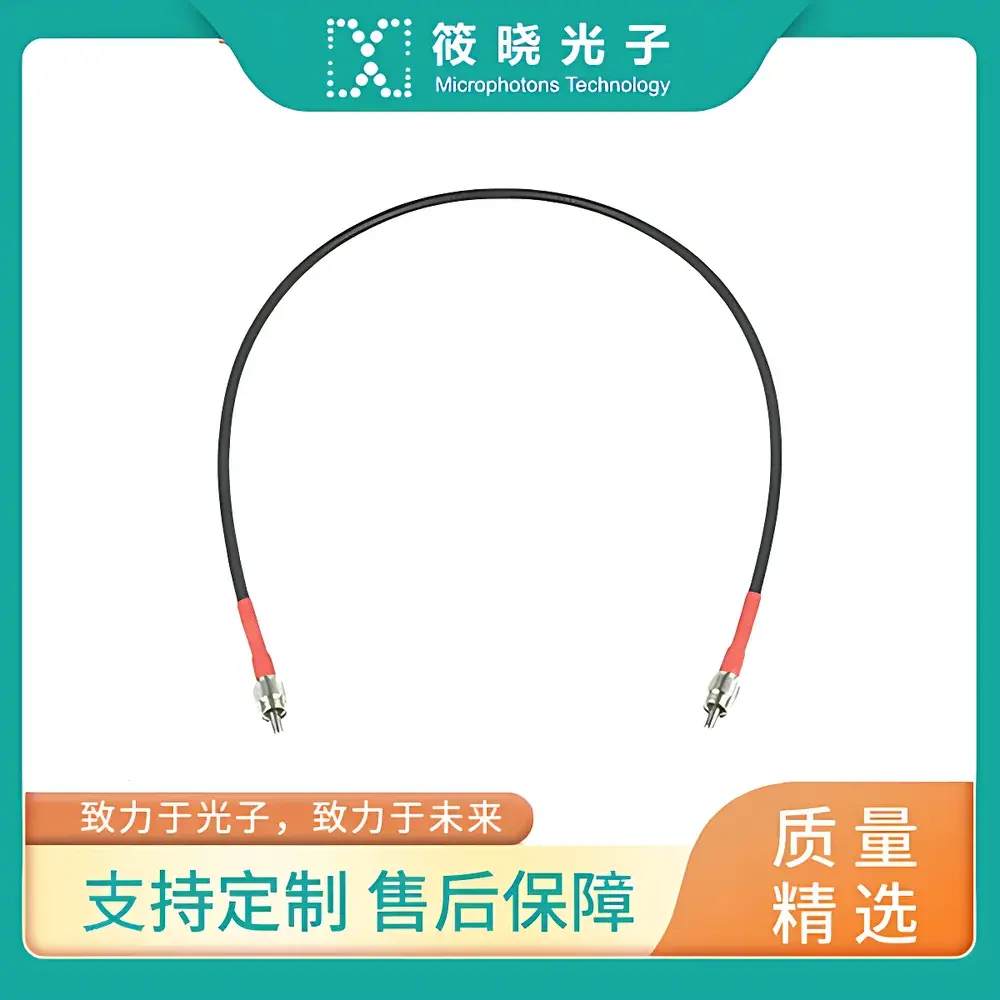
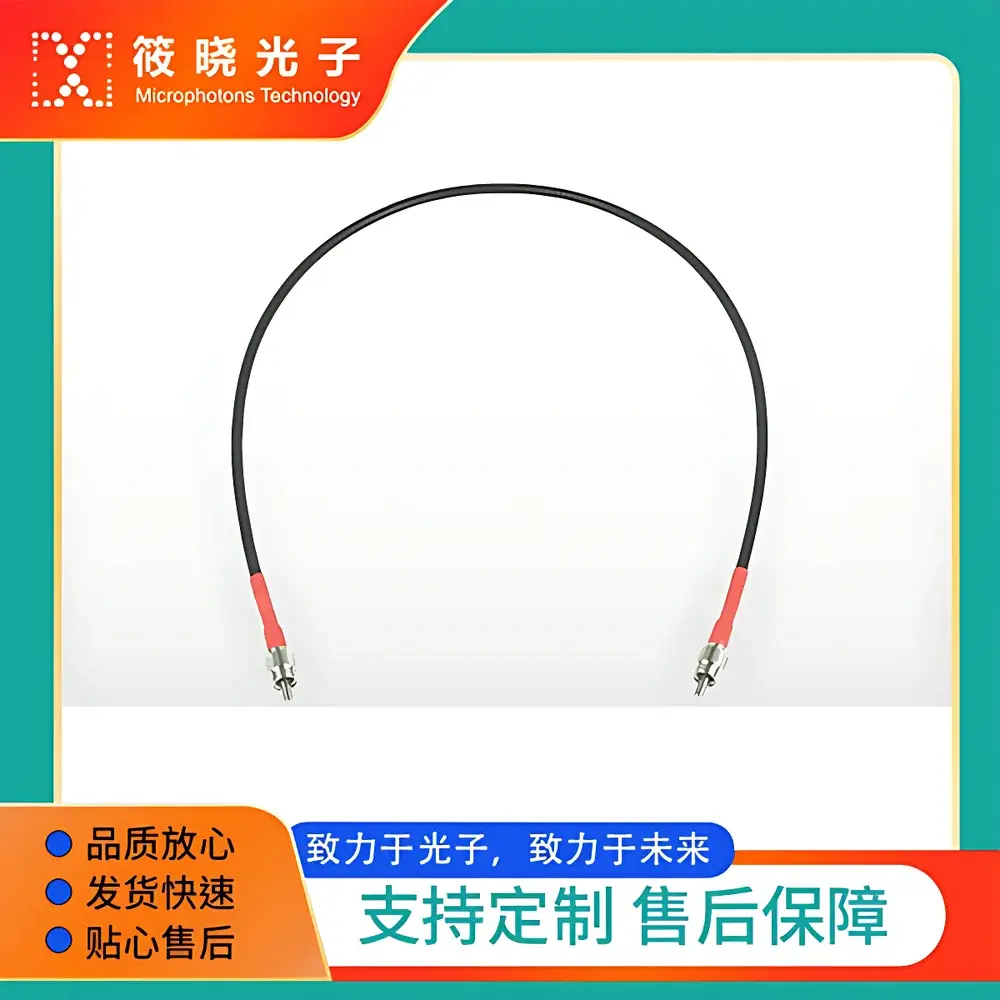
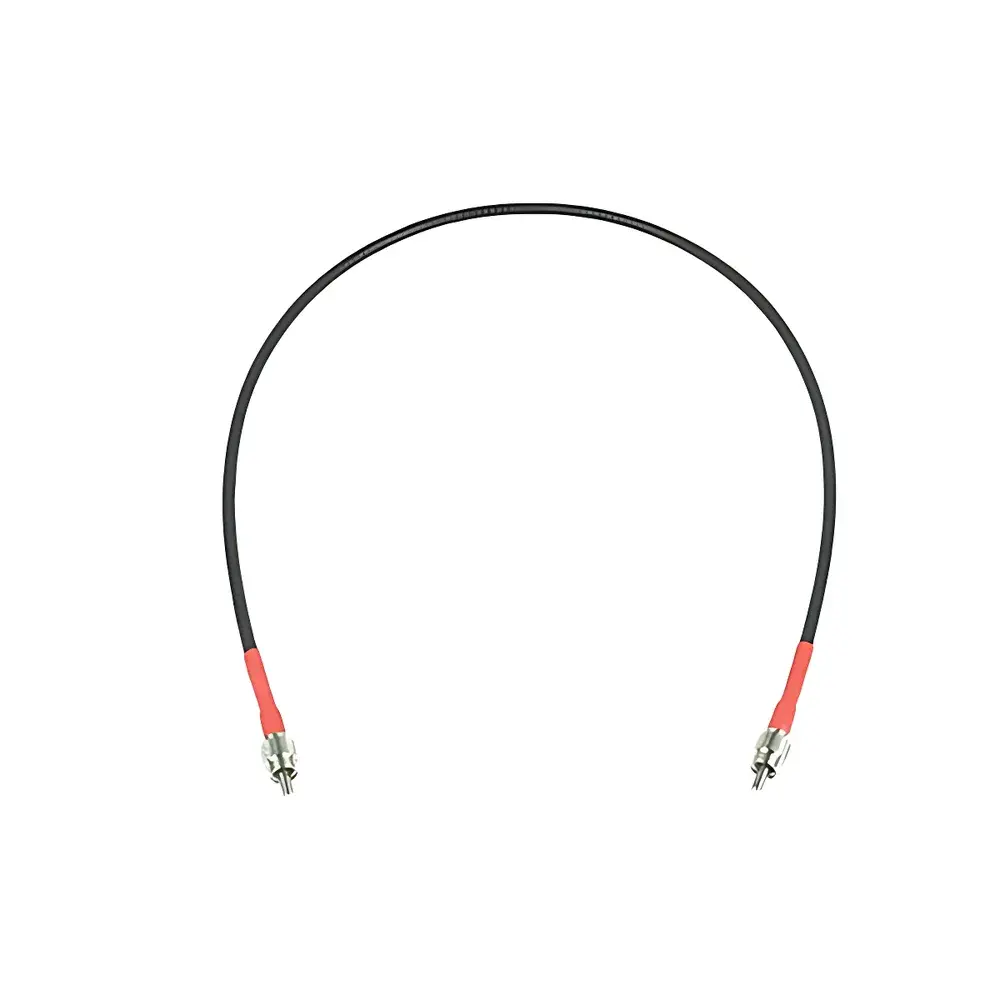
art photonics CIR500/550-100-FC/APC-FC/APC-MP37 Chalcogenide Glass Mid-IR Fiber Patch Cord (500 µm Core / 550 µm Cladding, APC-FC Termination)
| Brand | art photonics |
|---|---|
| Origin | Germany |
| Fiber Type | Step-Index Multimode Chalcogenide (CIR) |
| Wavelength Range | 1.1–6.5 µm |
| Core Diameter | 500 ± 10 µm |
| Cladding Diameter | 550 ± 15 µm |
| Numerical Aperture (NA) | 0.30 ± 0.03 |
| Coating OD | 700 ± 30 µm |
| Jacket | Dual-Polymer (PVC outer), Metal Armor Sleeve (OD 3.7 mm) |
| Length | 1.00 ± 0.05 m |
| Minimum Bend Radius | 100 mm |
| Operating Temperature | –50 °C to +90 °C |
| Connector | FC/APC (input), FC/APC (output), MP37 metal housing |
Overview
The art photonics CIR500/550-100-FC/APC-FC/APC-MP37 is a precision-engineered mid-infrared (mid-IR) fiber patch cord fabricated from high-purity chalcogenide glass (CIR series). Designed for stable, low-loss transmission across the 1.1–6.5 µm spectral band, this multimode step-index fiber leverages the intrinsic transparency of arsenic trisulfide (As₂S₃)-based glass in the molecular fingerprint region. Unlike silica-based fibers—opaque beyond ~2.2 µm—CIR fibers enable direct delivery of broadband thermal radiation, tunable quantum cascade laser (QCL) output, and optical parametric oscillator (OPO) beams without free-space alignment or beam-shaping optics. Its 500 µm core diameter supports high-power coupling while maintaining modal stability under mechanical stress, making it suitable for both spectroscopic signal collection and high-energy laser power transfer in demanding laboratory and industrial environments.
Key Features
- Optimized transmission window from 1.1 to 6.5 µm with peak transmittance >75% per meter in the 2.5–4.0 µm and 4.5–5.0 µm sub-bands
- Low propagation loss of 0.2–0.3 dB/m at critical mid-IR wavelengths (e.g., CO₂ laser line at 4.26 µm and QCL emission bands near 4.5–5.2 µm)
- Robust dual-layer polymer coating (inner acrylate + outer PVC) combined with a stainless-steel armored sleeve (OD 3.7 mm) for enhanced crush resistance and EMI shielding
- Precision FC/APC connectors with 60 dB, minimizing back-reflection into sensitive mid-IR sources such as QCLs and FTIR interferometers
- Thermal stability across –50 °C to +90 °C enables operation in cryogenic sample chambers, heated gas cells, and industrial process monitoring enclosures
- Controlled numerical aperture (NA = 0.30 ± 0.03) ensures efficient coupling with common mid-IR collimators and focusing objectives while limiting higher-order mode dispersion
Sample Compatibility & Compliance
This fiber cord is compatible with standard mid-IR optical benches, modular spectrometers (e.g., Bruker Tensor series, Thermo Nicolet iS50), and benchtop QCL systems (e.g., Block Engineering LaserTune, Hamamatsu L14870). It conforms to ISO 10110-3 for surface quality of optical fiber end-faces and meets IEC 61300-2-4 (bend test) and IEC 61300-2-1 (tensile load) requirements for ruggedized fiber interconnects. While not certified for medical or aerospace use out-of-the-box, its construction supports qualification per MIL-STD-810G (vibration, shock, temperature cycling) when integrated into validated subsystems. The FC/APC interface complies with IEC 61754-14 and Telcordia GR-326-CORE specifications.
Software & Data Management
No embedded firmware or proprietary software is associated with this passive optical component. However, its performance is fully traceable within instrument calibration workflows: spectral responsivity curves (measured via NIST-traceable FTIR reference detectors) are supplied with each batch; certificate of conformance includes wavelength-dependent attenuation data (1.1–6.5 µm, 5 nm resolution), NA verification report, and connector end-face inspection images (100× magnification, ISO 10110-7 compliant). All documentation adheres to GLP-compliant record retention standards and supports audit readiness for ISO/IEC 17025-accredited laboratories.
Applications
- FTIR spectroscopy: Remote sampling of hazardous, high-temperature, or vacuum-confined samples using flexible fiber probes
- Quantum cascade laser delivery: Low-back-reflection transport of pulsed or CW QCL output to gas absorption cells or photoacoustic detectors
- Flexible infrared thermography: Integration into articulated arms for non-contact temperature mapping of rotating machinery or confined geometries
- Mid-IR hyperspectral imaging: Coupling to focal plane array (FPA) spectrometers for real-time chemical identification in pharmaceutical blending or polymer extrusion lines
- Process analytical technology (PAT): In-line monitoring of moisture, hydrocarbons, and functional groups in continuous manufacturing per FDA Guidance for Industry (2019)
FAQ
What is the maximum average power this fiber can handle?
For continuous-wave (CW) sources at 4.5 µm, the damage threshold is ≥5 W under free-air coupling conditions with clean, properly aligned FC/APC terminations. Pulsed operation (e.g., nanosecond QCLs) requires derating based on peak fluence; consult the art photonics Power Handling Technical Note (Ref. TN-CIR-PH-2023).
Can this fiber be spliced to other mid-IR fibers?
Yes—fusion splicing to identical CIR fibers is achievable using a CO₂-laser-based splicer (e.g., Vytran FFS-2000) with optimized tapering and annealing protocols. Splice loss <0.5 dB is typical; splice strength exceeds 4 N tensile load.
Is the metal armor electrically conductive?
The stainless-steel sleeve is grounded-capable and provides electrostatic discharge (ESD) protection. For intrinsically safe environments, optional insulating epoxy coating is available upon request (MP37-INS variant).
Does the APC angle affect spectral phase response?
No—the 12° polish introduces negligible group delay variation (<1 fs) across the 1.1–6.5 µm band, preserving coherence for interferometric applications such as dual-comb spectroscopy.




