
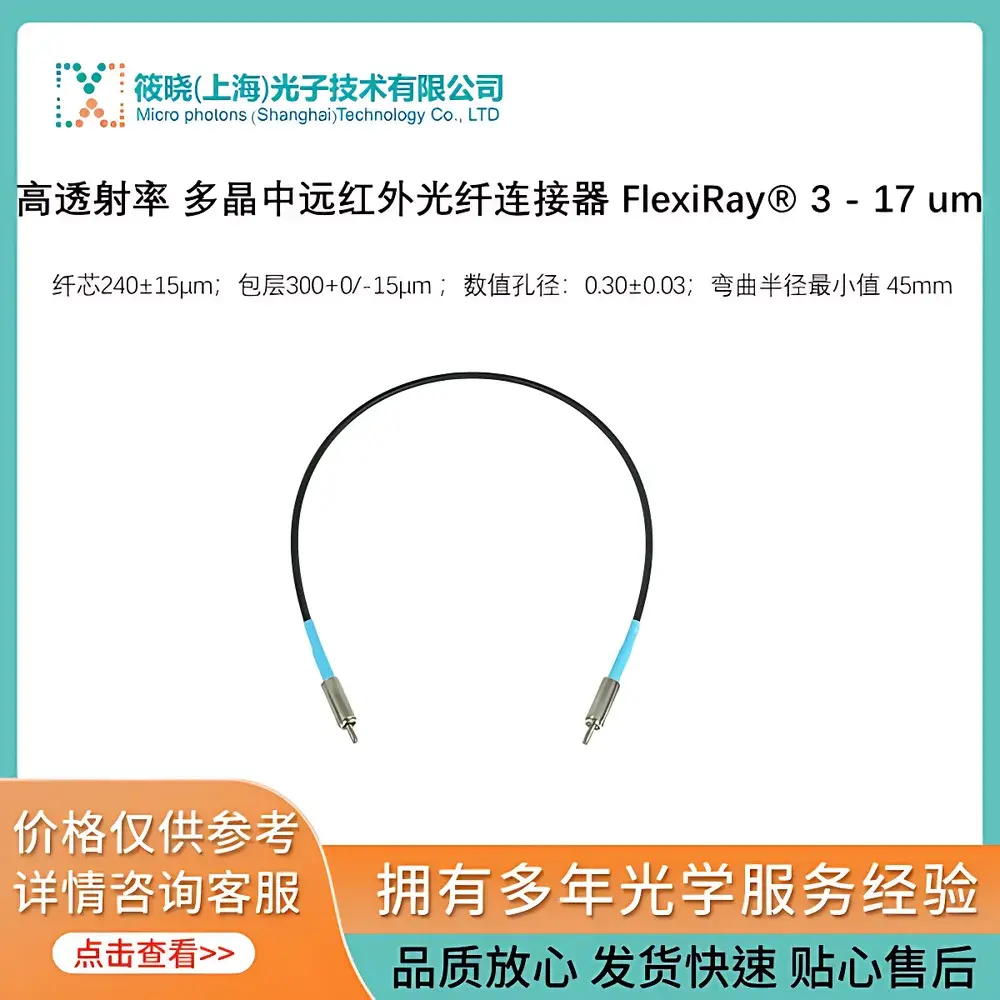
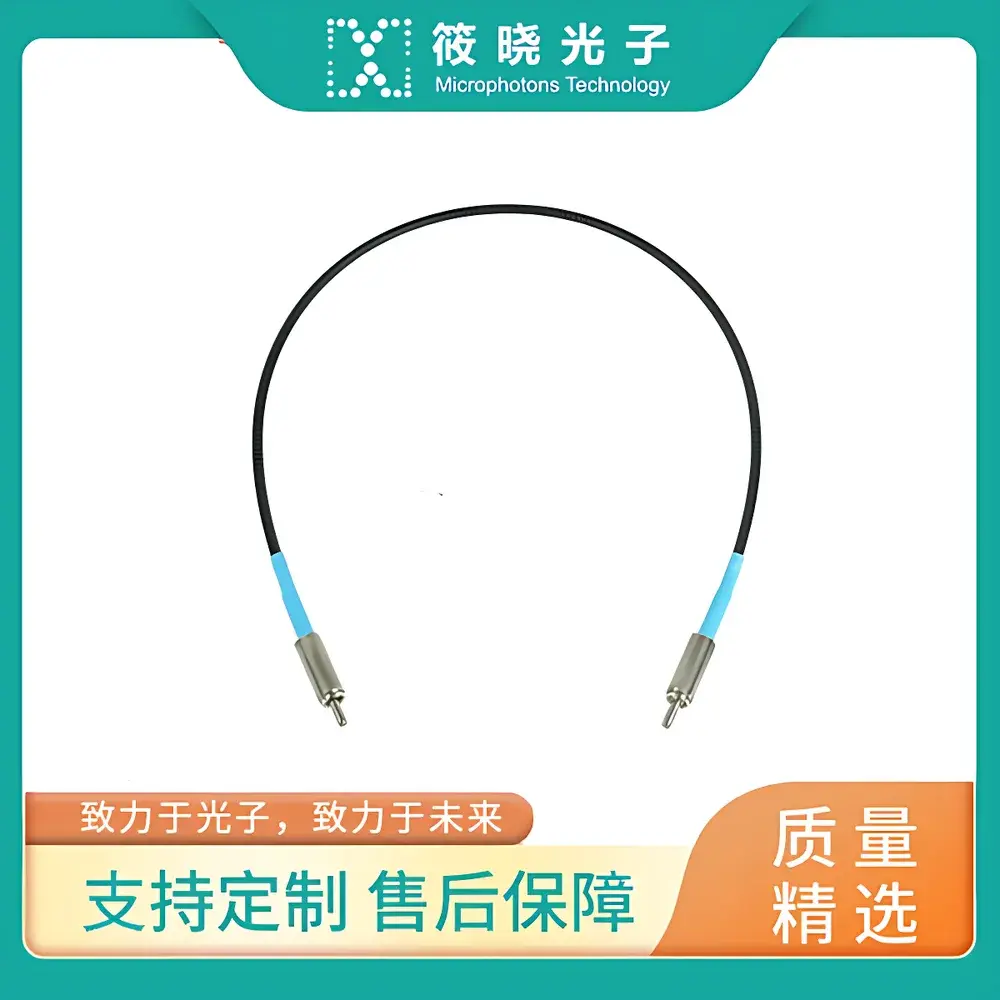
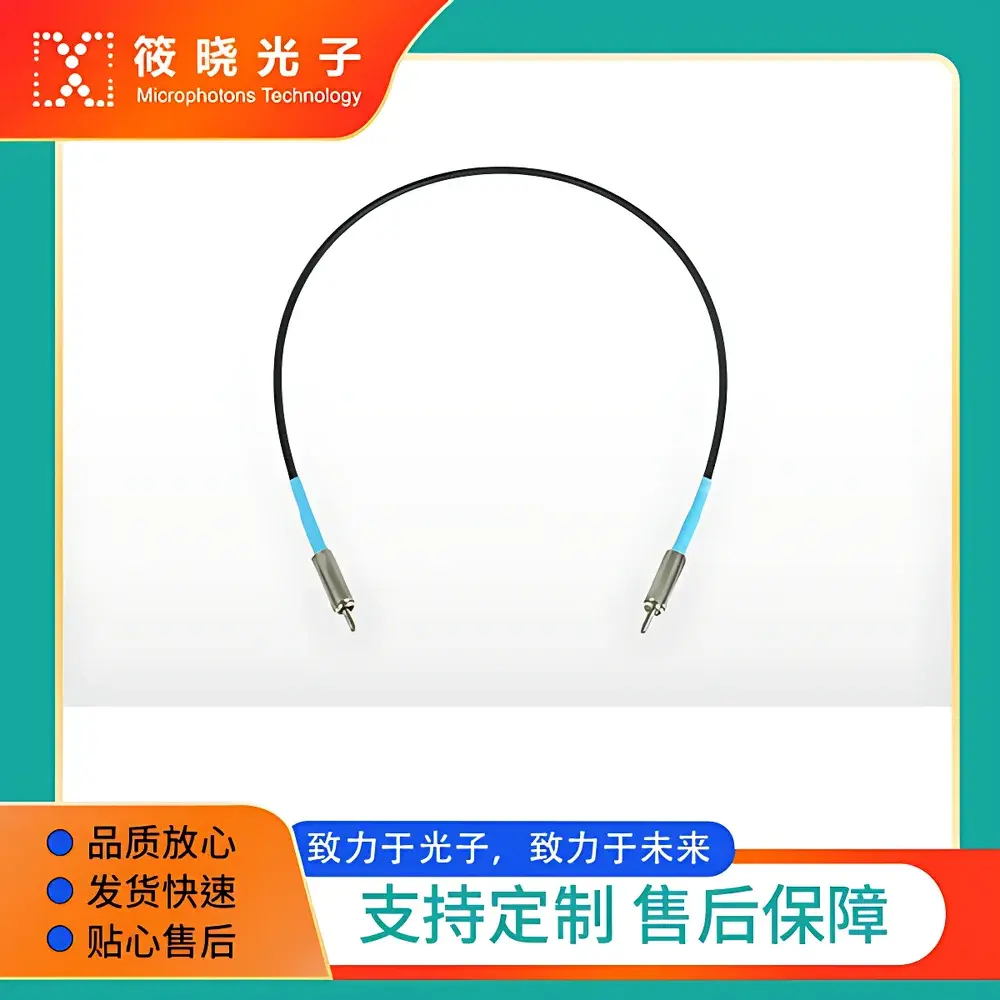
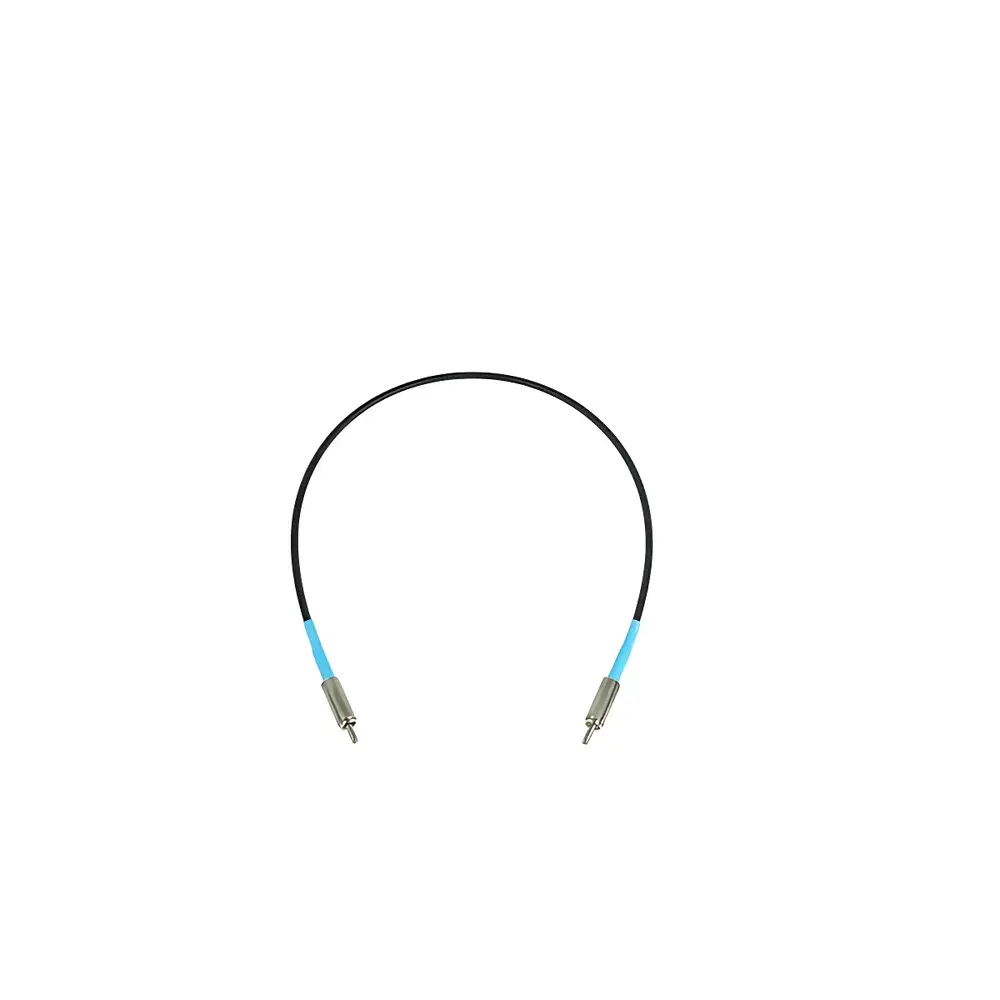
ART Photonics FlexiRay® PIR240/300 Polycrystalline Mid- to Far-Infrared Fiber Connector (3–17 µm Transmission Range)
| Brand | ART Photonics |
|---|---|
| Origin | Germany |
| Model | PIR240/300 |
| Wavelength Range | 3–17 µm |
| Core Diameter | 240 µm |
| Cladding Diameter | 300 µm |
| Fiber Type | Polycrystalline Silver Halide (AgClBr) |
| Numerical Aperture | ~0.22 |
| Bend Radius (Min) | ≥50 mm |
| Operating Temperature | –40 °C to +80 °C |
| Connector Interface | SMA-905 (standard), optional FC/PC or custom |
| Compliance | RoHS, CE, ISO 9001-manufactured |
Overview
The ART Photonics FlexiRay® PIR240/300 is a high-transmission, mechanically robust polycrystalline infrared fiber connector engineered for reliable light delivery across the mid- to far-infrared spectral region (3–17 µm). Unlike silica-based fibers—which exhibit strong absorption beyond 2.5 µm—this connector integrates a core of sintered silver chloride-bromide (AgClxBr1−x) polycrystalline material, enabling low-loss transmission in spectral windows critical for FTIR spectroscopy, quantum cascade laser (QCL) beam delivery, thermal imaging calibration, and gas sensing applications. The fiber’s 240 µm core and 300 µm cladding are precision-drawn under inert atmosphere and hermetically sealed with UV-curable polymer coatings to prevent hygroscopic degradation. Its SMA-905 termination ensures compatibility with standard IR spectrometers, tunable laser sources, and detector modules, while maintaining alignment stability under moderate mechanical stress and thermal cycling.
Key Features
- Optimized broadband transmission from 3 µm to 17 µm—with peak transmittance >75% at 10.6 µm (CO2 laser line) and >60% across 4–12 µm
- Polycrystalline AgClBr core fabricated via controlled hot-pressing and extrusion, minimizing grain boundary scattering and microcrack formation
- Low numerical aperture (NA ≈ 0.22) supports near-diffraction-limited coupling with collimated IR beams and reduces modal noise in spectroscopic setups
- Minimum bend radius of ≥50 mm enables integration into compact optical benches and portable field-deployable systems without measurable radiation loss or permanent deformation
- Hermetic polymer overcladding provides resistance to ambient humidity and mechanical abrasion—critical for long-term stability in laboratory and industrial environments
- Factory-aligned SMA-905 ferrule with ±2.5 µm concentricity tolerance ensures repeatable insertion loss <1.2 dB per mated connection (measured at 10.6 µm)
Sample Compatibility & Compliance
The FlexiRay® PIR240/300 is designed for use with non-coherent thermal sources (e.g., globars), coherent lasers (CO2, QCLs, OPOs), and cryogenically cooled MCT or InSb detectors. It is compatible with standard IR sample compartments, ATR accessories, and gas cell interfaces when coupled via appropriate focusing optics. The fiber complies with RoHS Directive 2011/65/EU and carries CE marking for electromagnetic compatibility (EMC Directive 2014/30/EU) and general safety (LVD Directive 2014/35/EU). While not classified as medical or aerospace-grade hardware, its manufacturing adheres to ISO 9001:2015 quality management protocols. Note: Due to inherent hygroscopicity of silver halides, prolonged exposure to >60% RH requires desiccated storage; no FDA 21 CFR Part 11 or IEC 61000-4 immunity testing is performed—users must validate suitability for regulated GMP/GLP workflows independently.
Software & Data Management
As a passive optical component, the FlexiRay® PIR240/300 does not incorporate embedded firmware, sensors, or digital interfaces. Its performance is characterized offline using calibrated FTIR spectrometers (e.g., Thermo Nicolet iS50) and power meters traceable to NIST standards. ART Photonics provides full spectral transmittance curves (3–17 µm, 1 cm−1 resolution), mechanical drawings (STEP/IGES), and connector torque specifications (0.5–0.7 N·m for SMA-905) in downloadable PDF and CSV formats. For system integration, users may import these datasets into optical modeling tools such as Zemax OpticStudio or CODE V to simulate coupling efficiency, étendue matching, and thermal load distribution.
Applications
- Remote sampling in hazardous or confined environments (e.g., stack emission monitoring, reactor headspace analysis)
- Beam delivery for CO2 laser surgery systems and industrial material processing (cutting, welding, ablation)
- In-line process control in pharmaceutical drying and polymer extrusion via real-time mid-IR absorption monitoring
- Calibration transfer between reference FTIR instruments and field-deployable spectrometers
- Gas-phase molecular fingerprinting in environmental chambers (CH4, NH3, NOx, SF6) using tunable QCL sources
- Thermal background suppression in cryogenic bolometer arrays through spectral filtering and spatial mode conditioning
FAQ
What is the maximum average power handling capacity of the PIR240/300 fiber?
For continuous-wave (CW) CO2 laser operation at 10.6 µm, the recommended maximum power density is 150 W/cm² at the input facet—equivalent to ~6.8 W for a 240 µm core. Pulsed operation (e.g., QCLs) requires derating based on pulse width and repetition rate; consult ART Photonics’ application note AN-PIR-04 for thermal damage threshold calculations.
Can this fiber be spliced or connectorized with other IR fiber types?
No. Polycrystalline AgClBr fibers are incompatible with fusion splicing due to thermal decomposition above 200 °C. Mechanical butt-coupling with index-matching gel (e.g., CsI suspension) is possible but introduces >3 dB insertion loss and degrades long-term stability; factory-terminated connectors are strongly advised.
Is the fiber suitable for vacuum applications?
Yes—provided the polymer coating remains intact and the operating pressure stays above 10⁻³ mbar. Outgassing tests per ASTM E595 show total mass loss (TML) <0.5% and collected volatile condensable materials (CVCM) <0.05%, meeting NASA low-outgassing requirements for non-optical surfaces.
How should the fiber be cleaned after exposure to organic vapors?
Use lint-free wipes saturated with anhydrous ethanol, followed by dry nitrogen purge. Avoid acetone or chlorinated solvents, which may swell the polymer cladding or induce halide leaching at the core–cladding interface.
Does ART Photonics offer custom lengths or connector configurations?
Yes—standard lengths range from 0.5 m to 5 m with SMA-905 terminations. Custom options include FC/PC, ST, or hybrid connectors; angled physical contact (APC) polishing; and metal-sheathed variants for EMI shielding. Lead time for custom orders is typically 6–8 weeks from design approval.



