
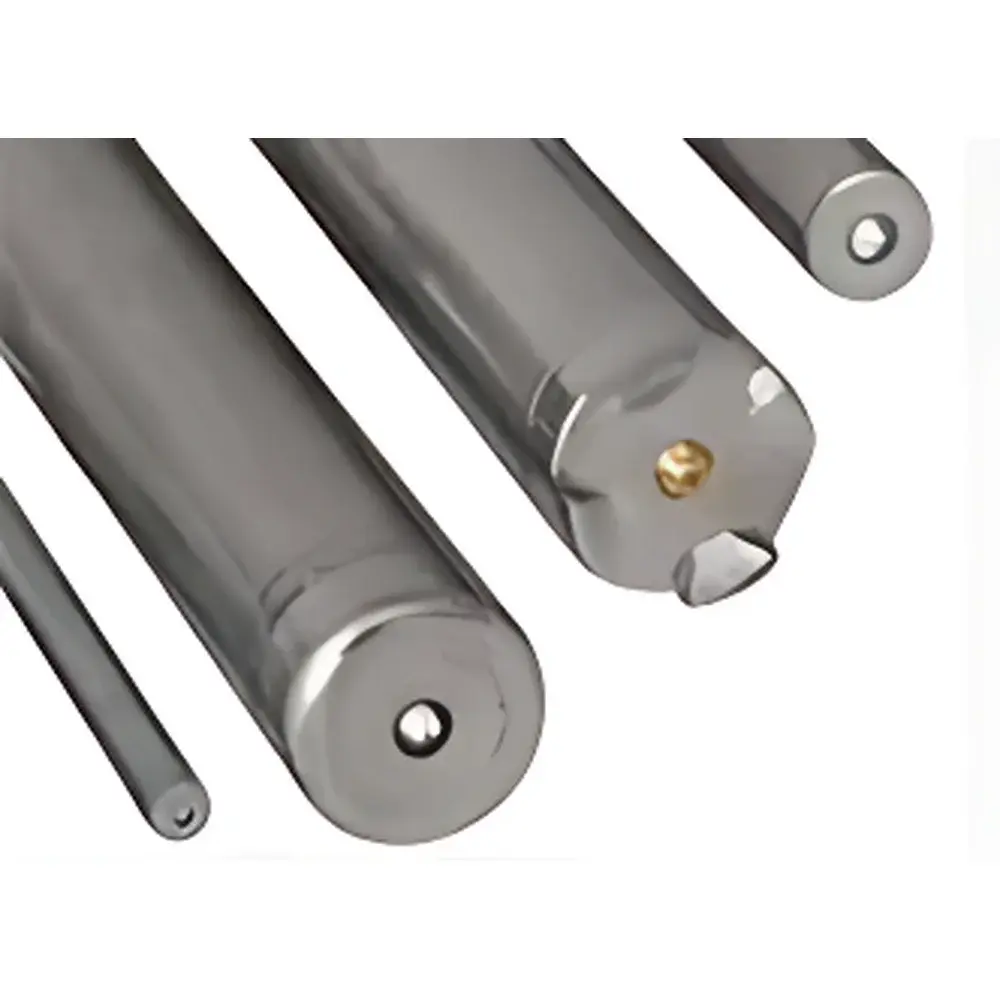
ART Photonics newopto Attenuated Total Reflection (ATR) Probe
| Brand | ART Photonics |
|---|---|
| Origin | Germany |
| Model | newopto |
| Fiber Types | PIR-900/1000 (AgCl:AgBr), CIR-500/550 (As-S-glass) |
| ATR Crystal Materials | Diamond, ZnSe, Cubic Zirconia |
| Transmission Ranges | 5.2–17 µm + 3.2–4.5 µm (Diamond), 3.2–17 µm (ZnSe), 1.5–6.5 µm (Cubic Zirconia) |
| Wavenumber Ranges | 600–1900 cm⁻¹ + 2300–3100 cm⁻¹ (Diamond), 600–3100 cm⁻¹ (ZnSe), 1550–6650 cm⁻¹ (Cubic Zirconia) |
| Operating Temperature | −150°C to +140°C (Diamond/ZnSe), −150°C to +90°C (Cubic Zirconia) |
| Max. Pressure | 200 bar (Diamond), 10 bar (ZnSe), 100 bar (Cubic Zirconia) |
| Total Length | 1.5 m (configurable: 1–5 m) |
| Shaft Length | 230 mm (configurable: 100–500 mm) |
| Shaft Diameter | 3–12 mm (standard options: 6.3 mm, 12 mm) |
| Shaft Material | Hastelloy C22 |
| Leg Length | 300 mm (configurable: 100–500 mm) |
| Protective Tube | Liquid-tight stainless steel conduit or KOPEX polymer tube |
| Minimum Bending Radius | 130 mm |
| Input/Output Connector | Long SMA (custom options available) |
| Compatible Process Interfaces | Ceramat-FOS, SensoGate-FOS |
Overview
The ART Photonics newopto Attenuated Total Reflection (ATR) Probe is an engineered optical sensing component designed for robust, in situ mid-infrared (MIR) and near-infrared (NIR) spectroscopic analysis in demanding industrial and laboratory environments. Based on the principle of evanescent wave coupling, the probe enables direct, non-destructive molecular interrogation of liquids, slurries, pastes, and semi-solids without sample preparation. Light propagates through a high-refractive-index infrared-transmitting fiber—either polycrystalline AgCl:AgBr (PIR) or chalcogenide As–S–glass (CIR)—and undergoes total internal reflection at the interface between the fiber core and the analyte. A portion of the electromagnetic field (the evanescent wave) penetrates into the adjacent medium, where it is selectively absorbed according to the vibrational modes of chemical bonds (e.g., C=O, O–H, N–H, C–H). This spectral signature is retained and transmitted back to the spectrometer, enabling real-time quantification and identification.
Key Features
- Multi-crystal ATR head options: diamond (highest durability & broadest MIR range), ZnSe (balanced transmission and cost), and cubic zirconia (optimized for NIR-to-MIR transition)
- Three infrared fiber platforms: PIR-900/1000 for extended MIR (4.0–18.0 µm), CIR-500/550 for NIR/MIR overlap (1.5–6.0 µm), each selected for minimal OH absorption and thermal stability
- Hastelloy C22 shaft construction ensures corrosion resistance in aggressive chemical environments—including halogenated solvents, strong acids, and caustic bases
- Hermetically sealed, liquid-tight stainless steel or KOPEX protective tubing prevents ingress under high-humidity or washdown conditions
- Configurable geometry: shaft length (100–500 mm), total probe length (1–5 m), leg length (100–500 mm), and shaft diameter (3–12 mm) support integration into reactors, pipelines, and flow cells
- Compatible with standardized process interfaces including Ceramat-FOS (ceramic ferrule-based optical seal) and SensoGate-FOS (pressure-balanced optical feedthrough), ensuring leak-tight operation up to 200 bar
Sample Compatibility & Compliance
The newopto ATR probe supports contact-based measurement of opaque, viscous, or highly scattering samples—eliminating the need for transmission cells or dilution. It is validated for continuous operation in GMP-compliant pharmaceutical crystallization, petrochemical refinery stream monitoring, and bioreactor nutrient profiling. The probe’s mechanical and optical design conforms to IEC 61241 (explosion-proof requirements for hazardous areas) and meets material traceability standards per ASTM F86 (surface treatment of metallic implants) and ISO 10993-1 (biocompatibility assessment). All fiber assemblies are tested per IEC 60793-2-40 for attenuation stability under thermal cycling (−150°C to +140°C) and pressure ramping (0–200 bar).
Software & Data Management
While the probe itself is hardware-only, it integrates seamlessly with third-party spectroscopic platforms—including Bruker Tensor series, Thermo Nicolet iS50, and Agilent Cary 630—via standard SMA-905 or custom connectorized interfaces. Spectral acquisition and chemometric modeling (e.g., PLS regression, PCA) are performed using industry-standard software suites compliant with FDA 21 CFR Part 11 (electronic records/signatures) and EU Annex 11 (computerized system validation). Audit trails, user access controls, and raw data immutability are maintained when deployed with validated LIMS or PAT (Process Analytical Technology) frameworks aligned with USP and ICH Q5 and Q7 guidelines.
Applications
- Real-time PAT monitoring of API crystallization kinetics, polymorph transitions, and supersaturation profiles
- In-line quantification of moisture, ethanol, and organic acid concentrations in fermentation broths
- Continuous quality assurance of polymer melt composition during extrusion and injection molding
- Remote detection of hydrocarbon chain length distribution in lubricant blending operations
- High-temperature catalytic reaction surveillance in fixed-bed or fluidized-bed reactors
- Corrosion inhibitor concentration tracking in closed-loop cooling water systems
FAQ
What spectral resolution can be achieved with this ATR probe?
Resolution is determined by the coupled spectrometer—not the probe—and typically ranges from 0.5 cm⁻¹ (FTIR benchtop) to 8 cm⁻¹ (compact NIR analyzers), depending on optical path modulation and detector type.
Can the probe be sterilized using steam-in-place (SIP) protocols?
Yes—diamond and ZnSe variants withstand repeated SIP cycles at 121°C and 2 bar; cubic zirconia is limited to ≤90°C and requires validation per ASME BPE-2022 Section SD-4.2.
Is fiber replacement possible in the field?
Fiber termination is factory-crimped and hermetically sealed; field replacement is not supported. However, modular shaft assemblies allow quick swap-out of damaged sections without full probe replacement.
Does the probe support quantitative calibration transfer between instruments?
Yes—when used with reference standards traceable to NIST SRM 2036 (liquid density) and SRM 1921b (water vapor absorption), inter-instrument calibration models maintain RMSEP < 0.15 wt% across identical probe configurations.
How is alignment drift mitigated during long-term deployment?
The monolithic crystal–fiber interface is epoxy-free and mechanically locked via precision-machined kinematic mounts, reducing angular drift to < 0.02° over 12 months under cyclic thermal load.




