
ART Photonics PIR-240 / PIR-400 / PIR-630 / PIR-900 Polycrystalline Infrared Fibers
| Brand | ART Photonics |
|---|---|
| Origin | Germany |
| Type | Polycrystalline Infrared (PIR) Fiber |
| Core Diameter | 240 µm / 400 µm / 630 µm / 900 µm |
| Cladding Diameter | 300 µm / 500 µm / 700 µm / 1000 µm |
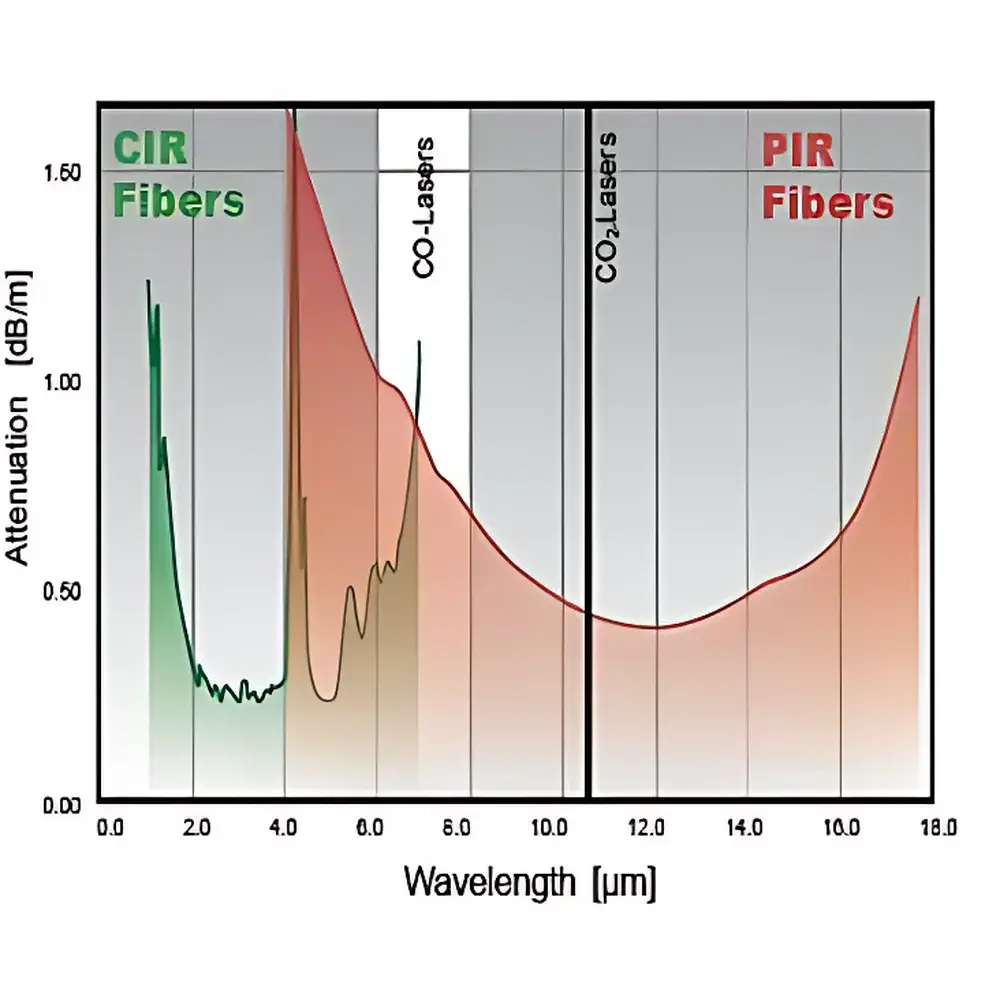
| Wavelength Range | 4–18 µm |
| Core Material | AgCl₀.₂₅Br₀.₇₅ |
| Cladding Material | AgCl₀.₅₀Br₀.₅₀ |
| Core Refractive Index | 2.15 |
| Numerical Aperture | 0.28 ± 0.03 |
| Max CW Power Handling | 50 W |
| Operating Temperature | 4 K to 420 K |
| Jacketing | Optional PEEK polymer buffer |
| Termination | SMA connector (optional) |
| Compliance | ISO 10110 optical component standards, RoHS-compliant materials |
Overview
ART Photonics PIR-series polycrystalline infrared fibers are engineered for high-fidelity light delivery and collection in the mid- to far-infrared spectral region (4–18 µm), where conventional silica-based or fluoride-glass fibers exhibit strong absorption. These fibers operate on the principle of total internal reflection within a crystalline core–cladding waveguide structure composed of silver halide solid solutions. Unlike single-crystal fibers—which suffer from brittleness and scalability limitations—PIR fibers are fabricated via vacuum extrusion of high-purity AgCl:AgBr mixed crystals, enabling reproducible polycrystalline microstructures with controlled grain boundaries and minimized scattering losses. Their broadband transparency, cryogenic-to-ambient thermal stability (4 K–420 K), and compatibility with CO₂ lasers (10.6 µm), quantum cascade lasers (QCLs), and Fourier-transform infrared (FTIR) spectrometers make them indispensable for demanding analytical, industrial, and fundamental research applications requiring robust IR beam transport.
Key Features
- Ultra-broad spectral transmission window spanning 4–18 µm, covering critical molecular fingerprint regions for gas sensing, polymer analysis, and biomedical spectroscopy
- Engineered core–cladding refractive index contrast (ncore = 2.15, nclad ≈ 2.05) yielding stable NA of 0.28 ± 0.03 across the operational band
- Vacuum-extruded polycrystalline architecture ensures mechanical flexibility and resistance to thermal shock—unlike brittle single-crystal alternatives
- Four standard core diameters (240, 400, 630, 900 µm) with matched cladding dimensions support scalable coupling efficiency and power handling
- Optional hermetic PEEK polymer jacket provides abrasion resistance, chemical inertness, and long-term dimensional stability under laboratory or field conditions
- SMA-905 terminations are precision-aligned and epoxy-free to minimize insertion loss (<0.3 dB per interface) and preserve thermal integrity
Sample Compatibility & Compliance
PIR fibers are compatible with both pulsed and continuous-wave (CW) infrared sources up to 50 W average power, provided beam profiles remain well within the fiber’s mode field and thermal load is uniformly distributed. They withstand repeated thermal cycling between cryogenic (liquid helium, 4 K) and elevated (420 K) temperatures without delamination or microcrack formation—validated per ASTM F2624 for thermal cycling of optical waveguides. All materials comply with RoHS Directive 2011/65/EU and EU REACH Regulation (EC) No. 1907/2006. Fiber geometry and surface quality adhere to ISO 10110-3 (surface imperfections) and ISO 10110-7 (homogeneity and striae), ensuring traceability and interchangeability in regulated environments including GLP-compliant spectroscopic labs.
Software & Data Management
While PIR fibers themselves are passive optical components, their integration into automated systems benefits from standardized calibration protocols embedded in industry-leading spectroscopic platforms—including Thermo Fisher Nicolet iS50, Bruker VERTEX 80v, and Hamamatsu C12880MA QCL drivers. ART Photonics provides detailed spectral attenuation curves (per meter), bend-loss characterization data (radius ≥ 50 mm), and power-handling derating tables for multi-wavelength operation. All documentation conforms to ISO/IEC 17025 requirements for reference material traceability, and raw test reports include uncertainty budgets compliant with GUM (JCGM 100:2008). For FDA-regulated workflows, fiber installation records and periodic end-face inspection logs may be incorporated into 21 CFR Part 11–compliant electronic lab notebooks (ELNs) via structured metadata tagging.
Applications
- In-situ FTIR monitoring of catalytic reactions inside high-pressure, high-temperature reactors (e.g., hydrodesulfurization, Fischer–Tropsch synthesis)
- Remote laser surgery and tissue ablation using Er:YAG (2.94 µm) or CO₂ (10.6 µm) lasers, enabled by flexible PEEK-jacketed delivery
- Cryogenic IR spectroscopy of superconducting materials and quantum devices operating at dilution refrigerator temperatures
- Environmental gas sensing networks employing open-path or multipass cell configurations with QCL sources
- Non-destructive evaluation (NDE) of polymer composites and pharmaceutical tablets via attenuated total reflectance (ATR) probes
FAQ
Can PIR fibers be used with pulsed lasers?
Yes—provided pulse energy density remains below 1 J/cm² and repetition rate does not induce cumulative thermal stress exceeding 420 K at the input facet.
What is the typical attenuation coefficient at 10.6 µm?
Standard PIR fibers exhibit 0.5–0.8 dB/m at 10.6 µm, depending on core diameter and surface polish quality.
Is cleaving possible in-house?
Cleaving requires diamond scribe tools and controlled fracture under inert atmosphere; ART Photonics recommends factory cleaving and polishing for optimal end-face quality and repeatability.
How is numerical aperture measured and verified?
NA is determined via far-field intensity profiling per IEC 60793-1-42, using calibrated IR camera systems and collimated HeNe-locked QCL sources.
Do you offer custom lengths or hybrid assemblies?
Yes—custom lengths (0.5–10 m), dual-fiber bundles, and fused fiber-optic couplers (e.g., 50:50, 90:10 splits) are available under NDA with full metrology documentation.




