


Artec Eva Handheld 3D Scanner
| Brand | Artec |
|---|---|
| Origin | Imported (Non-China) |
| Manufacturer Type | Authorized Distributor |
| Model | Artec Eva |
| Scanning Principle | White Light Structured Light |
| Frame Rate | Up to 16 fps |
| Point Capture Speed | Up to 2 million points/sec |
| Accuracy | Up to 0.1 mm |
| Resolution | 0.5 mm |
| Texture Resolution | 1.3 MP |
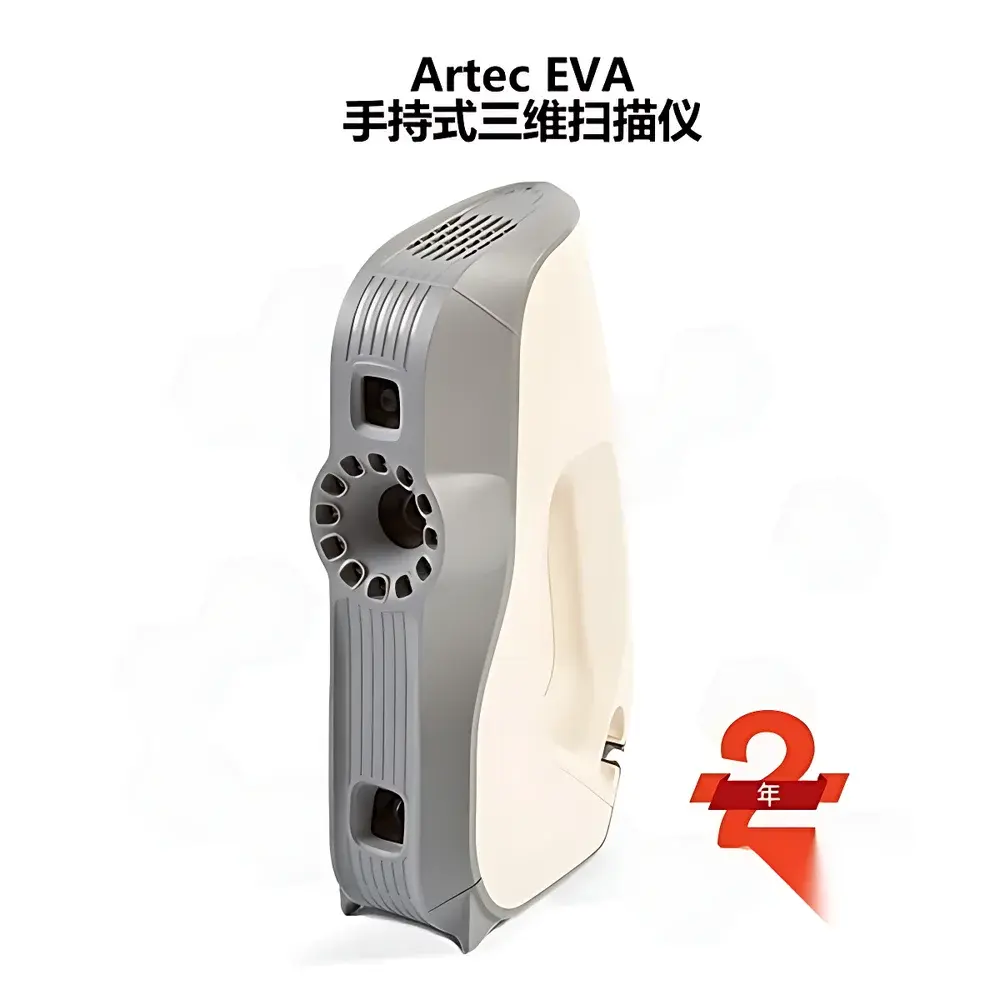
| Weight | 0.85 kg |
| Battery Life | Up to 6 hours |
| Operating System Compatibility | Windows 10/11, compatible with tablets |
| Safety Class | Class 1 LED (IEC 60825-1 compliant) |
| Calibration-Free Operation | Yes |
| Multi-Scanner Synchronization | Supported |
| SDK Available | Artec SDK (free download) |
Overview
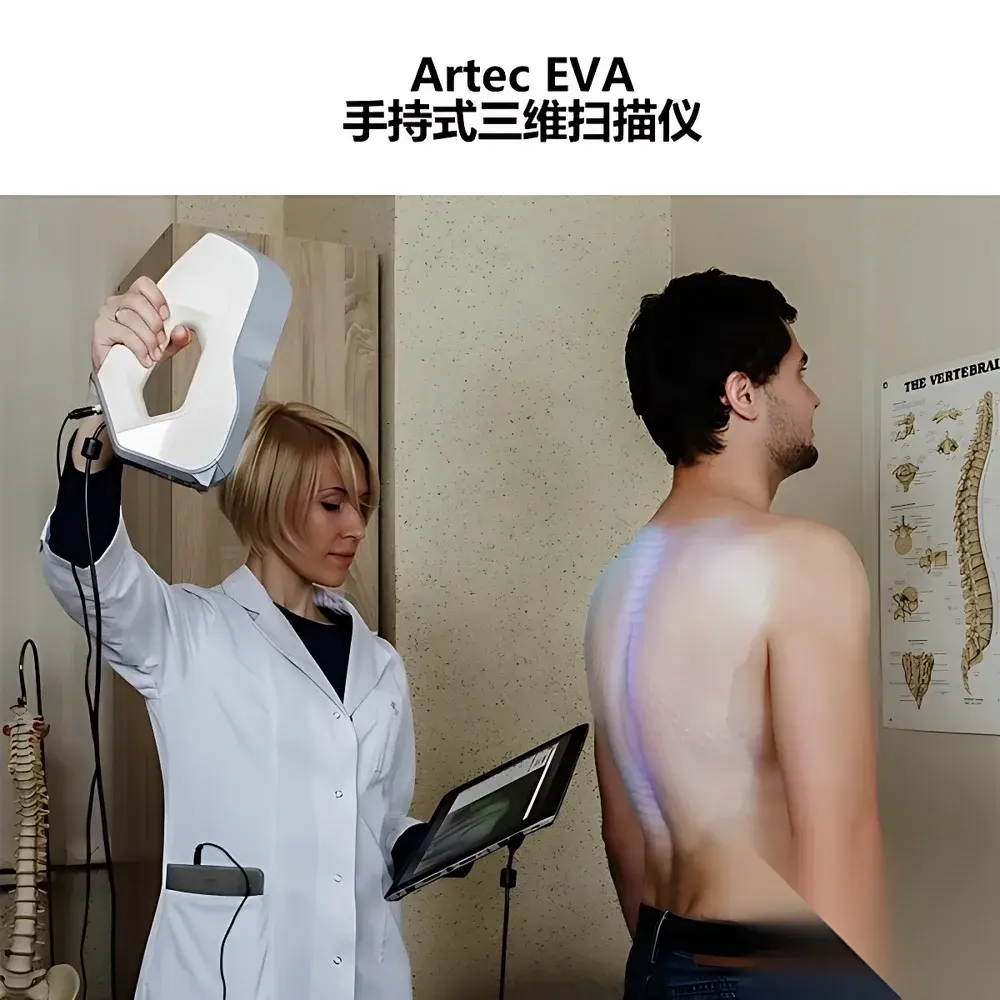
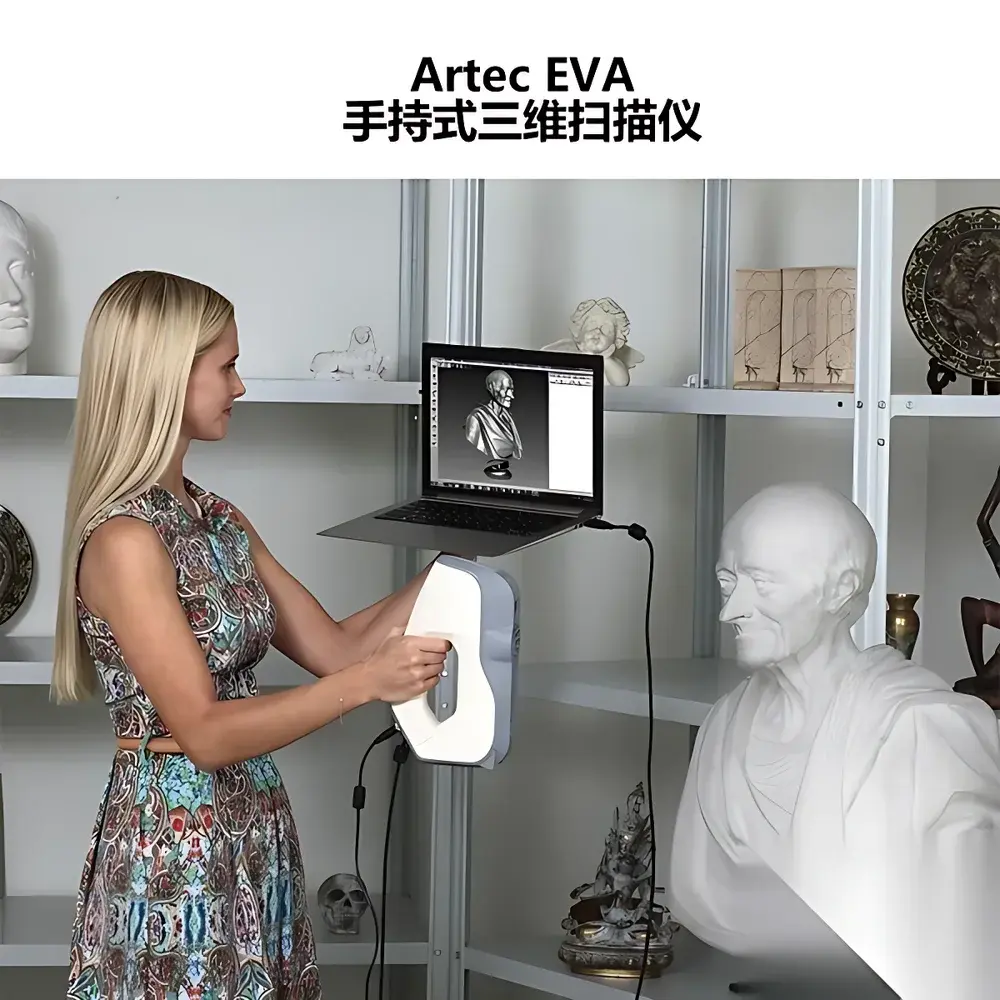
The Artec Eva Handheld 3D Scanner is an industrial-grade optical measurement instrument engineered for high-speed, high-fidelity digitization of medium-sized objects—ranging from human anatomy and automotive components (e.g., alloy wheels, exhaust systems) to heritage artifacts and ergonomic prototypes. It employs active white light structured light projection combined with dual high-resolution CMOS sensors to reconstruct surface geometry and photorealistic texture simultaneously. Unlike laser-based or time-of-flight systems, Eva’s Class 1 LED illumination ensures eye-safe operation in open laboratory, workshop, or clinical environments without requiring protective eyewear or controlled enclosures. Its real-time triangulation engine processes geometry and color data in parallel, enabling on-device visualization and immediate feedback during acquisition—critical for iterative QA/QC workflows and rapid prototyping validation.
Key Features
- Real-Time Dual-Data Acquisition: Captures synchronized geometric mesh and full-color texture at up to 16 frames per second, delivering up to 2 million 3D points/sec with sub-0.1 mm volumetric accuracy under optimal conditions (ISO 10360-8 compliant measurement uncertainty estimation).
- High-Fidelity Surface Representation: Achieves 0.5 mm spatial resolution and 1.3 MP texture mapping, preserving fine surface details—including subtle curvature transitions, engraved markings, and material-specific reflectance characteristics—even on challenging surfaces such as matte black plastics or polished metals.
- True Portability & Standalone Operation: Weighing only 0.85 kg and powered by a hot-swappable battery pack (6-hour runtime), Eva operates independently when paired with Windows-based tablets—eliminating dependency on tethered workstations or external power sources during field deployments or shop-floor inspections.
- Zero-Calibration, Target-Free Workflow: Requires no pre-scanning calibration plates, adhesive markers, or environmental setup. The scanner’s hybrid geometry-texture tracking algorithm maintains robust pose estimation across feature-poor regions (e.g., uniform surfaces, organic contours), reducing operator training time and increasing throughput in production metrology settings.
- Scalable Multi-Sensor Integration: Supports hardware-level synchronization of multiple Eva units via Ethernet or USB triggers, enabling automated turntable-free scanning of large assemblies or dynamic multi-angle capture for enhanced occlusion handling—ideal for reverse engineering of complex mechanical systems.
- Open Development Architecture: Ships with the freely distributable Artec SDK, providing C++ and Python APIs for integration into custom inspection pipelines, robotic guidance systems, or GLP-compliant digital twin frameworks—fully compatible with common industrial middleware (e.g., ROS 2, OPC UA).
Sample Compatibility & Compliance
Eva is validated for non-contact measurement of static or slowly moving objects within the 0.4–2 m working distance range. It reliably captures surfaces with varying optical properties—including low-reflectivity (e.g., carbon fiber composites), high-gloss (anodized aluminum, chrome plating), and semi-transparent materials (thin polymer films, frosted glass)—without spray coating or surface preparation. The system complies with IEC 60825-1:2014 (Class 1 laser safety equivalent), CE marking directives (2014/30/EU EMC, 2014/53/EU RED), and RoHS 2011/65/EU. While not certified for medical device use per FDA 21 CFR Part 820, its measurement repeatability and traceable performance metrics align with ISO/IEC 17025 requirements for accredited calibration laboratories performing dimensional verification.
Software & Data Management
Bundled Artec Studio software provides a complete post-processing environment supporting automatic alignment, noise filtering, hole filling, mesh simplification, and NURBS surface reconstruction. All processing steps are logged with timestamped audit trails, supporting compliance with ISO 9001:2015 clause 8.5.2 (Identification and traceability) and facilitating internal quality audits. Export formats include STL, OBJ, PLY, AOP, and e57—ensuring interoperability with major CAD platforms (SolidWorks, Fusion 360, Siemens NX), metrology suites (PolyWorks, GOM Inspect), and cloud-based PLM systems (PTC Windchill, Siemens Teamcenter). Encrypted project files support role-based access control when deployed on networked Windows servers under Active Directory domains.
Applications
- Reverse engineering of legacy parts lacking CAD documentation
- In-process dimensional verification of castings, forgings, and machined components
- Anthropometric modeling for ergonomic product design and PPE development
- Digital archiving of cultural heritage objects and forensic evidence
- Pre- and post-repair assessment of composite aircraft structures
- Custom orthotic/prosthetic device fitting using anatomical surface deviation analysis
FAQ
Does Artec Eva require reflective targets or spray coating for accurate scanning?
No. Eva’s hybrid geometry-texture tracking eliminates the need for physical markers or surface treatment—even on dark, shiny, or low-texture objects.
Can scan data be integrated into existing metrology software like PolyWorks or GOM Inspect?
Yes. Native export to standard formats (STL, OBJ, PLY, E57) ensures seamless import and GD&T analysis within industry-standard metrology applications.
Is the Artec SDK compatible with Linux or macOS environments?
The official Artec SDK supports Windows 10/11 only; however, cross-platform integration can be achieved via REST API wrappers or containerized Windows subsystems in enterprise IT infrastructures.
What is the recommended maintenance schedule for long-term accuracy stability?
Artec recommends annual verification using NIST-traceable reference artifacts (e.g., sphere arrays, step gauges) and firmware updates aligned with Artec’s public release cycle—documented in accordance with ISO/IEC 17025 Clause 6.4.10.
Can Eva be used in regulated manufacturing environments subject to FDA or ISO 13485 requirements?
While Eva itself is not a certified medical device, its repeatable measurement output and full audit trail functionality enable its use in design control and verification activities under FDA 21 CFR Part 820 and ISO 13485:2016, provided validation protocols are executed per organizational SOPs.





